The Maya Civilization: The Peak And Mystery Of A Great Culture Of America
Outstanding astronomers, builders of towering temples, inventors of a unique writing system... a dive into one of the most fascinating and enigmatic cultures in the history of pre-Columbian America.
A civilization that still fascinates today.
When we think of great lost civilizations, we often mention Egypt, Mesopotamia, or Greece. However, on the other side of the Atlantic, an equally brilliant culture developed for centuries, away from European eyes.
The Maya civilization is one of those societies that reached an impressive level of intellectual and artistic refinement, without the same tools or contacts as the civilizations of the Old World.
What stands out most is the contrast between the sophistication of their knowledge (in astronomy, mathematics, writing) and the mystery that still surrounds certain aspects of their history, particularly their decline.
The geographical and historical context of the Maya peak.
The Maya world does not correspond to a centralized empire in the sense understood for Rome or Egypt. It is rather a collection of city-states spread over a vast territory of Central America, sharing a common language, beliefs, and practices without ever politically unifying in a lasting way.
This organization into independent cities partly explains the richness and diversity of their artistic and scientific production: each city competes with its neighbors, particularly through the construction of increasingly impressive monuments.
The peak of this culture occurs during a period when the great cities experience significant demographic, economic, and intellectual growth, before undergoing a gradual decline whose causes remain debated.
A civilization in America alongside the Aztecs and Incas.
On the American continent, three great civilizations stand out for the extent of their achievements: the Mayans, the Aztecs, and the Incas. Each developed in a different geographical area and at a different time, but all three left a mark on the history of pre-Columbian America through their social organization, monuments, and beliefs.
The Aztecs, located further north, built a centralized warrior empire around their capital. The Incas, on the other hand, constructed a vast territory administered from the Andean heights.
The Mayans, for their part, are distinguished by a different approach to power, more fragmented, yet equally ambitious in cultural terms. It is precisely this lack of strict political unity that allowed for the emergence of multiple scientific and artistic centers, with each city striving to stand out.
The foundations of Maya society and organization.
Mayan society is based on a well-structured hierarchy, with sovereigns at its head who are considered intermediaries between humans and the divine world. Surrounding them are a nobility, priests responsible for rituals and knowledge, as well as artisans and farmers who sustain the local economy.
This social organization is not fixed: it varies from city to city, each having its own dynasties and power dynamics. Alliances, rivalries, and sometimes conflicts between cities shape the political life of the region.
This functioning of autonomous city-states, far from weakening Mayan culture, has instead stimulated competition: it is largely due to this rivalry among local powers that scientific and artistic advancements have been able to multiply.
Scientific advancements: astronomy and mathematics
What is most impressive about the Mayans is their mastery of so-called pure sciences, particularly astronomy and mathematics. These disciplines were not mere intellectual curiosities: they directly served to organize the religious, agricultural, and political life of the cities.
The meticulous observation of the sky allowed for the prediction of seasonal cycles, essential for agriculture, as well as for setting the dates of major religious ceremonies. The priests, guardians of this knowledge, held a central place in society.
This scientific rigor is accompanied by a unique calculation system that allowed for the precise manipulation of large numbers. It is this combination of sky observation and mastery of calculation that made it possible to develop particularly sophisticated time measurement tools.
The Mayan calendar, an intellectual feat.
The calendar is undoubtedly one of the most remarkable achievements of this culture. It is not just a simple practical tool: it embodies the entire worldview of the Maya, where time is perceived as cyclical and sacred.
This system of measuring time is based on the astronomical observations mentioned earlier, combined with complex mathematical calculations. It allowed for tracking both the short cycles related to rituals and the long cycles related to the history of dynasties and cities.
This intellectual feat reflects a very high level of abstraction, placing the Maya among the most advanced civilizations of their time in terms of calculation and celestial observation.
Mayan writing and knowledge systems
Another marker of an advanced civilization: writing. The Maya developed their own writing system, used to record the history of dynasties, significant events, and religious or scientific knowledge.
This writing appears engraved on monuments, painted on ceramics, or recorded in manuscripts. It reflects a desire to transmit knowledge and preserve collective memory, similar to what is found in other great civilizations of antiquity.
It is precisely thanks to this written heritage that researchers studying the past, archaeologists and historians, are able today to reconstruct entire sections of Maya history, even though many areas of uncertainty still remain.
Monumental architecture as artistic testimony
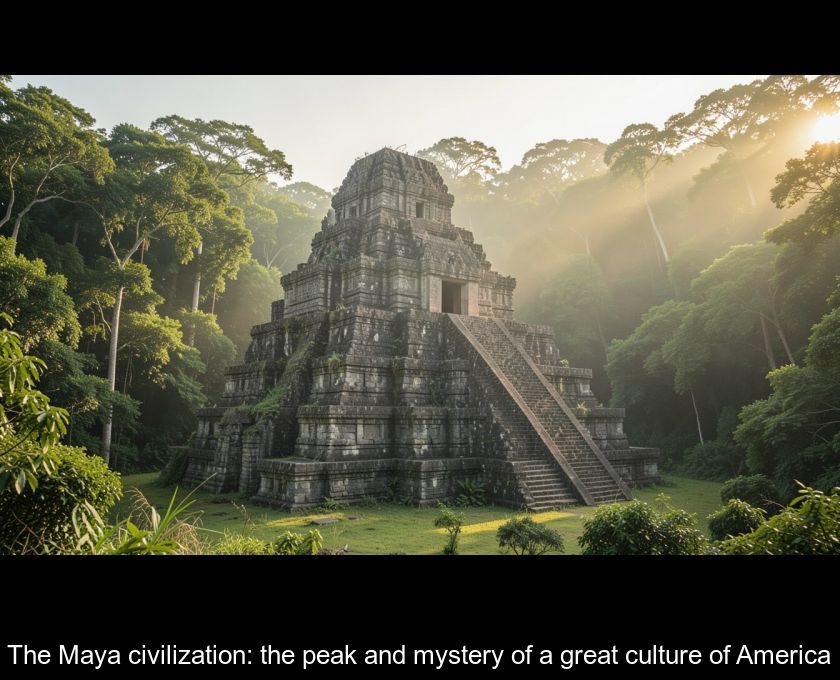
Mayan architecture is undoubtedly what strikes the collective imagination the most. The great cities compete in ambition by erecting imposing monuments, intended to impress as much as to honor the gods and the sovereigns.
These constructions do not only respond to an aesthetic logic: they are also part of the cosmological vision of the civilization, with an orientation often conceived in relation to the astronomical observations mentioned earlier.
This attention to monumentality recalls, in spirit, the approach of other great ancient civilizations that sought to translate their power and beliefs through durable edifices capable of enduring through the centuries.
The artistic and symbolic expressions of Maya culture.
Beyond architecture, Maya culture is distinguished by a rich and symbolic artistic production. Sculptures, painted ceramics, and carved reliefs depict scenes from political, religious, or mythological life.
These works are never purely decorative: they convey specific messages intended to legitimize the power of the ruling dynasties or to recall the foundational narratives related to the deities.
This strong symbolic dimension connects Maya art to other great ancient artistic traditions, where aesthetics always serve a broader discourse on power, the sacred, and the order of the world.
Religion and beliefs at the heart of civilization.
Religion permeates absolutely every aspect of Maya life, from social organization to architecture, as well as the calendar and the arts. The rulers themselves derive their legitimacy from their supposed connection to the divine world.
The priests, guardians of astronomical and calendrical knowledge, play a central role in this religious organization. They are the ones who determine the auspicious dates for ceremonies and interpret celestial signs.
This central place of religion brings Maya civilization closer to other great ancient cultures where the sacred structures the entirety of social, political, and intellectual life, without a clear separation between the different spheres of existence.
The mystery of the decline of the Maya empire
While the Maya apogee impresses with its scientific and artistic wealth, its decline remains one of the great mysteries of civilization history. The great cities, once prosperous, eventually became gradually abandoned.
This phenomenon of decline, which affects the entire Maya world without following a single pattern, continues to fuel the research of archaeologists and historians. No single explanation has reached a consensus, which in turn contributes to much of the popular fascination with this culture.
This ambiguity surrounding the exact causes of the collapse contrasts sharply with the precision and rigor demonstrated by the Mayans in their astronomical and calendrical calculations, making the mystery even more intriguing.
The legacy and place of Maya civilization in general culture.
Despite its decline, Maya civilization continues to fascinate and holds a prominent place in general culture, alongside other great civilizations of America such as the Aztecs and Incas. It is regularly cited as an example of a society that reached a very high level of scientific and artistic development without the same tools as the civilizations of the Old World.
This legacy is reflected today in the work of archaeologists and historians, who continue to study the remnants, writings, and monuments to better understand this culture.
To remember the Maya civilization is also to remember a broader lesson: that of a humanity capable, on different continents and without direct contact, of developing scientific knowledge and artistic expressions of comparable sophistication. A good reason to continue to take an interest in it, if only to better grasp the diversity of the great cultures that have shaped world history.