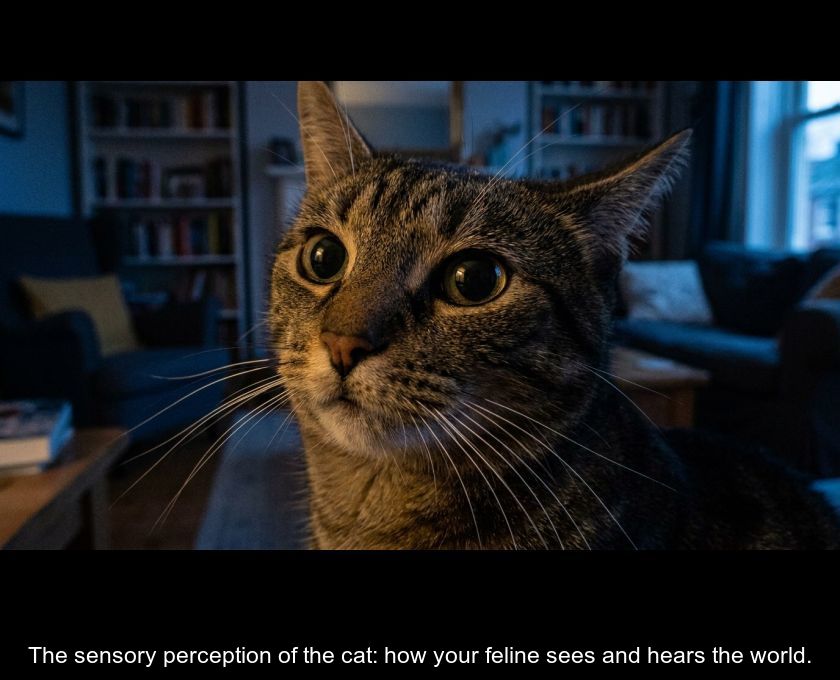
The Sensory Perception Of The Cat: How Your Feline Sees And Hears The World.
Big eyes in the dark, ears that swivel, nose always alert: the cat inhabits a world that our senses cannot perceive. Here, concretely, is what it perceives and why it sometimes behaves in such puzzling ways.
A world to visualize differently: the sensory reality of the cat.
We easily forget an obvious fact: your cat and you do not live in quite the same world. The senses of both species have evolved to respond to different lifestyles, and we have just enough shared perceptions to manage to understand each other.
It would be absurd to classify these abilities as superior or inferior. Biologists long ago abandoned the idea of a hierarchy of species: each animal is simply well-equipped for the role to which its ancestors adapted. A cat is an excellent cat because its organs and brain have been shaped for hunting small prey.
A small clarification of vocabulary, by the way. When we say to visualize the world from a cat's perspective, we are already betraying our own functioning: our imagination works in images. There is no reason to believe that a cat's imagination operates in the same way. A cat and a person looking through the same window do not see the same scene, and the cat also senses many things that you are completely unaware of.
The sense of smell, the king of senses: when feeling takes precedence over seeing.
In cats, smell is as much a part of their reality as sight. The internal surface of their nose dedicated to capturing scents is about five times larger than ours, and their olfactory bulb—the area of the brain that first processes smells—is significantly larger than ours, although still smaller than that of dogs.
Specifically, the inhaled air is first cleaned, humidified, and warmed as it passes over a fine entanglement of bones, before reaching the olfactory membrane. The nerve endings there are covered by an extremely thin film of mucus: if it were thicker, the molecules would take several seconds to arrive, and the information would already be outdated. These delicate endings regenerate only about once a month. Cats have several hundred different types of receptors, allowing them to theoretically distinguish many more odors than they will ever encounter.
Additionally, they possess a second olfactory apparatus that we do not have: the vomeronasal organ, two small sacs located in the palate, behind the upper incisors. Since they are filled with liquid, odors must be dissolved in saliva to be detected, and tiny muscles pump air inside. Thus, the cat chooses when to use it, unlike its nose, which works with every breath.
Nota Bene: the grimace your cat makes after sniffing a trace—upper lip curled, mouth slightly open, expression frozen for several seconds—has a name: flehmen. It is neither disgust nor a yawn; it pushes saliva towards this organ to analyze the scent of another cat.
Why cats don't think like us in pictures
We spend our time traveling mentally: we revisit a scene from yesterday, we project ourselves into tomorrow. Scientists strongly doubt that a cat's brain works this way. And even if it imagined something, it would likely evoke the smell of an object rather than its appearance, an exercise that very few humans can perform without extensive training, like perfumers or sommeliers.
Its perception of time is also very short. Cats have been trained to distinguish a four-second sound from a five-second sound, or to delay their reaction by a few seconds to receive a reward. However, there is no indication that a cat spontaneously knows whether an event happened a few days ago rather than a few hours ago.
What it possesses is a daily rhythm, reset each morning by dawn, complemented by learned cues: sunrise, sunset, the approximate time you fill its bowl. Most of the representations it forms last only a few seconds in its working memory before being erased. Only those that trigger a strong emotion move into long-term memory.
Humans and cats: two different ways of interpreting the same world.
Let's start with the eyes. The cat's eyes are enormous compared to its head, almost the size of ours, and its pupil dilates up to three times more than ours in the dark. Behind the retina, a reflective layer sends back to the receptor cells the light rays they missed, enhancing the eye's sensitivity by as much as 40 percent - and giving that characteristic glow when a light sweeps across its eyes in the dark.
Its retina is mostly made up of rods, those black-and-white cells in low light, while ours is primarily composed of cones. These rods are connected in bundles: the cat has ten times fewer nerves between the eye and the brain than we do. As a result, it sees in near darkness where our eyes are useless, but in broad daylight, its image is general and not very detailed. Its pupils, too wide to constrict to a point, contract into narrow vertical slits of less than a millimeter, and it can half-close its eyes to expose only the center.
In terms of colors, it has only two types of cones and perceives only blue and yellow. Red and green likely appear grayish to it, and above all, color interests it little: it is difficult to train a cat to distinguish a blue object from a yellow one, while brightness, pattern, shape, or size matter much more to it.
For hearing, the ratio reverses in its favor. The cat hears about eleven octaves, two more than we do at the high end, up to ultrasound: the pulses of bats, the high-pitched cries of rodents, which it can even differentiate from one species to another. It also retains low notes, thanks to an exceptionally large resonance chamber behind the eardrum. One area where it is inferior to us: distinguishing very fine nuances of tone and intensity, which our ears do remarkably well because we speak.
The anthropomorphic trap: the cat is not a small furry human.
A good part of the pleasure of living with an animal comes from projecting our thoughts and feelings onto them. We talk to our cats as if they understood every word, we label them as distant, cunning, or mischievous - especially the neighbors' cats, it is true. Since they are affectionate and communicative, there is a strong temptation to turn them into little furry humans.
Recent studies show the opposite. Cats share with us the brain mechanisms of basic emotions: fear, anger, joy, affection, anxiety. These are visceral, immediate reactions that allow them to decide quickly - to flee, crouch, or approach. In contrast, so-called relational emotions, those that require guessing what the other is thinking, are likely inaccessible to them.
Guilt is the best example of this. An experiment conducted with dogs demonstrated this well: owners were asked to prohibit a treat for their pet and then leave the room, with only some dogs being encouraged to eat it. Upon their return, all the owners were told that their dog had misbehaved... and all the dogs immediately took on a guilty look, whether they had done wrong or not. This was merely a reaction to the owner's body language. If a dog does not feel guilt, a cat feels it even less.
So beware of overly human explanations. When a cat urinates outside its litter box, it is not seeking revenge: it is most often anxious, generally due to other cats, whether from the neighborhood or from the household.
Eyes, ears, whiskers: the cat's sensory orchestra in action.
On the ground, all these senses work together. The upright and mobile ears pivot independently of each other to confirm the direction of a sound, and the brain compares the time delay of the sound arriving at the right ear versus the left ear, as well as the attenuation of high frequencies from the more distant side. The internal ridges of the outer ear further modify the sound depending on whether it comes from above or below: the cat thus also locates the height of the source.
Its eyes track movement in small jerks of about a quarter of a second, which prevents a blurry image and gives the brain time to process each snapshot. Its visual cortex compares these images sixty times per second, a bit faster than ours - which is why it perceives the flicker of certain lights. Specialized cells analyze movements up, down, sideways, diagonally, and anything that moves immediately attracts attention.
At close range, vision alone is not enough: the cat cannot focus on anything less than about thirty centimeters from its nose. It compensates by bringing its whiskers forward at the moment of the leap, giving it a three-dimensional tactile image just in front of its mouth. Its pads and claws are packed with receptors that indicate the resistance of the prey, and its long, highly sensitive canines guide the bite between two vertebrae.
Nota Bene: Whiskers are modified hairs equipped at their base with receptors that provide information about the distance and speed of retraction of each whisker. There are others above the eyes, on the sides of the head, and near the ankles. It is with this set that the cat assesses the width of an opening before entering it. Never cut them.
Filtering information: the cat's brain in the face of sensory flow
Feeling is one thing. Sorting is another. Every second of wakefulness, the eyes, ears, nose, whiskers, and inner ear produce a considerable volume of data, and no brain—ours included—can store it all. Imagine a control room lined with screens: at any given moment, only a tiny fraction matters, and it takes a very seasoned observer to know which one to monitor.
Filtering begins right at the sensory organs: the motion detectors in the visual cortex draw attention to what changes and leave the rest blurred. Then, representations are held for a few seconds in working memory, before almost all are erased. Only those charged with emotion are archived long-term.
A very simple mechanism explains much of daily behavior: habituation. A stimulus first provokes a reaction, then less and less, until there is none. This is what happens with toys: after a few minutes, the cat loses interest. Remove the toy, give it back, and it plays again but less. However, replace it with a slightly different object—different texture, color, or smell—and it’s back at it with renewed vigor. It’s not the game that bores it; it’s the toy. Hence the very practical advice: rotate two or three toys rather than leaving just one out all the time, and allow about five minutes between sessions.
The organization of the feline brain reflects its priorities: a developed cerebellum for balance and movement, a well-equipped auditory cortex, large olfactory bulbs... and areas dedicated to social interactions that are less developed than in other carnivores like wolves.
The example of Splodge: when smell reveals an invisible world
A researcher who lived with a cat named Splodge had noticed a daily routine: the animal systematically inspected the bumpers of cars parked in front of the house. After sniffing, it would look around, visibly anxious. It had just picked up the scent mark of an unknown cat, perhaps left a few hours earlier... miles away, when the vehicle was parked elsewhere.
The routine repeated day after day, month after month, without this otherwise very alert cat ever drawing the conclusion that seems obvious to us. And for good reason: in nature, a scent mark stays where it was left. Nothing in the evolution of cats has prepared them for the idea that a smell could travel with the object that carries it.
This little episode says two things. First, that your cat is constantly detecting messages of which you have no inkling, and that some of its strange behaviors—staring at a point, fidgeting in front of a car wheel, refusing a bag you bring home—stem from that. Secondly, it interprets these messages with the logic of a wild cat, not with ours. It does not guess our objects; it does not guess our movements.
A field experiment has confirmed the power of this sense: sand samples taken from mouse cages and placed by the roadside were visited by predators, including cat tracks, while clean sand remained ignored. And the attraction lasted at least two days.
A sensory intelligence forged by wild evolution.
All this equipment can be explained by a single story: that of a solitary hunter of small rodents. With keen eyes at dawn and dusk, ears tuned to high-pitched cries, sensitive paws, and whiskers that guide the bite—each part serves the same function. The only refinements that escape hunting are social: the ear flaps are particularly sensitive to the vocalizations of peers, and the vomeronasal organ primarily serves to decipher the scents of other cats.
However, this social sense also has a precise origin. The ancestors of domestic cats rarely crossed paths, except for reproduction or during the raising of kittens. Their social life relied on scent markings that could be read several days, sometimes weeks later. A female can thus form an idea of a male even before meeting him, by sniffing the traces he left on her territory.
Finally, a point often overlooked: domestication has changed almost nothing about this arsenal. A few thousand years of genetic evolution is very short, while we humans have changed culturally at a rapid pace. The only notable advancement in the cat's brain seems to be a new ability to bond with us. Its senses, however, remain those of a hunter.
The cat facing human objects: an adaptation still incomplete.
Cats remarkably understand three-dimensional space. Outside, in a familiar territory, they take shortcuts, proving that they have built a mental map through their explorations, and between two routes to an invisible goal, they choose the shortest one—while preferring, like many of us, a path that immediately heads in the right direction.
In contrast, the mechanics of our objects elude them. In an experiment, cats learned to pull a handle connected by a string to a treat placed under a grid. Many succeeded easily, giving the impression that they understood the connection. But as soon as a second string and a second handle were added, with only one leading to the food, they pulled randomly, unable to predict the correct one—and no better when the strings were crossed. For them, the handle was an arbitrary object, with no physical link to the reward.
Many supposedly clever tricks can be explained in the same way. A cat that opens a lever-handle door first jumped to a high point, as it does when a passage is blocked. The lever gave way, the door opened, and it was able to explore the adjacent room—a reward in itself for a territorial animal. After repeated attempts, it comes to place a single paw and gently pull down.
The same logic applies to meowing, which is almost absent among free-ranging cats and addressed almost exclusively to humans: it attracts our attention, is sometimes followed by a bowl or an open door, so it gets repeated and specialized. Some cats meow near the door to go out and in the middle of the kitchen to eat. It’s a learned code, unique to each duo, not a universal language.
Understanding the cat means accepting its sensory otherness.
Keep the essentials in mind: your cat sees few colors and little detail in broad daylight, but it detects the slightest movement and sees where you are blind. It hears two octaves higher than you and locates a sound source with remarkable precision. It reads its environment through its nose, with an additional organ dedicated to the scents of its peers. And it lives in a very short present, where a few seconds of working memory are often sufficient.
This translates into simple gestures in daily life. Never cut its whiskers. Avoid grabbing its paws, the tips of which are exceptionally sensitive. Do not present an object three centimeters from its nose; it cannot focus. Alternate its toys rather than leaving just one lying around, and favor mouse, feather, or paw-shaped formats that it will eagerly attack - a large toy the size of a rat will be handled with much more caution.
Also accept that a simple moved piece of furniture disrupts the network of associations it has patiently built: it will need to reassess everything before relaxing, so give it that time. And above all, remember that its main source of anxiety is not you, but other cats. A food bowl, litter box, and personal resting area, along with the ability to escape the sight of outdoor cats: these very concrete arrangements help reduce stress that can even impact its health.
Understanding a cat is therefore not about bringing it closer to us, but making the opposite effort. The day you stop expecting human reactions from it and observe what its senses tell it, most of its puzzling behaviors become perfectly logical.