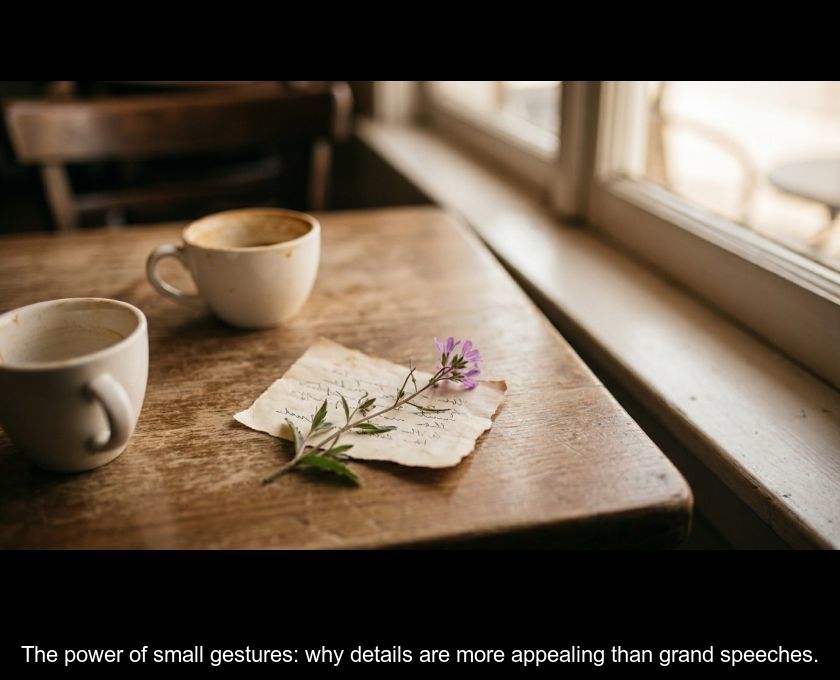
The Power Of Small Gestures: Why Details Are More Appealing Than Grand Speeches.
Flamboyant statements impress less than a bouquet of good flowers or a word slipped at the right moment. Here, concretely, is how the details do all the work.
Great speeches are alarming, details disarm.
A fiery declaration, a spectacular gesture, a tirade about one's feelings... all of this often produces the opposite of the desired effect. The person receiving this deluge asks a very simple and very embarrassing question: why so much effort to please me? Distrust sets in even before the sentence is finished.
Words, it must be said, cost nothing. Anyone can find the right formula, and anyone can forget it the very next day. They fly away, they commit to nothing, and we have all learned to be a little wary of them.
A gesture, on the other hand, has substance. A well-chosen gift, a tiny but perfectly timed gesture, a look at the right moment: these things speak for themselves and convey much more than they are. The practical rule can be summed up in one sentence: never describe your feelings, let them be guessed through your looks, your attitude, and your actions. It is the most convincing language that exists.
The personalized gift, a formidable (and inexpensive) weapon
A gift has considerable seductive power, but beware: it’s the intention that matters, not the price. An expensive item may bring joy for an afternoon, then end up in a drawer, just like the toy that a child grows tired of after a week.
A gift that truly touches someone adheres to three very concrete criteria. It alludes to a past episode of the other person’s life (a vacation spot, a teenage song, a lost book). It recalls an intimate symbol that you both share, a joke, a date, a nickname. Or it expresses, without saying it, your desire to please.
The advantage is enormous: an object that reflects special attention retains sentimental value. Every time the person sees it, the emotion returns, along with thoughts of you. A perfectly targeted little something will therefore always beat an impersonal piece of jewelry. So take the time to listen, mentally note the details, and then seek out the specific object that the other person mentioned one day, without thinking about it.
The caring that tells the other that they matter.
Multiplying expressions of interest is telling the same thing in a thousand ways: you occupy space in my thoughts. This involves very tangible things, starting with clothing. It doesn't matter if your outfit is elegant, original, or provocative; what matters is that it aligns with the tastes of the person you want to charm.
Two historical examples warrant a lengthy demonstration. When Cleopatra wanted to conquer Mark Antony, she didn't disguise herself as a courtesan: she dressed as a Greek goddess because she knew the triumvir's weakness for deities. Madame de Pompadour, on the other hand, had identified Louis XV's weak point: he was bored by everything. She constantly changed colors and styles, offering the king a spectacle that was never the same twice.
On your scale, play with contrast. Stay simple at work and at home, then, when you go out with the person in question, refine your attire as if you were dressing up a bit. This Cinderella-like transformation gives the impression that you have adorned yourself for them, and that is exactly the message you want to convey.
Make the encounter a celebration for the senses.
Take the banquet model: nothing has been left to chance. Flowers, a well-set table, chosen guests, music, an elaborate menu, delicate wines. The result speaks for itself; a true feast loosens tongues and lifts inhibitions.
You don’t need a castle. You need a list: what will be seen, felt, heard, tasted, touched during the two hours you will spend together? A color she loves, the smell of the dish he mentioned last week, music chosen in advance, soft lighting instead of kitchen neon.
This work is invisible, and that is its strength. The person won’t think, "what a staging," they will think, "I feel good here." And as they are busy savoring the experience you offer them, they are not spending their time analyzing you.
The spectacle of attention conceals your intentions.
There is a very simple mechanism behind all of this. A person fascinated by what they are experiencing pays less attention to what is wanted from them. Occupied with flowers, conversation, and little surprises, they no longer monitor your true intentions, whether it be a romantic desire, an agreement to obtain, or simply a friendship to win.
But the benefit is twofold, and this is where honesty is needed: thoughtfulness also transforms you. When you dedicate your energy to the details, you become much less pressing. You no longer watch for the outcome; you are busy doing well, and this absence of insistence is disarming in itself.
A practical piece of advice: never announce your intentions. No "I've been thinking about you all week, look what I've done." Commented attention becomes a discourse again, with all the distrust that it awakens. Let the other discover, be surprised, and conclude on their own.
Childhood, that golden age of the senses that we have lost.
Remember when you were six years old? The color of a new toy amazed you, a circus act transported you, the smell of cake or the sound of rain fascinated you for no reason. In our games, we imitated the adult world with an incredible attention to detail, and nothing escaped us.
Then the senses dull. We are rushed, we chain tasks together, we cross entire rooms without looking at anything. Our attention to our surroundings becomes distracted, economical, functional.
This loss is precisely your margin for maneuver. Every adult retains a nostalgia for that age when the world was immediate, colorful, and flavorful. To give back, even for just one evening, that quality of sensation is to offer something that almost no one provides anymore.
Bring the other back to their childlike wonder.
The principle is to subtract the person, the time you are together, from the selfish hustle of the real world. Specifically: slow down the pace. Don't look at the clock, don't talk about your work, don't rush from one place to another. Bring her back to an almost childlike simplicity.
To do this, aim for sensory experiences rather than arguments. Colors, small gifts, tiny ceremonies (a tea ritual, the same table each time, an object passed between you) work better than the best phrases. A child is more open to sensory pleasures than an adult, and the more fulfilled they are in this regard, the less they are governed by logic.
An additional advantage, and it is decisive: this sensory universe gives the other person a clear perception that you are leading them into a separate world, distinct from their daily life. This feeling of "intermission" is a fundamental ingredient of charm. One does not easily leave a place where they finally feel light.
The lesson from the stars: three times nothing, but unforgettable.
Those who fascinate crowds do not shout louder than others. Often, it is a few subtle touches that create the most haunting effect: a certain way of holding a cigarette, an inflection of voice, a studied gait. These micro-signatures have a visceral impact, and one begins to imitate them without even realizing it.
Cinema invented this effect with the close-up: it abruptly extracts the actor from their surroundings and makes them occupy our entire mental field. Seek the same thing. Your style, your presence must stand out enough for your image to linger in the other person's mind after you leave. Remain a little vague, a little evanescent, while never being absent or forgettable; that is the delicate nuance.
One last tip, very effective: the impassive face. Instead of manifesting all your moods, reacting and overreacting to every sentence, maintain a calm and somewhat inscrutable expression. The other person will then start to interpret, project, and guess. They work for you.
What we perceive without noticing it
Many details operate below the level of consciousness. We register an unusual color, an object with a strange shape, an unexpected scent, without ever clearly saying to ourselves, "Oh, that's nice." And yet we return to it, not knowing why. We are drawn to certain things solely because they stand out from the ordinary.
Nota Bene: when we talk about "subliminal" attraction, it is simply an impression that enters us without going through reflection. Seduction largely works this way; it bypasses consciousness to speak directly to the imagination. This is also what we call insinuation: we plant an idea like a seed, discreetly, and later the person believes it came from themselves.
In practice, this means one thing: dose it. An unusual object in your home, a fragrance note that resembles nothing else, a recurring color that becomes your signature. Enough to be perceived, never enough to be commented on. What is overly emphasized becomes an argument, and an argument can be debated.
Crack open the door to your privacy.
Nothing sharpens curiosity quite like a piece of intimate life left intentionally exposed. The figures who fascinate the general public have always understood this: they let slip a cause they defend, an attachment, a fragment of their personal history, and the public weaves stories around it for months.
On the scale of a relationship, this plays out in a matter of seconds. You share a seemingly insignificant detail, a memory, a fear, a quirky habit, then you change the subject as if you've said too much. The half-revealed confidence, the revelation followed by a small excuse: these techniques have considerable power because they create the impression of rare access.
The rule is to reveal as if inadvertently, never on command. If you spill everything, there’s nothing left to imagine, and familiarity extinguishes the desire to know. Always keep a few shadowy areas in your character: it’s these that make people want to come back.
Slow down time to recreate a present.
Our minds are bombarded with information, pulled in every direction, unable to stop. Many people suffer from this without articulating it: they seek out sports, alcohol, anything that brings them back to the moment. Offer them that moment, and you offer something rare.
The method is that of the hypnotist, who makes a watch at the end of a chain follow the gaze. The only way to relax a mind is to focus it on a single object. You must therefore become that object: complete attention, an unwavering gaze, a conversation that doesn’t jump from one topic to another.
This refocusing has a delightful side effect. When the mind settles, the little anxious thoughts fade away: do I really appeal to others, am I good enough, where is all this going? But it all depends on you. If you check your phone, if you talk about next week, the other person will immediately return to their own agitation. Immerse yourself in the present, and they will follow you.
Speak to the senses, not to reason.
Trying to convince someone with arguments is the surest way to awaken their defenses. No one likes to be persuaded, as if they were incapable of deciding for themselves. So aim lower and more effectively: the senses.
Start with the visual, which remains our dominant sense, but don’t stop there, as the five senses train each other. A smell awakens the desire to touch, a light touch immediately engages the eyes. Modulate your voice: deeper, slower; it changes everything, and no one will know why. When the senses saturate attention, strictly rational thought takes a back seat.
Two useful remarks. A slight disorder often has more effect than a flawless presentation; too much perfection smells of preparation. And sharing a physical activity—a dance, a walk, a swim—silences internal commentary better than a long conversation, because the body takes over from the mind.
Cherish the other as one watches over a child.
There is a form of attention that touches almost everyone: the kind that recalls a mother's care. Surrounding the other with order and comfort, caring for their needs before they express them, not judging their clumsiness or foolishness. We all hold onto the nostalgia of a time when someone took care of everything for us.
The secret lies in a discreet method: catalog their needs without making it obvious. Listen to the offhand remarks, note what they dislike, what they lack, what exhausts them. Inquire with others, catch the innocuous comments as they come.
Then, act with precision. It’s this accuracy that leaves people speechless: the person feels as if you can read their thoughts, when in reality, you have simply listened better than others. In a life filled with power struggles and hurried people, being pampered in this way creates an extremely strong attachment.
Constant attentions... but never suffocating.
An attachment is nourished by a regular flow of small things. Don't let the other person forget you during the moments when they are alone; these are the moments that decide everything: a word, a short message, an object left at their place, an impromptu meeting. The worst enemy is not the rival; it is inertia, that moment when one stops making an effort because they believe the game is won.
For the person remembers very well the courtship you gave them. If the attention wanes even slightly, they draw an unpleasant conclusion: as long as you wanted to obtain something, you went out of your way. On the contrary, show that nothing is finished, continue to deserve, and throw out new bait.
But keep it measured, as excess, whether good or bad, has no seductive virtue. Drowning someone in constant kindness, being clingy, transparent, available at all times, is the best way to make them flee. Play with absence, create silences, maintain some shadows. Consistency in attention, yes; total familiarity, no.
Pamela Harriman, or the supreme art of detail
From the 1940s to the early 1960s, Pamela Churchill Harriman had a series of affairs with the most famous and wealthy men of her time. What captivated them was neither her beauty, nor her lineage, nor her quick wit: it was a sense of detail taken to dizzying heights.
The process deserves to be detailed because it is reproducible. First, an attentive gaze, drinking in every word they said and absorbing their tastes. Then the execution: barely welcomed into their homes, she would decorate the house with their favorite flowers and persuade the chef to prepare dishes that could only be found in the finest restaurants. They mentioned an artist they liked? A few days later, the artist would be invited to one of her parties. She would find them admirable works of art, dress exactly as they liked.
And all of this without a word, never announcing her intentions: she observed, asked third parties, caught a remark thrown out at the table. Above all, remember this from her example: grand declarations are forgotten, the thousand little nuances intoxicate. Listen better than others, take notes, then act without commenting. That is the whole art, and it is within your reach at the next encounter.