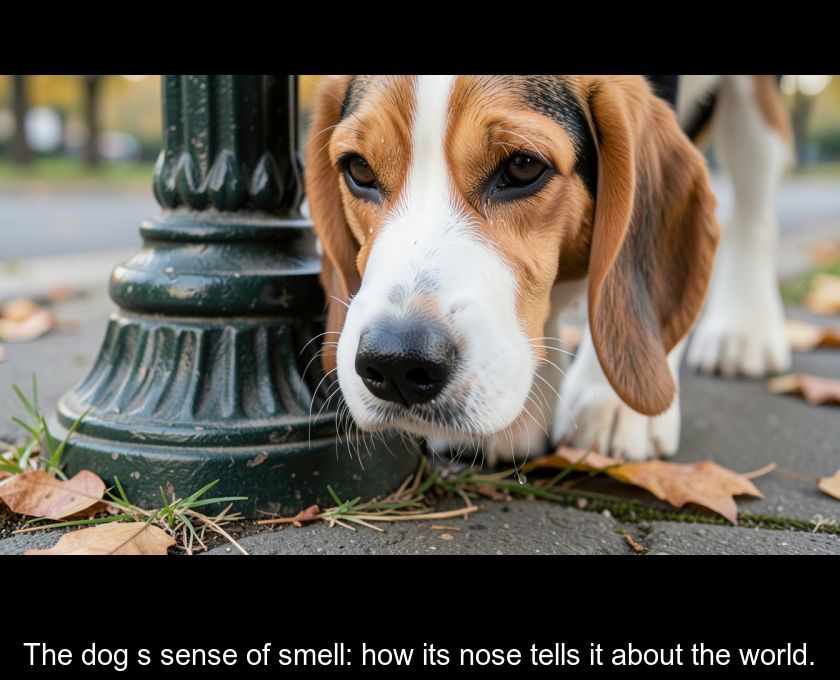
The Dog's Sense Of Smell: How Its Nose Tells It About The World.
Does your dog stop at every lamppost, nose glued to the sidewalk? He's not lingering; he's gathering information. We invite you to discover how his nose works, what he picks up on that escapes us, and how to respect this extraordinary sense in our daily lives.
Each animal lives in its own bubble.
To understand your dog's sense of smell, you must first accept a somewhat strange idea: it does not quite live in the same world as you. Biologists have a word for this, borrowed from German: Umwelt. It is the world as the animal experiences it, with what it can perceive and what it can do.
This idea comes from Jakob von Uexküll, who advocated it in the early decades of the 20th century. He saw each living being as enclosed in its own soap bubble. His most famous example is that of the tick.
The tick sees nothing and hears nothing. Its only hope is to someday detect a bit of butyric acid, the scent that betrays the passage of a warm-blooded animal. It can wait for a day or ten years! When the scent finally arrives, it relies on the heat, takes the only blood meal of its life, lays its eggs, and dies. The dog's world is much richer than its own, but it is made up of smells above all, whereas ours is made up of images.
A world seen at knee height
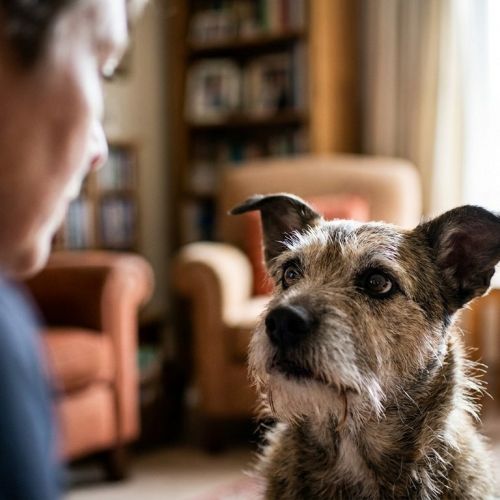
The first difference, and it matters: size. A dog's nose is about 35 to 60 centimeters off the ground, roughly at knee height. Closer to the ground, smells are stronger because the air hasn't had time to disperse them yet. Low-frequency sounds bounce off the ground and are heard better.
The film shot with Stanley gives a good idea of this. This Jack Russell carried a camera for the artist Jana Sterbak, and we finally see the street as he sees it. The images are jerky, and above all, the dog doesn't pay much attention to anything until his nose has sensed something. It's the smell that makes him move, and it tells him where to look next.
His eyes are actually more interested in what moves than in shapes. Show him a squirrel that isn't moving, then the same squirrel darting away: for him, it's almost not the same thing! He also sees fewer colors than we do and relies mainly on the contrasts between light and dark. That's why he sometimes hesitates in front of a pool full of reflections or a poorly lit room.
Note: Want an idea of what he sees? Replace the bulb in a room with a yellow bulb. The shades immediately appear washed out.
A snout lined with millions of sensors
If the dog smells so well, it's primarily a matter of space. Its long snout hides a maze of small corridors, covered with a special mucous membrane whose role is to capture scent molecules. Think of it as a tiny carpet: on this mucous membrane, a multitude of receptors equipped with hairs sort the molecules as they pass and retain each according to its size.
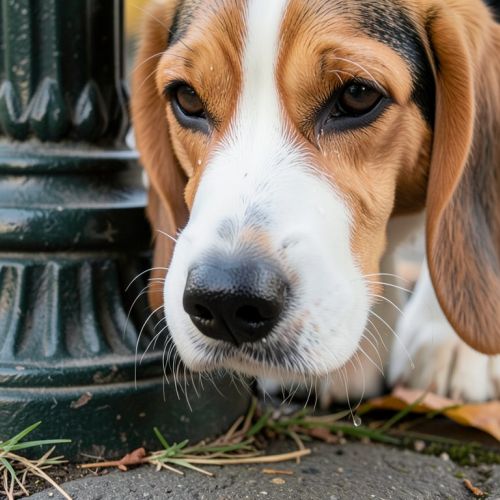
And the dog has a lot of receptors. A beagle has over 300 million. And you? About 6 million, which is fifty times less!
Its genes also work in its favor. A larger portion of its genetic heritage is dedicated to producing the cells that detect scents, giving it more of them and more varieties. The result: it can smell families of odors that our noses can't even imagine.
A nose directly connected to the brain.
How is a smell born? No receptor recognizes it alone. It is the group of receptors that react simultaneously that forms a sort of code, and this code only becomes a smell once it reaches the brain.
In dogs, the pathway is very short. The nose is directly connected to the olfactory bulbs, while what their eyes see or their ears hear first goes through a relay. If you were to mentally divide a dog's brain into eight equal parts, one of them, give or take, would correspond to these bulbs. In humans, even vision, the sense we rely on the most, does not get such a large share (it is processed at the back of the skull, in the occipital lobes).
This explains some dizzying numbers. For a beagle, we are talking about a difference of several million: its nose would be that many times more sensitive than yours. To give you an image, imagine filling two Olympic-sized swimming pools and pouring in just one small spoonful of sugar. A dog would find that sugar.
Sniffing: a gesture far more technical than it seems.
The dog does not simply breathe to smell. It sniffs: it pulls in air in small bursts to bring as many molecules as possible to its receptors. It is a deliberate action, almost a task.
For us, air enters and exits through the same path. For him, it's smarter, as shown by photos of the air currents around the nose. He starts by tightening the muscles of his nostrils, thus taking a good gulp of air. Then, his nostrils begin to quiver: either to send that air deeper, or to expel it through two small slits on the sides.
These lateral slits act as an exit door. The air he no longer needs leaves through there, without passing back through the entrance of the nostrils.
Why he never gets tired of a scent
This circuit has a big advantage. Since the used air exits through a different path than the fresh air, nothing interferes with the final scent: it arrives alone at the receptors. And the air that comes out from the sides creates small eddies, which push the next scent towards the nostrils and help the dog to inhale faster.
You have probably seen this without paying attention: when a dog sniffs the ground closely, it often kicks up a small cloud of dust. It also often lets out a tiny sneeze right after. This seems like a way to clear its nostrils before sniffing again.
Thanks to all this, it avoids a trap that we know well. Enter a kitchen where coffee has just brewed, or a room where a rotten smell lingers: after a while, you can hardly smell anything. The dog, however, does not get used to it. It constantly updates its scent map.
Note: it is not the only one sniffing to question its surroundings. Some specialists also mention the elephant, whose trunk acts as a scent periscope, the turtle, and even the marmoset.
Past, present, future: time feels.
Here is perhaps the most astonishing thing about a dog's sense of smell: it allows them to sense time. A faint, damaged, or hidden scent beneath other odors speaks to them of the past. A strong scent, on the other hand, tells them that it is fresh. And what the wind brings them announces what they will find further ahead, in other words, the future.
Their present is therefore broader than ours. When we look at a scene, we only see the moment. The dog, however, smells in the same breath what has just happened and what awaits them right after.
The downside is that scents do not stay in place. They travel, dilute, and then disappear. To keep track, the dog must constantly sniff and move from one object to another, as if the world only exists as long as they can smell it. Some specialists see this as the reason why they are often thought to be incapable of concentrating: their present, in reality, is always shifting.
Seasons and time, a matter of noses (and mustaches)
The scent also serves as a calendar for him. The spring air does not carry the same smells as that of winter at all, and your dog perceives this change through its nose.
For now, it relies on an internal clock located in the brain, at the level of the suprachiasmatic nucleus of the hypothalamus (a small area that regulates the body's rhythms). It is very active at dawn, calmer in the afternoon, and then wakes up again in the evening. Owners dragged out of bed at dawn know something about this...
Another, more surprising possibility. In the evening, warm air circulates along the walls of our homes without us feeling it, and the dog might notice it, perhaps thanks to its whiskers. One clue supports this: tracking dogs, trained to follow a scent, first head towards the windows when they are made to work in a room where the heating has been on.
Finally, a moment lasts less time for him than for us because his fusion frequency (the speed at which successive images form continuous motion) is higher. He lives, in a way, in the immediate.
A rose, a hammer, a streetlamp: objects according to the dog.
Let's return to the bubble. For the dog, an object only has meaning based on what it can do with it: eat it, chew it, roll in it, sit on it. We talk about functional circles. Feces, for example, fall into the "eating" circle (which explains many unappetizing scenes during walks!).
A hammer means nothing to it, unless it has an interesting smell or its handle seems good to chew on. The same goes for a rose: to it, it is just part of the plant, nothing more... until another dog has lifted its leg on it or a human hand has touched it. It then tells it much more than a bouquet tells us.
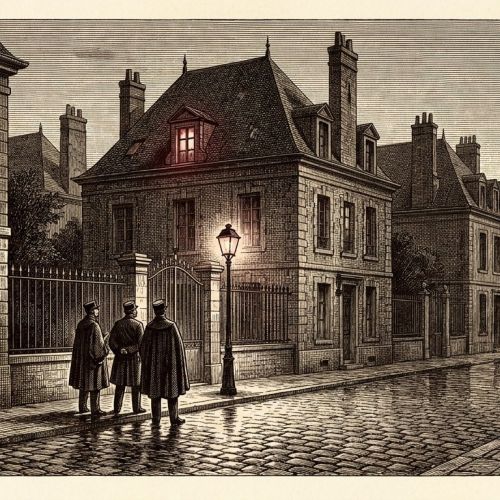
An entire building hardly interests it: it can neither carry it, nor bite it, nor move it. Even the smallest corner of a facade, the base of a streetlamp, or a fire hydrant fascinates it much more: that’s where other dogs in the neighborhood have left their messages.
Your home, a map of scents.
At your place too, your dog perceives space in its own way. A room is not just a collection of furniture for it, but a series of zones: those that hold scents, those that give them (a closet that is opened, a window), and those where it has a chance of finding you at rest.
This is also why it so often prefers your bed to its own basket. The bed is full of your scent, while the basket offers only an artificial fragrance. A good sleeping spot, from its perspective, has three qualities: enough space to stretch out, a good temperature, and the presence of its family nearby.
Be wary of the urge to impose our tastes on it. According to some specialists, a dog raincoat, which we find cozy, might instead remind it of the pressure from a dominant dog. Before buying an accessory, ask yourself what it means for your dog, and not just for you.
Among dogs, we greet each other nose to nose.
Observe two dogs crossing paths: they stick close to each other. Their personal space ranges from 0 to 3 centimeters, which means it practically doesn't exist! For Americans, the usual distance when facing a stranger is around 45 centimeters.
For dogs, politeness involves contact. They get very close, examine each other's fur, sniff each other all over, and nibble a bit. Pulling on the leash to prevent all this is therefore a mistake: you deprive them of their normal way of getting to know each other.
This greeting may also help them verify who they are dealing with. A dog remembers countless fellow canines, and a quick sniff seems sufficient for it to distinguish a friend from an enemy.
It also recognizes its own scent; just watch it bounce near its droppings while out for a walk. However, when placed in front of a mirror, it fails the famous mirror test (the animal must show that it recognizes itself). Some specialists believe that a mirror of scents, constructed from their olfactory signature, would be a much fairer test for them.
The tongue strikes, a legacy of wolves.
The famous slobbery kiss has a very practical origin. To understand it, we must go back to wild canids. A hungry wolf pup (just like a young coyote or a kit fox) licks around its mother's mouth, and this gesture prompts her to regurgitate some of the meat she has swallowed for him.
In dogs, this gesture has become a way of saying hello: by licking, they gather information about what the other has been doing. A shy puppy also uses it to appease a larger dog.
Sometimes there is a more gluttonous reason. Your skin has the salty taste of sweat, and the area around your mouth often retains traces of your last meal. Dogs can indeed recognize four flavors: sour, bitter, sweet, and salty. Their tongues are very well equipped to detect sweetness, and for them, a hint of salt makes a sweet flavor even sweeter.
Don't be surprised to see them lick an unfamiliar object. Swallowing a few molecules is their way of making direct contact with their surroundings.
Your feet, your shoes, and you: her favorite signature.
For your dog, you are primarily a scent. He recognizes it, just like the sound of your approaching footsteps, even before you are in his line of sight.
And which part of your body says the most? The feet. Sweat, especially that caused by stress, makes them a top source of personal odor. Locked up all day in shoes, they leave behind a concentrated scent, trapped in leather or fabric.
Your socks and shoes are therefore true business cards. It's no surprise that they attract him so much: they carry your scent in its most concentrated form.
On a walk: let him read the sidewalk.
The walk is the moment when your dog reads the news. Every lamppost, every corner of a wall teaches him who has passed by and how long ago. Pressing him to move on is a bit like snatching the newspaper from your hands at every line. A few simple reflexes change everything:
- Let him sniff: it's his normal way of reading his surroundings, not a waste of time.
- Don't tighten the leash when he meets another dog: both need to get close and smell each other to get acquainted.
- Get down to his level to greet him: crouch instead of just bending over slightly, and avoid scolding him when he jumps to come to you.
Also keep in mind that the city constantly bombards him with sounds and smells that he cannot filter, an endless source of new experiences. He needs more time than we do to get used to it, but he can adapt: gradually acclimate him. The bookstore dog, who has become accustomed to the comings and goings of the shop, is a good example.
At home: keep his nose busy (and let's recap)
A dog that is bored alone at home quickly finds ways to entertain itself: chewed socks, rummaged trash... The best remedy is to provide it with an activity, and its nose is perfect for that. A simple trick: before leaving, hide some treats around the apartment. Searching for them will keep it occupied during your absence.
Finally, know that dogs learn mainly through associations: training them means teaching them to connect two events. They do this daily, without being asked: they learn to associate the opening of the refrigerator (and the smell that comes from it) with their food bowl.
In summary, your dog lives in a world of smells, just a few dozen centimeters off the ground, with a nose covered in sensors that tells it about the past, the near future, and others. Respecting this sense means allowing it to sniff, greet other dogs, and keep its nose busy when you're not around. And to measure the difference, try spending an afternoon at its height and smelling each object: you will no longer see your walks the same way.