Armistice Of November 11, 1918: How The Great War Turned In One Year
Every November 11th, bells and ceremonies commemorate the end of the Great War. But do you know how this conflict, which had been stagnant for over three years in the trenches, was able to turn in just a few months? From German offensives threatening Paris to the signing in a simple carriage, here is the year 1918 recounted step by step.
Early 1918: a war that seems never-ending
To understand what was at stake in 1918, one must first remember the deadlock into which the armies have sunk since the beginning. In the summer of 1914, France mobilizes with the belief that everything will be resolved in a few months and that everyone will return home quickly.
However, by the end of that first year, both sides are entrenched. A continuous line of trenches stretches from the North Sea and does not stop until the gates of Switzerland. For years, the front hardly moves: battles are fought for just a few kilometers, sometimes for a wood or a simple hill.
The major battles that follow (Verdun, the Somme, then the Chemin des Dames) result in hundreds of thousands of casualties without making any decisive outcomes. In the end, nearly one and a half million French soldiers will not return.
It is this stagnant war that will suddenly start moving again between March and November 1918, and here is how it shifted, step by step, until the silence of arms.
Clemenceau, the "Father of Victory," holds the country.
Before the major maneuvers of 1918, another battle was being fought in Paris on the political front. The year 1917 was fraught with dangers for morale: after the bloody failure of the Chemin des Dames, some regiments mutinied and even threatened to march on the capital, while strikes erupted at the rear.
Pétain, appointed in place of Nivelle, responded both with sanctions (554 death sentences, 49 of which were executed) and with concrete gestures: more frequent leaves, better meals, and more decent accommodations.
In November 1917, Poincaré called upon Clemenceau to lead the government. The man had a valuable asset: the soldiers appreciated him, and he did not hesitate to visit them right in the trenches.
His method can be summed up in one formula: to wage war everywhere, both within the country and against the enemy. This refusal to allow any relaxation earned him a nickname that has remained in history, the "Father of Victory."
March 21, 1918: Germany goes all in.
On March 21, the German army launched a considerable offensive in Picardy. Its command hopes for the decisive victory that years of trench warfare have denied everyone. Time is pressing for them: each passing month brings the massive arrival of American soldiers closer.
The Allied lines give way, and it takes the attackers only three or four days to reach the Somme. An even graver danger looms: that the British and French, failing to coordinate their efforts, end up waging their own separate wars.
The parade arrives on March 26. On that day, Foch takes command of all coalition troops, with a rarely used title: that of supreme commander.
The term designates a leader placed above all other generals, regardless of their nationality. In practical terms, one person now decides where to send reinforcements instead of negotiating each movement between general staffs.
Paris under the shells of "Big Bertha"
At the same time, Parisians discover an unexpected threat, as cannons with an extraordinary range, set up behind German lines, manage to drop their shells right in the heart of the capital.
Why are they called "Big Bertha"? The nickname comes from the Krupp family, whose arms factories are famous: Bertha was the name of the industrialist's daughter.
The heaviest tragedy occurs during Holy Week. On March 29, Good Friday, a projectile strikes Saint-Gervais, killing 91 people in the church. The shelling continues until September, resulting in several hundred deaths in total.
Militarily, these bombings do not change the course of the war. The intended effect lies elsewhere: to make civilians understand that the war can reach them even in their own homes.
Late May: the Germans again on the Marne.
At the end of spring, the German army strikes another point on the front: the Chemin des Dames, the sector where the French had suffered so many losses the previous year. The attack lasts from May 27 to 30, and its troops push forward without stopping until they reach the Marne.
The symbolism is terrible. It is on this river that Paris was saved at the very beginning of the war, when Gallieni requisitioned taxis to transport reinforcements to the front. The capital is once again in danger: only about sixty kilometers now separate it from the enemy.
The human toll is severe for the Allies, with around 60,000 men captured. Remember this paradox as it sheds light on everything that follows: at the beginning of summer, Germany has never seemed so close to winning, while its defeat is merely a matter of months.
The Americans, the game-changing reinforcements.
While Germany pushes its pawns, another, more discreet movement is profoundly changing the balance of power: American soldiers are arriving in France, ever more numerous.
Why did the United States, which had long remained on the sidelines, ultimately decide to engage? It all started at sea. The sinking of the Lusitania first made an impression across the Atlantic: 128 American passengers died, and Berlin refused the compensation demanded. Then submarine attacks multiplied, and this escalation pushed Washington into the war.
The port of Boulogne saw the first soldiers from America disembark as early as 1917, with Pershing at their head. By the heart of the following summer, their number reached about a million: an entire army was coming to bolster the coalition.
For European armies worn to the bone, this fresh blood carries significant weight: on the battlefield, of course, but also in the minds of both sides of the front.
July 18, 1918: the war changes sides.
On July 18, it is the Allies' turn to attack, and this time they engage together and en masse the new weapons of modern warfare: about 600 planes and a thousand tanks. Among these machines, the Renault tanks make a difference thanks to their maneuverability.
The threat then shifts: it is the German divisions that risk being caught in a pincer movement. For an army, being surrounded means being cut off from its rear, thus from its ammunition and food. Retreat becomes the only option to save the men.
On that day, the initiative passes to the other side. From the summer onwards, it is the Allies who choose where and when to strike, and they will not ease the pressure until autumn.
Back to square one: the Hindenburg line
When August comes to an end, everything is to be redone for Berlin. Its divisions have been pushed back to the Hindenburg line, which is where they stood before the great blow of March. The ground gained in the spring has been completely lost.
This line is named after the leader who has been directing the German army alongside Ludendorff since Falkenhayn's dismissal. It is a fortified barrier on which the Germans relied to hold their position.
However, the retreat turns into a rout. It is in Artois that the last Allied success takes place, on land where three years earlier an attack could cost 100,000 lives for barely 5 kilometers gained. The comparison says it all about the progress made: the war of position is over and the war of movement has resumed.
Rethondes: a signature at dawn
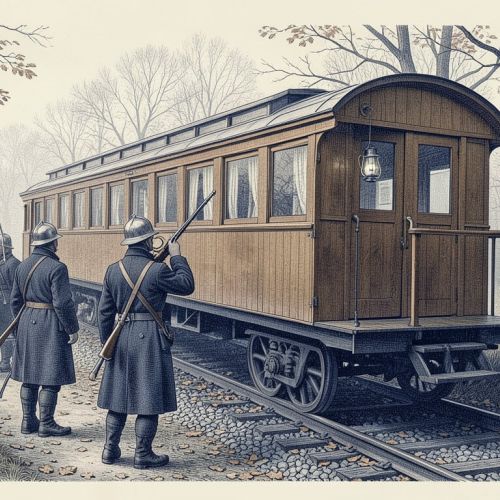
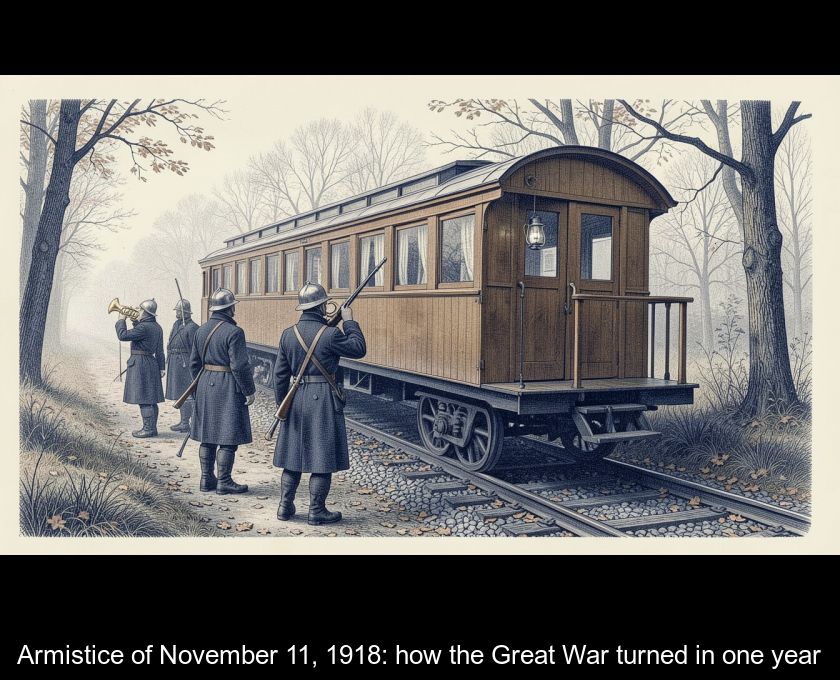
Germany can no longer afford to continue the fight, and the setting for the final scene is very simple: a railway car, that of Foch, immobilized in the middle of a clearing. The place is located in Rethondes, not far from Compiègne.
It is there, in the early morning of November 11, 1918, that the armistice receives its signatures. But the cessation of hostilities is not instantaneous: the guns do not fall silent until eleven o'clock. Note the nuance, as it is often encountered: the agreement is reached at dawn, and silence only falls by late morning.
You may sometimes come across the expression "armistice of Compiègne": it refers to the same event. Both names are correct; one designates the exact location, while the other refers to the nearby, more well-known city.
Eleven o'clock: the silence of arms, the sound of bells.
At eleven o'clock, the front falls silent and immediately, from one bell tower to another, the whole of France rings out to announce the news. For many, it is first and foremost an immense relief after more than four years of suffering.
But this celebration has another side. According to some historians, it was above all a mournful victory: in the homes where a place remained empty at the table, the bells did not ring in the same way.
It is this dual memory, of deliverance and sorrow, that the ceremonies of November 11th continue to carry. We celebrate the end of the fighting, but we primarily read names.
How to read the war memorial in your town
The war memorial remains the simplest way to grasp what this war was like. A few minutes are enough to learn a lot, provided you know what to look for.
- Read the list slowly, from top to bottom, rather than skimming through it.
- Identify the repeated surnames: on some memorials, the same family occupies four or five lines in a row. These are often brothers.
- Consider the age of the men: among the soldiers were both 18-year-old boys and fathers.
- Relate the list to the size of the community: in a small village, a long column of names alone conveys the extent of the mourning.
With a child, the exercise works very well: ask them to count the identical names and then explain what such repetition means for a single household. It is often more telling than any story.
Note Well: an armistice is not yet peace.
One point deserves clarification as it often leads to confusion: the armistice of November 11 does not officially end the war. An armistice is an agreement by which the belligerents suspend hostilities, nothing more, and the conditions of peace remain entirely to be negotiated.
More than seven months pass between the cessation of hostilities and a formal peace. It is only on June 28, 1919, that Germany affixes its signature at the bottom of the Treaty of Versailles, the document that sets out the rules for the post-war period on paper.
Two other expressions frequently arise when discussing this period:
- Poilu: the nickname given to French soldiers of the Great War.
- Trench warfare: a type of warfare where armies, entrenched in their trenches, confront each other without being able to advance.
June 1940: France defeated
Let's change the era to know the end of the story of the wagon. On June 14, 1940, German troops occupy Paris. On the roads, a vast crowd flees the invasion: more than eight million people take part in what will be called the exodus.
On June 17, Pétain announces that he is requesting an armistice. The next day, from London, de Gaulle broadcasts his call to continue the fight on the BBC.
Ironically, both men experienced Verdun. The first commanded the sector there, while the second, a young captain at the time, had received a bayonet wound at Douaumont before being captured and even reported dead. A generation later, they embody two opposing responses to defeat.
The Rethondes carriage, or the story in reverse
The sequel takes place in a location you now know: the clearing of Rethondes. The same railway car is back in service, but the roles have reversed: it is now the French who come to sign their defeat.
On the German side, the highest officials are present: around Hitler stand Göring, Keitel, and Brauchitsch. The representatives of the defeated France have no choice but to initial the document, which they do on June 22, 1940.
The victor does not stop at the ceremony. By Hitler's order, the car is to be sent to Berlin to be delivered to the flames. As for the nearby memorial, it is blown up with explosives. One can read a form of revenge in this, as a desire to erase even in stone the memory of November 1918.
What to remember for November 11th
If you were to keep only a few landmarks from this decisive year, they would be these:
- In spring, Germany launches its major offensives and threatens Paris once again, bombarded by long-range cannons.
- In the face of danger, the Allies entrust unified command to Foch while Clemenceau firmly holds the country.
- In the height of summer, bolstered by the Americans, the Allies counterattack and turn the tide of the war.
- By the end of August, all the territory gained by Germany in spring is lost again.
- On November 11, just hours after a signature concluded in the early morning, the front falls silent at eleven o'clock.
During the next ceremony, take a few minutes in front of your town's war memorial. Read the names, look for those that repeat, and tell those accompanying you the story of that wagon that served twice, in the same clearing, for two opposing defeats. It is the best way to keep alive a date that continues to bring people together.