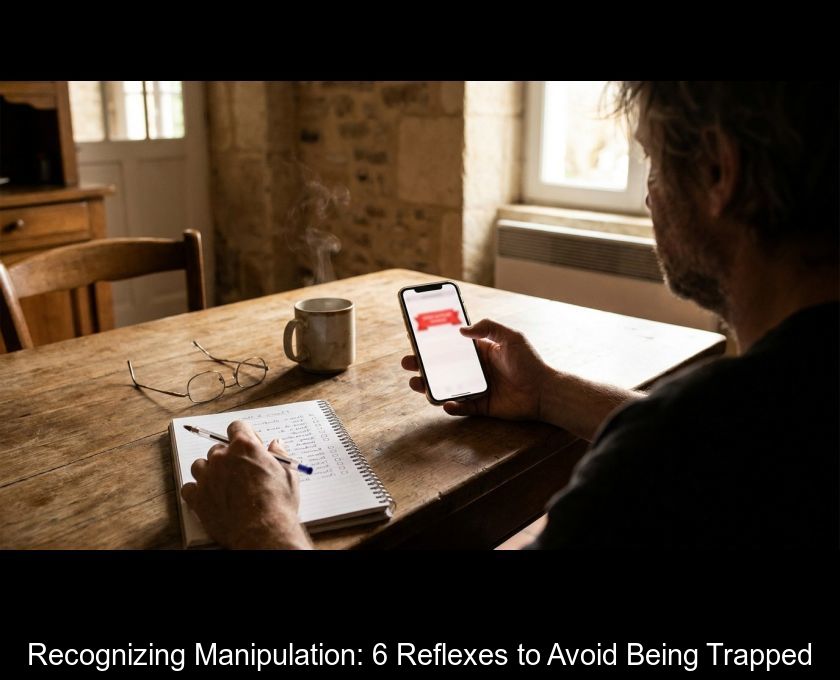
Recognizing Manipulation: 6 Reflexes To Avoid Being Trapped
A pressing message, an anger-inducing headline, a number that circulates everywhere... Not everything that tries to convince you is a scam, but some signs are unmistakable. We explain how to sort through them with six simple reflexes and how to apply them in less than thirty seconds.
Persuading is not manipulating.
Every day, dozens of messages try to change your mind, get you to buy a product, or share information. Most use very ordinary persuasion methods: a well-told story, a striking photo, a highlighted statistic. And persuasion is not dishonest in itself.
What separates persuasion from manipulation boils down to two ideas. First, the facts must be true: a fabricated statistic, a false quote, or a fake diploma is fraud, even when presented very well. Second, the method must be able to be stated out loud before being used, and still work regardless.
A salesperson can thus tell their client that they are going to share the story of another client because a real-life example resonates more than a table of percentages, and their story will still have an impact. A false scarcity, fake reviews, or a phony expert, on the other hand, only work if you don’t know what’s going on. Once the method is revealed, everything collapses.
The six reflexes that follow will help you perform this test daily, without necessarily seeing manipulation in everything that is well said.
An urgent message? Take a break.
First instinct, and the one that pays off the most. Most manipulation techniques rely on speed: they trigger an automatic reaction before reasoning, which is slower, has had time to kick in. Instead of memorizing all the tricks, remember just one rule: a strong emotion that coincides with pressure to act quickly is a stop signal, not an order.
What sign should alert you? You find yourself angry, anxious, or overly excited, yet you would struggle to summarize what the message asserts in one sentence. In this case, there’s a good chance the substance is quite thin.
Imagine a text message demanding payment of a bill within the hour, or an alert from a loved one pleading to forward it to all their contacts. Put down the phone, take a moment to breathe, and ask yourself what would actually happen if you waited until tomorrow. The countdown of a "last hours" sale or the "soon to be out of stock" rarely withstands this question.
Be careful, not all urgency is false! A real urgency can be explained, with a specific reason and consequence. Taking a pause doesn’t prevent action afterward: it simply transforms a reflex into a decision.
Name the frame
Every message tells a story before even delivering its facts. The same price increase can be presented as a crisis or as an opportunity to seize. A debate about a law can be narrated as a political disagreement or as a moral failing. And a societal issue described as a "battle" does not elicit the same responses as if it were described as a "disease." It is this framing that must be identified first; the sorting between true and false will come later.
This choice is never neutral: a metaphor highlights certain solutions and dismisses others without stating so. The question you should ask yourself is simple: is this framing the most accurate for the situation, or merely the most convenient for the speaker? Once the framing is named, it becomes possible to pose the question it was precisely meant to make us forget.
Be particularly wary of titles phrased as questions. They slip in an assumption that would be debated if it were stated outright. Exercise the same caution with loaded labels (scandal, betrayal, shame) that replace a precise and verifiable description of the facts.
As an exercise, take a title framed in terms of loss and rewrite it in terms of gain: the impression changes completely, while the information remains the same. American researchers McCombs and Shaw demonstrated in 1972, while studying an American election, that the press does not dictate public opinion but strongly influences what seems important to it.
Separate the atmosphere from the evidence.
A video disturbs you, a post outrages you? Take it apart like a device. The fact itself, the music, the colors, the angle of the photo, the confidence of the voiceover: each of these pieces can produce an effect, but only one provides information. This reflex is one of the hardest to develop, yet also one of the most enlightening.
Indeed, manipulative content struggles with this little sorting. Once the music is cut and the colors forgotten, there are often very few facts left that can be verified. And a very confident voice makes a statement seem more solid than it actually is.
Be equally cautious with photos and videos that circulate on their own. A photo is always framed, sometimes reframed, and this choice influences what we believe we see. The right reflex is to trace back to the original version, with its date and location, before forming an opinion on what it shows.
Two exercises help sharpen the eye: watching an advertisement without sound while noting what the image conveys on its own, and comparing photos of the same event in two different newspapers. You can also observe the dominant color of a brand: it is likely chosen to create a certain mood.
Who speaks, and who benefits?
A brand that boasts about its products or a party that defends its program does not hide its interest, and anyone can judge with full knowledge of the facts. Things become more complicated with an anonymous source, or one that conceals what it stands to gain financially or politically: it deserves much closer scrutiny. When faced with a message that seeks to convince you, two questions go hand in hand: who benefits if I believe it, and do I really know who is speaking to me?
The phrase "experts say," without any names, should also raise your eyebrows. A true expert has a name, an institution, and a specialty that corresponds to the subject, and a quick search is often enough to determine if that expert exists. A champion or a famous actor giving their opinion on a medication is not a medication expert: their prestige simply spills over onto a subject that is not theirs (this is the halo effect).
Other signals should make you slow down: an unverifiable number of users or supporters, several voices that seem independent but actually come from a single source, or a request that only makes sense if you don’t ask anyone else's opinion before responding. On commercial websites, stars and the number of reviews are the most visible social proof, which makes fake reviews easier to spot (and this area is highly regulated).
Finally, a source that never acknowledges its mistakes should inspire more distrust, not less. A serious source corrects its errors openly.
Heard before doesn't mean true.
Specialists talk about the illusion of truth effect, and the mechanism is very simple: the more you hear an idea, the more familiar it seems to you, and the more familiar it seems, the more likely you are to believe it is true. An idea heard a hundred times eventually sounds right.
The most surprising thing is that this effect withstands warnings. Experiments have found it in people who were told from the outset that some of the repeated statements were false! The feeling of familiarity occurs automatically, at a level that warnings do not reach.
The warning sign is an idea that you are very sure of without being able to say where it comes from or what it is based on. Test it with one of those ideas that everyone repeats, and verify it yourself. Another test is to think of a slogan that comes to you effortlessly, then see if you remember a specific piece of information provided by the same brand just as well.
Finally, an idea repeated by several voices that seem different is more convincing than the same idea repeated over and over by a single voice. Hence the importance of the previous reflex: before believing an idea because many voices repeat it, check that these voices are truly independent.
Get out of your bubble.
Social media news feeds are personalized: they prioritize showing you content that resembles what you have already liked or shared. As a result, the range of viewpoints that reach you may narrow by default, without you having asked for it. These feeds aim to keep you in front of the screen for as long as possible, and the accuracy of what you see takes a back seat.
According to American researcher Jonah Berger, content designed to circulate relies on three triggers: strong emotional excitement, practical utility, and the small prestige gained from sharing it (he refers to this as "social currency").
The solution is to seek out sources that do not share the same interests or audience as your usual sources. A practical rule: before adopting a significant idea (about health, money, or voting), consult at least one source whose interest is not aligned with that of the first source. However, this does not mean putting all opinions on the same level: an unfounded opinion does not carry as much weight as solid information.
To measure your bubble, observe your feed for a day. What portion of the content that elicits the most reactions is primarily based on outrage? And does this feed seem narrower to you than it did a few years ago? If so, investigate why.
Why knowing is not enough
Bad news, awareness is much slower than the brain's shortcuts, which act in a fraction of a second. The proof: even researchers studying these shortcuts (cognitive biases) fall prey to anchoring or framing when it comes to their own choices. Having read the list does not protect you.
Degrees are not a shield either. They protect you against traps that exploit a lack of knowledge, but much less against repetition, emotion, or ideas related to who you are. Some highly educated individuals even find simply better arguments to justify, in hindsight, what they wanted to believe.
When a discussion stalls despite the evidence, it is often because the other person feels threatened in their identity, not because they lack information. And you yourself are more or less sensitive depending on the topic, your current state, what you already knew, and the variety of your sources.
For some specialists, this should not be seen as stupidity. The brain has simply retained quick reflexes, effective most of the time, that were not designed for the flood of messages from today's media.
From reflexes to habits
The goal is therefore not to know everything, nor to be suspicious of every message you receive: constant distrust would quickly exhaust you and would lead you to dismiss solid information simply because it is well presented. Instead, it is about adopting a few habits of attention.
The simplest way is to keep the list of six reflexes handy: in your phone's notes app, bookmarked in your browser, or simply as a photo. This list is only valuable for the use you make of it in the moment, in response to the message that triggers your reaction.
Thirty seconds facing a shocking headline
You scroll through your news feed, and suddenly a phrase in bold letters makes you jump. No need to spend the evening on it; the following sequence takes less than half a minute, right in the middle of scrolling:
- Spot the urge: the desire to share immediately is the first clue.
- Take a pause before any click, comment, or share.
- Identify the frame that the headline already implies.
- Look for the fact: is outrage replacing missing information?
- Find the source: a name, and a declared interest.
- Decide whether to trust or not, to share or not, this time with full awareness.
With a little practice, these steps flow almost effortlessly, and the final gesture becomes a real choice rather than a reflex.
The exercise of the last sharing
Nothing beats a real case to anchor these reflexes. Find the last piece of content that made you want to share it (a video, an article, a screenshot) and analyze it:
- Was there an urgency, and what would have happened while waiting?
- What context did it place you in?
- Once the music, colors, and tone were set aside, what information remained?
- Were the opinions, the expert, or the rarity highlighted real or fabricated?
- Who had something to gain from it, and did they say so?
- Did you consult a source with different interests?
There's no need to conclude that this content was false. Just count the number of levers it activated: the result is often more informative than one might think.
Training together
Researchers have developed a strategy that resembles a vaccine. The principle, called inoculation, involves exposing you to the tricks of manipulation in advance so that you are prepared when you encounter them for real. This is also referred to as "prebunking": the warning comes before false information circulates, not after.
Psychologists Sander van der Linden and Stephan Lewandowsky have worked on open games for everyone and on media literacy tools tested in the field.
The group also works in your favor. In Asch's famous conformity experiments, it only took one person to disagree for others to follow the majority's opinion much less, and this result has been found across several cultures. Close ones who learn together to spot the tricks of manipulation therefore protect themselves better than if each were on their own.
In practical terms, share the list of six reflexes with a friend or family member, and then observe how each applies the list to the same content. According to some specialists, circulating the list among others is even more beneficial than perfecting one's own defense alone.
Note Well
Beware of the opposite excess, however. Seeing manipulation in everything that is well said is a bias like any other, and it can cause you to miss solid information. Public health campaigns, disaster prevention efforts, or civil rights advocacy also play on emotion and narrative, but with true facts, a clear purpose, and the genuine interest of the public.
Take a dietary supplement that has been the subject of a small, preliminary study. Presenting this study skillfully, while clearly stating that it is only preliminary, is honest persuasion. Writing "clinically proven" on the supplement box is fraud.
Finally, the more vulnerable the audience, the more demanding one must be: children, people in crisis, or those with limited access to other sources. With them, an honest message allows more time for verification and relies much less on urgency.
In summary: the 6 reflexes
Persuasion is not condemnable as long as the facts are true and the method could be announced openly. Manipulation, on the other hand, only works if you don't see the strings. To spot them, keep these six reflexes in mind:
- Urgency and strong emotion: take a pause and ask yourself what happens if we wait.
- The frame: name it before judging the content.
- The setting: set aside the music, colors, and tone, and look at what facts remain.
- The source: who is speaking, and who stands to gain from being believed?
- The already heard: familiarity does not mean truth.
- The bubble: vary your sources, with at least one having different interests.
Note this list in your phone, try it on the next headline that makes you jump, and then share it with your loved ones: it works best when used collectively.