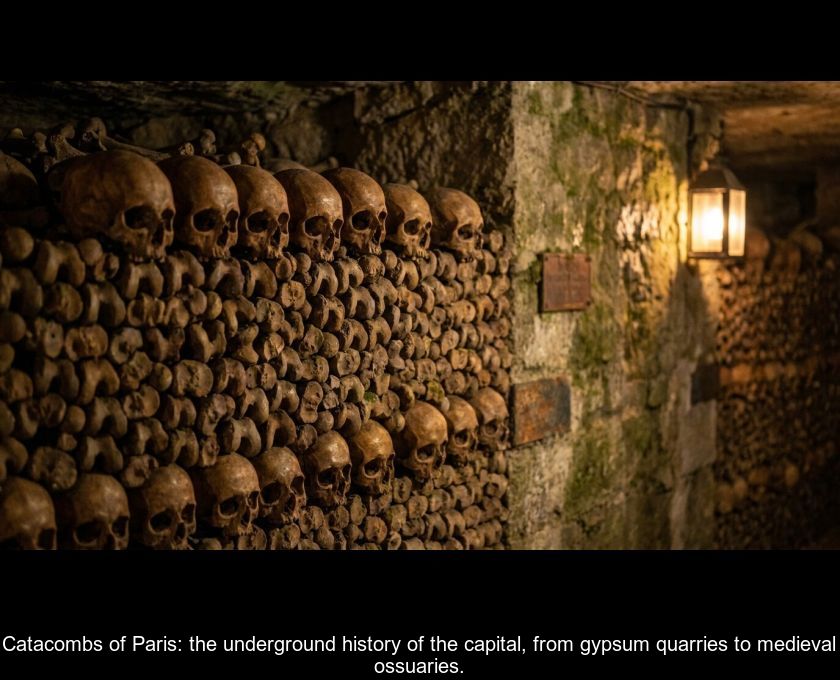
Catacombs Of Paris: The Underground History Of The Capital, From Gypsum Quarries To Medieval Ossuaries.
Beneath the sidewalks, a second Paris: quarries emptied of their stone, medieval ossuaries, forgotten cellars, and the foundations of a vanished cathedral. Here’s how to read, understand, and visit this underground that tells the city’s story better than its facades.
Paris, a city with two levels: the memory of the underground.
Paris is often spoken of as a backdrop of facades, zinc roofs, and perspectives. Yet, a significant part of its history cannot be read at eye level: it lies below, in the emptied quarries, bricked-up cellars, filled pits, and forgotten mass graves. The Parisian soil is not an inert base; it is a layered tapestry of eras.
One example suffices to illustrate this. The largest cemetery in the capital, that of the Innocents, located at the site of the current square of the same name near Les Halles, swallowed up around two million bodies between the 13th and 18th centuries. When it was closed in 1780, everything had to be evacuated: the bones were transferred in 1786 to old quarries, the very ones that would become the catacombs of Denfert-Rochereau. In other words, the famous catacombs are not a romantic whim but a practical solution to an urban hygiene problem.
And the phenomenon repeats itself everywhere. On a platform of the Châtelet metro station, on line 7, you can still see vaults higher than the tunnel: these are "cagnards," 17th-century structures built in front of a Seine port, bricked up in 1860, rediscovered around 1921 by the engineers of the metro, and preserved at the request of lovers of old Paris. The underground keeps what the surface erases.
The gypsum quarries of Butte-Chaumont, a medieval heritage.
To build Paris, they first dug into Paris. For a long time, the city sourced its materials locally or from its immediate surroundings, and the heights of the northeast of the capital have provided a precious rock for centuries: gypsum, the "plaster stone." Every building erected, every plastered partition, every ceiling corresponds somewhere to a void left in the hill.
This logic of the city using itself is not exceptional. The great arenas of Lutetia, on the slope of Mount Sainte-Geneviève, eventually served as a quarry for the inhabitants of the suburb once the spectacle fell out of fashion: people came to take cut stones, free and already at hand. The principle is the same on a larger scale for gypsum, with the difference that the extraction goes underground and leaves a network of galleries.
Another curiosity is that the opposite also exists: in Paris, some reliefs are not natural but accumulated. Behind the large greenhouses of the Jardin des Plantes, the Coypeau hill, topped by an iron kiosk built in 1786, is nothing more than an old medieval dump turned into a hill. Digging on one side, piling up on the other: Parisian topography is partly a human work, and this is what urban archaeology seeks to unravel.
La Mouzaïa, a neighborhood shaped by underground mining.
When wandering through the Mouzaïa area in the northeast of Paris, one is struck by an anomaly: flowering villas, paved alleys, low houses of one or two stories, amidst a city of tall buildings. This is not an urban planner's whim; it is a direct consequence of what lies beneath.
Where the underground is perforated by galleries of old quarries, one cannot place just anything on the surface. A heavy construction requires deep foundations, underpinning, and costly fill. Lightweight buildings, on the other hand, can adapt to fragile ground. The landscape of narrow streets and small houses with gardens is thus the visible, open-air trace of a strictly underground history.
For the walker, the lesson is useful and can be applied throughout the capital: when a neighborhood stands out, look for the cause beneath. An inexplicable slope, a steep staircase, a street that dips, a row of low houses... These are symptoms. On Rue Sainte-Foy, in the 2nd arrondissement, a simple staircase takes you up to the former walkway of the Charles V rampart, and the streets of Aboukir and Cléry, right next door, align with one embracing the embankment of the great ditch, the other the counterscarp. The ground remembers; one must learn to read it.
The mystery of the Carrières-d'Amérique and Paris plaster.
The name is intriguing: the Carrières-d'Amérique. It refers to one of those large extraction sites in the northeastern suburbs of Paris, and the imagination has taken care of the rest, associating these galleries with the export of plaster stone to the other side of the Atlantic. The expression "plaster of Paris" has long circulated as a mark of quality: a material associated with a place, much like wine is with a terroir.
What remains certain, however, is what the exploitation leaves behind. Once the gypsum is extracted, a void remains, with support pillars left more or less intact, and quarry ceilings that slowly settle. Hence the consolidation campaigns, the fillings, the monitoring wells: a mined underground is managed over centuries.
Nota Bene: gypsum, plaster, user manual. Gypsum is a soft, white to grayish rock, extracted in blocks. When heated, it loses some of its water and turns into powder: this is plaster. It is then enough to add water for the powder to rehydrate, harden, and set. This very simple cycle - heat, grind, rehydrate - has allowed generations of Parisian buildings to be coated, partitioned, and molded. And this is also why plaster, an enemy of moisture, requires well-maintained masonry.
Urban archaeology at work: the excavations of Notre-Dame
Urban archaeology has a particularity that distinguishes it from rural archaeology: it rarely works where it wants. It intervenes where the city opens up, during a construction site, a drilling, or a demolition. It is a discipline of opportunity, often conducted in urgency.
Parisian examples are eloquent. In 1869, the extension of Rue Monge uncovered the foundations of the arenas of Lutetia. In 1898, the drilling for the first metro line revealed the foundations of the "liberty" tower of the Bastille, at the height of 211 and 236 Rue Saint-Antoine: they were dismantled stone by stone and reassembled in Square Henri-Galli, where they can still be seen today. Around 1921, the metro works uncovered the vaults of the Seine in the Châtelet area. Closer to our time, a site excavated from 1990 to 1996 at the location of Parc de Bercy revealed a village established on the banks during the Neolithic, with dwellings, oak canoes, a hunter's bow, stone and flint tools, and decorated ceramics, now displayed in the orangerie of the Carnavalet Museum.
Around Notre-Dame, the method has been the same: foundations appeared in 1847, then in 1965. Beneath the forecourt and its surroundings, the ground preserved the memory of the earlier states of Île de la Cité. Additionally, just a stone's throw away, there is an exemplary case of a recovered level: the basement of the Bernardins' refectory, on Rue de Poissy, regularly flooded by floods and filled in by the monks in 1709, was cleared a few decades ago, revealing 32 strong columns on octagonal bases in a hall measuring 80 meters long by 15 wide.
The buried remains of the first Merovingian cathedral.
Before the Gothic cathedral that the whole world photographs, there was a first cathedral at this location, from the Merovingian period. Its silhouette is unknown, but its traces are known: substructures, meaning the lower parts of the masonry, foundations, and remnants of walls that remained underground after the building's disappearance.
These remains were uncovered in two phases, in 1847 and then in 1965. They do not constitute a visitable and spectacular monument, and this is precisely one of the lessons of urban archaeology: in a densely rebuilt city, we interpret footprints, alignments, and soil levels, more rarely elevations. We reason by cross-referencing, dating a wall by what rests upon it or by the artifacts found at its base.
The most telling objects from these excavations are preserved in a small museum dedicated to the cathedral, nestled in a building of the archbishopric on Rue du Cloître-Notre-Dame. Three tiny rooms, overlooked by most Parisians, while the edifice they recount is one of the most visited in the capital. It is here that one best understands Notre-Dame: not as a postcard, but as the latest, thoroughly studied state of a place of worship occupied since the early Christian centuries.
A fragment of glass, a witness to the Christianization of Paris.
In these display cases, the most moving piece is neither a capital nor a statue: it is a humble piece of glass, the bottom of a bowl. When looked at in the light, a chrisma can be seen in transparency. This small fragment is the oldest witness to the Christianization of Paris.
It is safe to say that archaeological value has nothing to do with aesthetic value. A shard of pottery, found in the right context, can sometimes tell us more than an entire monument: it proves a practice, a belief, a presence, at a time when texts are silent. This is the very principle of archaeological reasoning - the modest object as evidence.
Nota Bene: what is a chrisma? It is the monogram of Christ, formed by the intertwining of the first Greek letters of his name. It can be found engraved, painted, molded, or blown into glass, on everyday objects as well as on sarcophagi. Spotting a chrisma on a fragment of a bowl thus identifies a Christian use, in a home or during a meal, and not just in a sanctuary. The detail changes everything: the new religion is no longer a monumental hypothesis; it is in the tableware.
The vanished cellars of a medieval alley explored by archaeologists.
In front of the cathedral, until the 19th century, there was not this vast open esplanade but a dense fabric of buildings, including a narrow alley. It has disappeared, its cellars remain, and it is these that archaeologists have explored.
This scenario is very common in Paris: demolition levels the ground floor but spares the basement, which becomes a time capsule. In these cellars are piled successive floors, backfill, domestic waste, fallen or discarded objects. The recovered furniture reveals the daily life of a neighborhood that no plan truly describes.
And what a neighborhood: the tip of the island was covered with episcopal buildings, a closed ecclesiastical complex in the evening that maintained its own police force. Rue Chanoinesse preserves its memory, with its canon residences at numbers 22 and 24. At number 26, in a long courtyard, the ground is covered with long slabs where some Gothic letters can still be discerned: these are tombstones from a religious establishment in the Cité, repurposed to keep feet dry. This is the Parisian basement in all its frankness, practical before being pious.
The scoop of the Hôtel-Dieu, a trace of everyday life from the past.
Among the objects displayed in the small museum of the cathedral, a faience cup bears a touching inscription: "drunk to providence." It was likely used in the nearby Hôtel-Dieu, the historic hospital of the Île de la Cité, in the 17th century.
A simple drinking vessel, then, but one that documents an entire reality: that of an Ancien Régime hospital where both souls and bodies are cared for, and where an invitation to entrust oneself to heaven is inscribed on the patients' dishes. The word "providence" is not an ornament; it is the mental framework of the institution.
This cup also speaks to the macabre flows of the old city. The Cemetery of the Innocents covered all the Parisian parishes without a cemetery, as well as the morgue and the Hôtel-Dieu: the dead from the hospital crossed the Seine to end up in its graves, and then, a century later, in the former quarries that became catacombs. An object of care on one side, two million bodies on the other, and the same logistical chain. This is the kind of thread one pulls when interested in underground Paris: it always connects the intimate to the collective.
The Père-Lachaise ossuary, a necropolis hidden beneath the hill.
A cemetery, contrary to what one might imagine, is not a place where everything remains in place forever. Burial plots expire, land is reused, and it becomes necessary to relocate remains. That is why every large cemetery has, somewhere, an ossuary.
The process is ancient and well documented by medieval mass graves. At Les Innocents, which quickly became saturated, arcaded galleries were built, with the attics serving as ossuaries: the exhumed bones were stored there to free up space for new graves. The only remaining ossuary in the capital can be visited outdoors, in the small square next to the Saint-Séverin church, on Rue des Prêtres-Saint-Séverin: a winding corridor under pointed roofs, constructed at the end of the 15th century around the cemetery. Notable parishioners were buried under the galleries, while the attics open to drafts received the "ordinary" bodies extracted from the graves.
At Père-Lachaise, this function is housed in the bowels of the hill, discreetly, away from the tourist paths where people seek out famous graves - and where roses are regularly placed between the tombs of Héloïse and Abélard. The 19th-century garden cemetery has taken up, in a modern and invisible form, the practice of the medieval ossuaries: gathering anonymous bones in one place, underground.
The war memorial of Bartholomé, eight years of labor.
This collective space, the underground necropolis of Père-Lachaise, does not remain silent on the surface. It is marked, accompanied, protected by a war memorial that the sculptor Bartholomé took eight years to complete. Eight years: the number alone indicates that this was not a decorative commission rushed between two projects.
This long time is that of a traditional monumental sculpture: searching for composition, sketches, models, plaster casts, and then moving to stone, with its revisions and corrections. The monument becomes a door, a threshold, the symbolic entrance to the place where those whose names are no longer known rest.
Here, we measure the difference between a grave and a common monument. The grave individualizes, it names, it dates. The monument, on the other hand, must speak for a faceless crowd. This is a daunting exercise, which perhaps explains the eight years of labor: finding the form that embraces everyone without betraying anyone.
A funerary work born from mourning and simplicity.
A significant part of Parisian funerary art arises from very concrete sorrow, rather than an official program. This is what makes these works moving, and often understated: true mourning has little taste for emphasis.
Compare two registers. In the cloister of the former School of Practical Medicine, located on rue de l'École-de-Médecine, stands a statue of Death sculpted by Allouard in 1910: a large, very conventional Grim Reaper, trampling a crown, a crosier, and silver to remind us of the vanity of men. It is magnificent and theatrical. In contrast, on rue Jean-Goujon, the chapel of Notre-Dame-de-la-Consolation was built by architect Albert Désiré Guilbert in 1900 thanks to donations from Parisians and the initiative of families, following the fire of 1897 that claimed one hundred twenty-five victims, including one hundred twenty women. Behind the main altar, victims rest under cenotaphs in an atrium arranged as a Stations of the Cross, and the inscription above the portal simply advises: "Do not grieve like those who have no hope."
On one side, the allegory; on the other, a phrase and names. The most powerful monuments almost always play on this simplicity: a door, a threshold, an inscription. The rest is brought by the visitor.
Explore the invisible Paris: discretion and respect for places.
Good news: a large part of this underground Paris can be discovered without equipment, without permission, and without risk. However, one must know where to look and be willing to take their time. Strolling is almost a profession, with its tricks: looking up, stopping unexpectedly, pushing open a carriage door, not hesitating to get lost.
Here are some concrete landmarks for a first circuit, all freely accessible or nearly so:
- the Gothic ossuary of Saint-Séverin, at the back right of the small square, rue des Prêtres-Saint-Séverin
- the Sainte-Agnès crypt, at the bedside of Saint-Eustache, rue Montmartre, where exhibitions and debates allow visitors to admire capitals and columns from the 12th, 13th, and 14th centuries repurposed in a wall, discovered when a curious priest had these basements cleaned, which were then converted into a banana ripening room
- the 17th-century vaults visible from a platform at Châtelet metro station, on the line 7 side, with a walkway and panels reproducing old engravings
- the foundations of the Bastille tower reassembled in square Henri-Galli, and the counter-scarp stones left on a platform of line 5
- the reused funeral slabs at 26, rue Chanoinesse
There is only one rule of conduct, but it is imperative: discretion. The charm of these places lies precisely in their free and unmarked access. They are endangered species of the urban kind, with precarious balances. The attentive visitor is the opposite of a predator: nothing is taken, nothing is forced, one does not settle in people's homes, and one speaks softly in private courtyards. And one closes the door behind them.
A fragile underground heritage to pass on.
What is underground seems safe. This is false, and Parisian history proves it repeatedly. The arenas of Lutetia, uncovered in 1869, were filled in to install a depot for the Omnibus Company, and the construction of buildings along Rue Monge caused a good third of them to disappear forever: it took the campaign led in 1883 by Victor Hugo and Victor Duruy to save the rest, restored in 1917-1918. The remains of the Virgin Chapel of Saint-Germain-des-Prés have been degrading for over a century in the open air at Laurent-Prache Square. A too-rough renovation was enough to erase, in the courtyard of the Hôtel de Sens, the traces of a vanished chapel fresco.
Fragility thus comes as much from forgetfulness as from construction. An unidentified basement is filled in without remorse, a cellar is concreted, a quarry is filled, an inscription is washed away. What saves is the gaze: the Commission of Old Paris preserved the cagnards of Châtelet only because someone, at the right moment, pointed out their interest.
So keep it simple. Choose a neighborhood, walk slowly, note what stands out - a slope, an inexplicable staircase, houses that are too low, a slab engraved under your feet. Then tell it. Those who have been initiated become initiators in turn for their loved ones and friends, sharing their addresses like one shares a secret. This is probably the best protection that underground Paris has.