Cathar Villages And The Inquisition: Najac, Monestiés, Castelnou... How To Read Occitan Heritage.
Fortresses perched on ridges, churches built as punishment, ramparts pierced by four gates: the villages of Occitanie tell, stone by stone, the story of the crusade against Albigensianism and the centuries of conflict that followed. Here’s how to decipher them on site.
The Occitan villages, witnesses of a tumultuous medieval past.
Between Aveyron, Tarn, Garonne, and the foothills of the Pyrenees, a common story repeats itself from village to village: a defensive site chosen to lock down a valley, a religious power established very early on, followed by centuries of assaults, sieges, and reconstructions. This past is not read in books when you are on site: it is read on the facades, in the layout of the streets, and even in the style of the churches.
To visit these towns effectively, get into the habit of identifying three layers. First, the high point: castle, keep, watchtower, ramparts—this is the military layer. Next, the square and its arcades, often lined with half-timbered or stone houses from the 14th and 15th centuries—this is the commercial layer. Finally, the church, which almost always reveals who was in command, and sometimes why it was built.
For in Occitan country, a church is not always just a place of worship. In the 13th century, in Najac, it was residents suspected of having embraced the Cathar religion who financed their church, under the orders of the Inquisitors. Elsewhere, it was the Counts of Toulouse who founded new towns to hold the ground. Here, stone is political.
Nota bene: you will constantly encounter three words. A castelnau is a village that developed at the foot of a castle. A sauveté is a rural town built around a monastery and placed under religious protection. A bastide is a new town laid out in a grid pattern, built throughout the Southwest against a backdrop of influence struggles between the kingdoms of France and England.
Najac, a strategic fortress overlooking the gorges of the Aveyron.
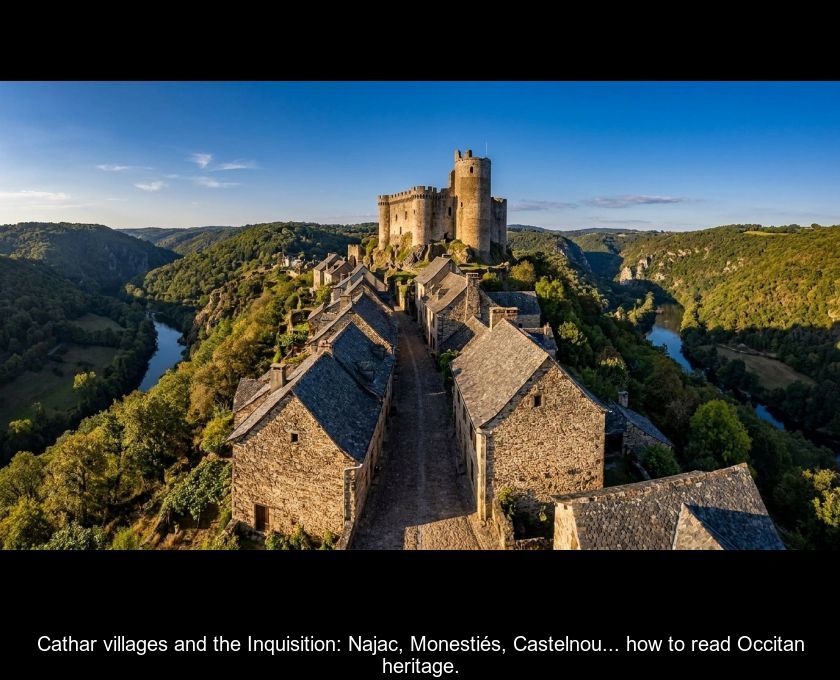
Perched atop a rocky ridge, the fortress of Najac overlooks both the village and the wild gorges of the Aveyron. We are in Aveyron, at an altitude of 340 meters, in a small town of 700 inhabitants that literally cascades down the slope beneath its roofs.
This position is not merely an aesthetic whim: Najac is the key to the valley. Whoever holds the ridge holds the passage, and this has given the site a particularly tumultuous history. Over the centuries, the stronghold has faced assaults from the English, then from the Protestants, and later from the Croquants.
In the heart of the village, stop at the long and narrow Place du Barry: this elongated shape is no coincidence, as it reflects the commercial activities of the village. The houses lining it, made of stone or timber framing, date back to the 14th and 15th centuries. Look at the overhanging floors and the half-timbering; these are the surest signs of this period.
To understand the whole at a glance, climb to the Governor's Chapel: the panorama there explains better than a long speech the logic of the site, with the river below and the ridge blocking the valley.
From the 12th-century keep to the work of Alphonse of Poitiers.
The first castle of Najac, built in the 12th century, is a structure with square towers. In the 13th century, it was replaced by an imposing fortress, the work of Alphonse of Poitiers, the last count of Toulouse and brother of King Saint Louis. In other words, royal power took control of a strategic stronghold in the Southwest and rebuilt it to its specifications.
On the ground, this layering is very evident. The square towers belong to the first construction phase, while the strength of the walls and the keep pertains to the second. The royal fortress, with its keep and the Governor's chapel, is open for visits from April to October.
To go further without being a specialist, the Governor's House is the right choice: this renovated 13th-century residence houses an interpretation center dedicated to the architecture and heritage of the bastides of Rouergue, featuring exhibitions, activities, and workshops for young audiences. It is open from April to October, and by reservation for the rest of the year.
The village completes the picture with a small museum showcasing photographs and archival postcards about life in the past, as well as guided tours of the town, including sensory visits and treasure hunts for children during the summer.
The Inquisition in Najac: residents suspected of Catharism
This is where Najac becomes a case study. In the 13th century, some inhabitants of the village were suspected of embracing the Cathar religion. The Inquisitors, those church judges tasked with rooting out deviations in faith, condemned them, and the sentence was of a very particular kind: to build the Saint-Jean church at their own expense.
Understand the mechanism; it is remarkably effective. The punishment is neither discreet nor temporary: it costs money to the condemned, occupies years of construction, and leaves a monument in the middle of the village that everyone sees every day. The penance becomes a public edifice.
When you enter Saint-Jean, keep this idea in mind: you are in a church born from a collective condemnation. This explains its size and quality; a village of this size would not have necessarily undertaken such a project on its own.
This is also what makes Najac a concrete starting point for addressing the crusade against Albigensianism and its aftermath. Rather than distant battles, we touch here on the material trace left by religious repression in an ordinary village of Rouergue.
The Church of Saint John, penance imposed by the Inquisitors.
The Church of Saint-Jean dates back to the 13th and 14th centuries. With its southern Gothic pointed art, it is one of the first Gothic churches in Rouergue: this is not a detail for scholars; it is what gives it its heritage value.
Nota bene: pointed art refers to Gothic architecture. It is recognized by the pointed arch that replaces the rounded Romanesque semicircular arch, and by the ribbed vaults that support the ceilings. In its southern version, it remains more sober, more massive, and less perforated than the Gothic of the great cathedrals in the North.
Specifically, to recognize a building from this family, practice on three points: the shape of the windows and arches, the ribbing of the vaults, and the general appearance of the walls, which are often thick and sparsely pierced in the South. Once your eye is trained, you will be able to date a good number of the churches you encounter in the region at a glance.
Saint-Jean can be visited in the village itself, below the fortress: the route from the fortress to the church to the Barry square constitutes the most logical walk, from military power to religious power, and then to commercial life.
A southern Gothic art born from religious repression.
What Najac shows on a small scale, Occitanie shows on a grand scale: the map of styles follows the map of powers. Before the Gothic period, the South is a land of Romanesque art, with masterpieces like the church of Santa Maria del Mercadal in Castelnou, a Catalan Romanesque from the 12th century, or the abbey of Saint-Guilhem-le-Désert, a jewel of early Languedoc Romanesque art and a UNESCO World Heritage site.
From the 13th century onwards, the pointed arch establishes itself, often arriving in the direct wake of religious and political affairs. The counts of Toulouse founded new towns: Raymond VII created Castelnau-de-Montmiral around 1222, and in the following century, the count of Toulouse added a bastide to the sanctuary of Villeneuve in Aveyron. Framing the territory also means building it.
Religious furnishings tell the same story. In Castelnau-de-Montmiral, the reliquary cross of the consuls, from the late 14th century, is a masterpiece of southern religious goldsmithing, originally adorned with 354 precious stones. In Villeneuve, the Church of the Holy Sepulchre preserves frescoes, and the nearby village of Toulongergues has a pre-Romanesque church from the 10th century with polychrome frescoes.
Moral for the visitor: never separate the object from its context. A vault, an altarpiece, a processional cross tells you who paid, who commissioned, and sometimes, who needed to be forgiven.
Monestiés, a village built around religious power since the 10th century.
Between Albi and Cordes-sur-Ciel, nestled in a bend of the Cérou River, Monestiés has today 1,360 inhabitants at an altitude of 210 meters, in the Ségala region of Tarn. The medieval village, once fortified, developed around the Saint-Pierre church, which served as the seat of religious and political power since the 10th century. The first written mention: 936.
Its name itself is a clue. It is believed to come from the word Monasterio, which would either suggest the monastic affiliation of the village or the proximity of a monastery. This is why the layout of the town revolves around its church rather than a castle: here, it is the Church that structures the space.
From this past, Monestiés has preserved a true labyrinth of narrow streets lined with ancient houses. Take the time to look up: half-timbered houses, doors with sculpted lintels, arcades, and corbels follow one another in a very simple, very warm harmony. The sculpted lintels, in particular, are often the oldest and most expressive elements of a façade.
Not to be missed: the 16th-century Saint-Jacques chapel houses a polychrome limestone statuary ensemble from the 15th century dedicated to the passion of Christ. The Saint-Pierre church, dating from the 11th to the 16th centuries, retains a monumental altarpiece from the 17th century and a painting from the 18th century. An old private mansion from the 15th century hosts the Bajèn-Vega painting museum, dedicated to a couple of Spanish artists who came to exile in Tarn. The village can also be visited with a guided tour, by reservation, from April to October.
Castelnou, a Catalan rural architecture forged by conflicts.
Change of scenery: heading to the Pyrénées-Orientales, at the foot of Canigou. Castelnou, with 295 inhabitants and an altitude of 245 meters, is a typical medieval village of Catalan rural architecture, nestled at the foot of the Aspres and surrounded by two limestone plateaus, the Thuir plateau and the Roc de Majorque, which rises to 443 meters.
Founded in the 10th century, this village was the capital of the viscounty of Vallespir for over three centuries before seeming to fall asleep. It spectacularly retains its medieval appearance: ramparts punctuated by eight towers, four gates positioned at the four cardinal points, a watchtower, and a 10th-century viscount's castle.
Remember this detail about the four gates oriented towards the cardinal points; it is the signature of a village designed as a device: controlling entrances, monitoring ridges, organizing traffic. The buildings follow the same logic, all made of stone and arranged in steps on a steep site. And the contrast is delightful; this apparent ruggedness leads to flowery and intimate alleys, animated by numerous artisans.
For visits, the castle and its garden can be explored through guided tours from May to September, with an audio guide available in French, English, and Catalan, a Braille booklet, and easy-to-read notebooks. The 12th-century church of Santa Maria del Mercadal complements the discovery with its Catalan Romanesque style. The village can also be visited with a guided tour by appointment.
Auvillar and the fortified stages on the Camino de Santiago
Pilgrimages have shaped Occitan heritage as much as wars. Auvillar, in Tarn-et-Garonne, with 950 inhabitants at an altitude of 115 meters, is a beautiful example: labeled as a Stopover Town on one of the Camino de Santiago routes, this former stronghold of the kings of Navarre overlooks the Garonne valley in a subtle blend of bricks and stones.
Its jewel is the circular grain hall, which fits into a triangular square lined with arcades and rich buildings, some dating back to the 15th century. The imposing clock tower marks the entrance to the historic heart. The Church of Saint-Pierre, a former Benedictine priory from the 12th to the 14th centuries that has been fully restored, features rich furnishings and a baroque altarpiece. From the castle square, the view opens up to the river and the hills of Quercy.
For a long time a center of river trade, Auvillar shipped earthenware and goose quills for writing from its port: the Sainte-Catherine chapel, with its murals, and the old boat ramp bear witness to this, and the Old Auvillar Museum preserves over 600 pieces of earthenware from the 18th and 19th centuries as well as the history of navigation on the Garonne.
Elsewhere along these routes, the same logic repeats itself. Saint-Guilhem-le-Désert, at the end of its gorge, was a major site of Christianity in the Middle Ages where faithful, crusaders, and pilgrims came to venerate a piece of the True Cross, around an abbey founded in the 9th century. In Villeneuve, Aveyron, the high gate and Savignac tower recall the ancient fortifications, while the Church of the Holy Sepulchre and its frescoes signal the village's place on the path. Stage, market, protection: the trio is almost always the same.
The Occitan heritage today, a living memory of medieval villages.
What stands out when exploring these villages is that they are not empty backdrops. In Najac, there is still a market on Sunday mornings, a night market on Wednesdays in July and August, local products like Najacois stuffed pork roast and chocolates, as well as canoeing and paddleboarding on the Aveyron. In Monestiés, the producers' night market takes place on summer Thursdays.
The same vitality can be found elsewhere: a farmers' market on Sunday mornings and an organic market on Wednesday afternoons in Auvillar, featuring a calligrapher, art galleries, and a soap factory; a Tuesday market in Castelnou from mid-June to mid-September, complemented by Les Créateurs en Fête on the first Sundays and Le Dimanche des Peintres on the third Sundays from June to September. The Medieval Festival in Castelnou takes place on the last weekend of July.
To organize your discovery, here are three simple tips. Check the seasons: many sites, such as the fortress of Najac or its interpretation center, open from April to October, and the castle of Castelnou from May to September. Book guided village tours, often available by reservation or appointment. And consider suitable options; sensory tours, treasure hunts for children, braille booklets, and easy-to-read documents are available in some villages.
Finally, take advantage of the proximity, as these towns can be visited in clusters. Cordes-sur-Ciel is 25 kilometers from Najac and 15 kilometers from Monestiés, while Castelnau-de-Montmiral is about thirty kilometers from Monestiés and 22 kilometers from Bruniquel. By visiting two or three villages in one day, you will see the common thread emerge: defensive sites, market squares, churches that bear the memory of the Inquisition and the crusade against Albigensianism. Choose a village, start at the high point, end at the church, and Occitan medieval history will cease to be an abstraction.