How Trees Survive Winter: The Great Secret Of Winter Dormancy.
Losing a million leaves to better survive the winter: behind this seemingly absurd gesture lies a surprisingly precise survival strategy. Here, step by step, is what trees really do when the cold arrives.
How do trees prepare to face winter?
At the end of summer, the forest changes its atmosphere. The vibrant green of the treetops dulls, shifting towards pale yellow, and the trees give the impression of having worked hard for months. It's not just an impression: the preparation for winter has already begun.
Their strategy is very similar to that of the brown bear. During the summer and early autumn, the bear eats to build up a layer of fat. The tree, on the other hand, captures as much sunlight as possible to produce sugars and nutrients that it stores beneath its bark and in its roots. It doesn't gain weight in the sense we understand (only its wood thickens); it simply fills its tissues with reserves.
Except that at some point, the tree is satiated. The wild cherries, rowans, and alders show this as early as August: they begin to redden even though there are still weeks of good weather to take advantage of. Their reservoirs are full; they couldn't possibly store another gram of sugar. This is their way of announcing the annual closure of the store.
Other species, whose reservoirs are larger, continue photosynthesis until the first major cold spells. But as early as July, most begin a discreet and decisive movement: they gradually reduce their water content. Why? Because the tree can only function if the water is liquid. If it freezes, everything stops, and wood that is too moist can literally burst, like a pipe frozen in the cold.
The respiration of trees: the vital role of leaves and needles
We often forget that trees breathe. Not only do they "produce oxygen," but they also consume it, just like us. Part of their lungs is visible: these are the leaves and needles.
On their underside are tiny slit-like openings, somewhat like small mouths. It is through these orifices that, during the day, oxygen is expelled and carbon dioxide is absorbed. At night, the movement reverses: photosynthesis stops, sugar is burned in the cells, and CO2 is released in quantity.
This dual movement explains a figure that often surprises. In summer, trees release about 10,000 kilograms of oxygen per square kilometer each day, which meets the needs of 10,000 people (we each consume about a kilogram per day). But only during the day. At night, there is only consumption.
There is no need to fear asphyxiation during a nighttime walk: air currents constantly mix the gases in the atmospheric layer closest to the ground, so the drop in oxygen levels remains very moderate.
Without leaves, how does the tree continue to breathe?
Here is the question that should jump out at us every autumn. If leaves are the respiratory organs, how does a completely bare beech or oak survive four or five months of cold?
The answer lies beneath our feet. The journey from leaves to trunk and then to roots is long, and the roots are also capable of breathing. If this were not the case, winter would simply be fatal for deciduous trees, deprived of aerial respiratory organs as soon as the leaves fall.
Because the tree does not stop. It lives in slow motion, but it lives: it even continues to develop at the root level. To do this, it must produce energy from the reserves accumulated during the warm season, and this production requires oxygen. Winter dormancy is therefore not a temporary death; it is a functioning at minimal levels.
Nota Bene: In winter, the situation in the soil is delicate. Trees are at rest and do not renew their oxygen reserves, even during the day, while underground life continues with such vigor that the soil does not freeze beyond five centimeters, even in polar cold. What saves us are the large air movements that bring oceanic air to the continents: marine algae release oxygen all year round, regardless of the season, and fill the deficit.
Why do roots need oxygen even in winter?
Let's get back on track. A tree in winter rest slowly burns its sugar reserves to maintain its tissues and advance its roots. This process occurs in the cells and releases CO2, just like in us after a meal. It therefore needs oxygen, and this oxygen, in winter, primarily comes from the soil.
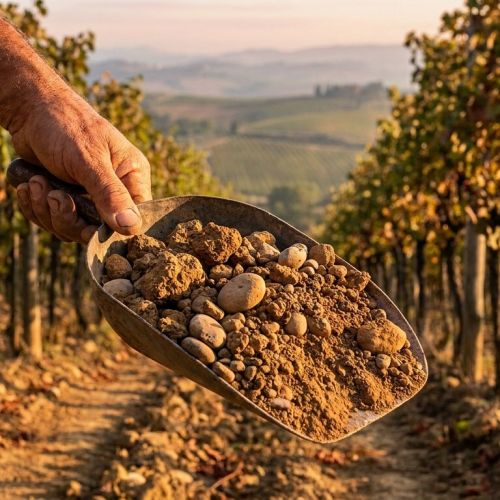
However, forest soil is not a compact mass. Good soil is flexible and aerated up to several meters deep, traversed by a multitude of small channels through which air circulates. It is the underground lung of the tree, which explains how a tree can survive winter without a single leaf.
Some species have even perfected the system. The alder, champion of swampy soils, has aeration channels that run through its roots and transport oxygen to the finest tips, somewhat like a diver connected to the surface. Additionally, the base of its trunk has cork cells that allow air to enter. This is why it grows where beeches, spruces, pines, hornbeams, and birches rot.
Compacted soil: an invisible danger for root respiration
From all of the above, a very concrete and often overlooked consequence arises. If the soil around the trunk is compacted to the point that the small air channels are blocked, the tree suffocates from the bottom. Even partial asphyxiation of the roots endangers its health.
This danger is all the more insidious because it is not visible. Nothing changes in the appearance of the soil, no wounds are visible on the bark, and yet the tree loses its ability to produce energy during the time it needs it most.
The phenomenon can be observed on a large scale in forests where logging machinery has compacted the earth. The roots can no longer develop properly, anchorage becomes very insufficient, and the first strong winter wind does the rest. One then believes it to be a meteorological accident, while the problem was already underground.
So remember this simple principle: the winter health of a tree depends as much on what happens beneath its feet as on what happens to its branches. Loose, breathable soil, with its layer of decomposing dead leaves, is better than any care given to the foliage.
Does the age of the tree influence its resistance to cold?
Yes, in several ways. The first occurs even before birth. Seeds respond to environmental conditions while they mature in the flower, just after fertilization. If it is particularly hot and dry, the corresponding genes are activated: it has been proven that these conditions make pine seedlings more resistant to heat. But be careful, the seedlings simultaneously lose an equivalent resistance to cold. Nothing comes for free.
Next, size plays a role. Very young shrubs, due to their small size, offer little resistance to the wind, and snow is almost never a problem for them. Adolescents, on the other hand, with their gangly shape and small crown, are the most vulnerable: under wet, sticky snow, they break off cleanly or lie down without ever managing to fully right themselves.
I have a telling episode in mind: three days of drizzle at slightly negative temperatures. Freezing rain settled on the frozen branches and visibly weighed them down. Among the adult trees, the most affected were the conifers, Douglas firs and spruces, which lost up to two-thirds of their branches in a continuous crash. It will take decades for them to regain a balanced shape.
And what about the young birches that bent to the ground? When the ice melted, 95% of the trunks straightened up, and a few years later, they showed hardly any scars. Only those that remained lying down died. The flexibility of youth resisted better than the mass of adults.
The defense mechanisms against cold and lack of water.
The main danger of winter is not the cold itself: it is thirst. When the ground is frozen, no water replenishment is possible. A tree that continues to transpire would dry out and risk dying of thirst in the middle of winter, surrounded by snow.
Conifers have solved the problem without shedding their needles, and their arsenal deserves to be detailed. Their needles contain an antifreeze substance that protects them from the cold. Their surface is covered with a thick layer of wax that blocks evaporation. Their covering is tough and solid. Finally, the small openings through which respiration occurs are deeply embedded in the epidermis, further limiting losses. The result: they keep their green attire and restart photosynthesis as soon as temperatures rise, without losing a day in spring.
Deciduous trees, on the other hand, have thin and tender leaves, practically defenseless. It’s no surprise that they shed them at the first frost. But they have other tools. In the face of prolonged drought, an adult tree significantly reduces its water consumption and stops pumping the soil indiscriminately from the beginning of summer. It thickens the thin waxy layer on the upper side of its leaves and overlays several layers of outer cells. It breathes less well, it's true, but all the hatches are closed.
The last line of defense, collective in nature: in a natural forest, trees of the same species have extremely different genetic backgrounds. Some tolerate drought better than cold, others are well-equipped against insects, and still others do not mind having their roots in water. When conditions become harsher, it is the least equipped individuals that suffer, but the majority of the forest remains intact.
The fall of leaves: a strategic and risky decision
Making up to a million leaves a year only to use them for a few months seems absurd. Yet, it makes perfect sense, and for a reason one might not suspect: storm resistance.
Starting in October, strong winds arrive. At speeds of 100 kilometers per hour, they can uproot large trees, and in some years, gusts hit every week. The waterlogged soil offers little anchorage, while the pressure exerted by a storm on a tree can reach 200 tons. By shedding 1,200 square meters of leaf surface, a deciduous tree gains considerable aerodynamics, like a sailboat lowering a 30-meter by 40-meter mainsail. Snow has only bare branches to settle on: more falls to the ground than remains on the tree.
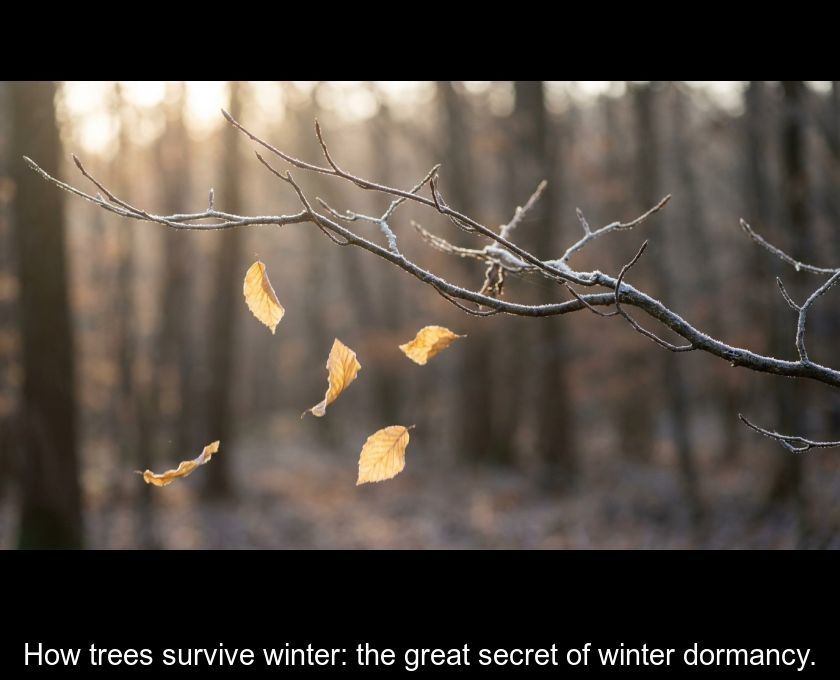
But beware, leaf drop is an active process, and this is where the risk arises. The tree must first transport nutrient reserves from the leaves back to the trunk and roots, decompose chlorophyll to reuse its elements in spring (this pumping of the green pigment reveals the yellows and browns already present in the leaf). Only then does it create a separation layer that closes off communication with the twig. A slight gust of wind is enough to detach the leaf. And it's a good opportunity to expel any unnecessary accumulated substances.
Only after this entire process can the tree rest. However, this rest is not a luxury: sleep deprivation has the same effect on trees as it does on us; it can be fatal. Just one year without a break, and they won't come back in spring. This is exactly what happens to baby beeches and baby oaks brought home from a walk and potted on a windowsill: in a living room at 21 °C lit in the evening, winter goes unnoticed, the young tree continues to grow, seems full of vitality... then suddenly withers.
Is climate change disrupting the autumn schedule?
Trees do not sense the arrival of winter and do not know whether it will be mild or harsh. They register two signals: the drop in temperatures and the shortening of days. If the temperatures do indeed drop, that is. However, it is no longer rare for autumn to display late summer values.
I observe three old oaks planted side by side, just a few centimeters apart, along a road. Soil, water, microclimate: everything is identical. And yet the one on the right changes color one to two weeks before the other two. The timing of leaf fall is therefore also a matter of individual character.
The dilemma is real. Take advantage of the mildness to store a few extra calories, at the risk of being caught off guard by a sudden frost and being unable to produce the separation layer? Or play it safe, shed the leaves early, and sleep peacefully? The cautious one lies down, while the two daredevils fill their tanks to the brim.
So far, recklessness has paid off. But with autumn temperatures remaining high for longer, foliage sometimes stays on the branches until the first week of November, while the storm season always begins in October. The risk of a gust toppling a tree still dressed increases. In the long run, the cautious ones probably have better chances.
Another disruption, this time in spring: buds open all the earlier if winter has been harsh. The milder the cold season, the later the leafing out. As if, without real frosts, winter rest is not restorative and the tree does not wake up properly. Finally, when high temperatures in autumn follow a warm year, some trees completely lose track of time and bud in September. The young shoots have not had time to mature, meaning they have not lignified to withstand the cold, and the frost destroys them. The buds intended for the following spring are lost, and the restart is hindered.
Young trees in the shade: a unique winter strategy.
For a young tree growing under the canopy of its parents, autumn does not resemble the usual scenario at all. When the mother tree loses its leaves, light suddenly floods down to the ground. The little ones were just waiting for this: they rush to seize this suddenly available energy.
As a result, the first frosts almost always catch them in full activity. If nighttime temperatures drop well below zero, say around -5 °C, they succumb to fatigue and enter winter rest immediately. The formation of the separation layer becomes impossible, and leaf fall is excluded: they will spend the winter dressed.
Which, in their case, does not matter at all. Their small size offers little resistance to the wind, and snow often spares them. The risks faced by large trees do not concern them.
In spring, they pull the same trick by opening their buds two weeks before their larger neighbors. How do they know when to start? They rely on the warming at ground level, which signals the arrival of spring about two weeks earlier than at 30 meters high, where the winds and the biting cold of starry nights delay the beautiful season. The canopy of old trees creates a shelter that mitigates late frosts, and the layer of decomposing dead leaves, like a compost heap, raises the temperature by a few degrees.
Add the days gained in autumn to those gained in spring: that amounts to a month of growth in full light, or about 20% of the growing season. For a tree condemned to wait decades in the shade, this is not a detail; it is a growth engine.
What to remember, and what you can observe starting this winter.
The winter of trees is not an empty parenthesis; it is an organized sequence: filling reserves to saturation, gradually reducing water content starting in July, relocating chlorophyll and nutrients into the trunk and roots, creating a separation layer, shedding leaves, and then an essential rest. Each step conditions the next, and the final rest is non-negotiable.
Two strategies coexist: that of deciduous trees, which sacrifice their foliage to gain aerodynamics and rid themselves of fragile organs, and that of conifers, which retain their needles thanks to an antifreeze substance, a thick layer of wax, a tough envelope, and recessed breathing pores. Two responses to the same problem: not dying of thirst when the ground is frozen.
Two concrete actions if you have trees nearby. Do not compact the soil around their trunk: the air channels in the soil are their substitute lungs throughout the winter. And if a child brings home a young forest plant, forget about the heated and well-lit living room windowsill: without winter and without night, it will not survive.
Finally, treat yourself to a walk in the forest this autumn and observe. Compare two neighboring trees of the same species: the cautious one that turns yellow early, and the daring one that keeps its leaves. Look at the oak that packs everything away and only releases its leaves when they are uniformly brown, the shades of brown and yellow of the beeches, the bright red of the wild cherries, and conversely, the alders, ashes, and elderberries that drop still green foliage because they can afford to. Each tree tells, in its own way, how it plans to spend the winter.