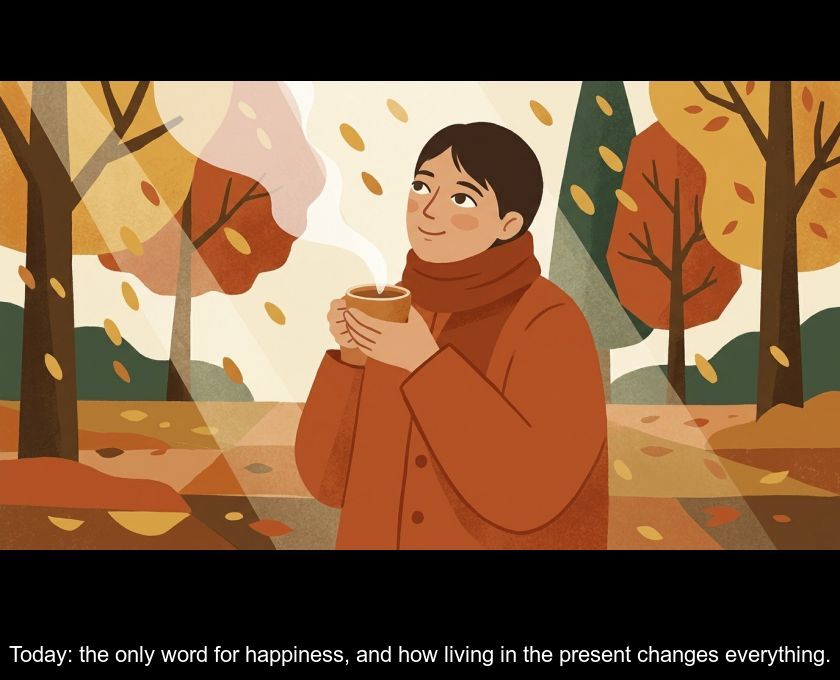
Today: The Only Word For Happiness, And How Living In The Present Changes Everything.
Happiness is not played out yesterday or tomorrow, but in the twenty-four hours that begin. Here, very concretely, is how to inhabit your days instead of just going through them.
Today, the only word that sums up happiness.
If we had to keep just one word to talk about happiness, it would be this one: today. Not "one day," not "when I finish," not "when things get better." Today, the day you are living while reading these lines.
Because happiness is not a massive block that you obtain once and for all. It is rather a stacking of small bits gathered here and there, seemingly eclectic: a well-drawn sky, a conversation, a fit of laughter, the smell of bread. It is the repetition of these pieces, day after day, that ultimately gives the feeling of a happy life.
From time to time, the impression arises within us that all these moments have meaning and coherence. It never lasts long (thankfully, otherwise it would be a bit solemn and boring), and then we return to dispersion, that is to say, to life. But that flash is motivating: it reminds us that the quality of existence is determined in the details of ordinary days.
Live the misfortunes of today without projecting them onto tomorrow.
First principle, and it is decisive: when we are unhappy, we have every interest in only experiencing today's misfortunes. The worry that occupies you is already heavy enough as it is. There's no need to add, on top of that, the imagination of what it could become tomorrow, how it could last, amplify, or worsen.
In practice, it starts with a simple gesture: acceptance. Accepting is not rejoicing in what hurts, it is not saying "it's good," it is simply saying "it is there." And then immediately following up with the only useful question: "what can I do?" - knowing that in this "what can I do" there are several possibilities: change the situation, or change my reaction, act right away, or wait.
For the small annoyances of daily life (the phone ringing when you are focused, the device breaking down at the worst moment, the interlocutor being bad faith), the sequence consists of three steps: breathe, smile, tell yourself internally "okay, it's fine, I understand, it's not going to happen the way I wanted." The real problem is almost never the annoyance itself, it is our irritation. So we first take care of calming ourselves down, then of what we can actually do.
And we avoid wasting our time looking for a culprit, either within ourselves or in others. An old Greek sage, Epictetus, summarized it this way: blaming others for one's misfortunes is that of an ignorant person, blaming only oneself is that of a man who begins to educate himself, blaming neither oneself nor others is that of an educated man. The time spent on anger and its rumination is time lost for happiness.
Fully savor today's joys.
The second principle is symmetrical: when things are going reasonably well, we must not forget to fully experience the joys of today. We often believe that savoring comes naturally, that the brain knows how to do it on its own, that it’s enough to place it in front of something pleasant. This is mostly false: our days are filled with things to do, think about, and monitor, and pleasure passes by without us truly experiencing it.
Savoring is a skill that can be learned, and it relies on three very concrete efforts. One: stop doing what you are currently doing and become present in the moment. Two: become aware of what is there. Three: take the time to breathe and feel it in your body, even if it lasts only a few seconds.
Examples? In front of a beautiful sky or a bird's song, really stop, look, breathe, smile, and then continue on - instead of mentally noting "that's nice" while continuing to walk at the same pace. When seeing loved ones arrive on a train platform, become aware that you love them and that you are lucky to be reunited like this once again.
Or, even more modestly: upon waking, feel your hands moving, your legs shifting, your body breathing, and your heart beating. Smile at all of this for a handful of seconds, instead of jumping out of bed like a hurried creature.
Pamper each day with love and respect.
From these two principles comes a simple rule: nurture each of your days with love and respect. Not by waiting for it to be exceptional, but by treating it as something that matters. Twenty-four hours cannot be replaced.
In practical terms, this can take the form of small daily rituals, always the same: a few minutes of meditation or mindful breathing in the morning, a walk in the woods or a park whenever possible, and in the evening, as you fall asleep, recalling three good moments from the day. This exercise of "three good things" is probably the most rewarding of all: it costs nothing and retrains your perspective.
Another lesser-known resolution deserves to be tried: stop doing anything while sighing. First, by refusing what makes you sigh when possible (heavy invitations, chores taken on more often than your fair share). Then, when something is unavoidable, engage in it with a light heart rather than begrudgingly.
Because even doing the dishes, even taking out the trash, is not nothing: it is life. We are here, we breathe, we hear, we see. That’s already not so bad, and the dead would surely love to experience what makes us sigh.
The wisdom of Goethe: the present alone is our happiness.
Goethe expressed it in a phrase that is still quoted two centuries later: the present alone is our happiness. It is not a pretty decorative sentence; it is an almost geographical observation. The past is a bottomless abyss that engulfs everything that passes, the future another abyss, impenetrable that one, and our lives are built between the two, on this thin bridge that is the moment.
In other words: the present is the continuous flow of the future into the past. It is fragile, it is dizzying, and the first time you think about it seriously, it can be a bit frightening. After this moment of fear, what to do? Breathe. Smile. Accept that it is this way. And then look at everything else: life is here, with its people, its light, its fruits and vegetables, its street noise.
That is why the present is not a luxury for the contemplative. It is the only ground on which you can act, love, enjoy something. Yesterday is no longer available, tomorrow does not yet exist. Today, yes.
Less thinking, more savoring the moment.
Our brain loves to comment. It comments while we eat, while we walk, while we listen to someone. And this chatter disconnects us from the experience itself. A very telling example is that of a meal.
Eating quickly prevents saliva and chewing from doing their job, and eating while reading, looking at a screen, or talking on the phone produces two unfortunate effects: we do not savor the food, and above all, we no longer perceive the signals of satiety - so we eat too much. Try the opposite once: a sandwich, nothing else, no newspaper, no phone. You will clearly hear your stomach say "stop, that's enough," while your mind continues to serve ready-made arguments ("finish it, you'll be hungry later," "you're not going to throw it away, are you?").
This is not a dietary detail; it's a general model. Our thoughts are often ready-made thinking, and the body knows better where we stand. Experiencing the lived experience rather than discoursing about it is the inversion to be made.
Hence the importance of silence as well. Being silent for a moment after beautiful music, instead of applauding out of habit, or after a beautiful landscape, instead of commenting on it. Silence has the taste of respectful attention given to the world, and it allows happiness the time to pass through us.
Between animal feeling and human consciousness of happiness
A fun question, and not so naive: are animals simply content, or fully happy? Do they remain at an animal perception of their well-being – a full belly, safety, the presence of other benevolent creatures – or do they, like us, shift into a reflective consciousness that makes one feel deeply happy? It's impossible to decide. But the question sheds light on our own functioning.
For happiness is primarily an emotion, and as such it concerns the body before the mind. This foundation is something we share with living beings: warmth, satiety, rest, the presence of loved ones. Our consciousness comes afterward, and it can do two opposing things. It can greatly enrich this feeling by savoring it, prolonging it, transforming it into a sense of fullness. Or it can completely destroy it by commenting on it, comparing it, worrying about its duration.
Nota Bene: this is also why happiness is learned like a physical exercise. If we want more breath, strength, or flexibility, we know that we must train, and not just wish for it. Strangely, for our emotions, we become unrealistic and hope that mere decision will suffice. It is not enough: we must regularly practice exercises that strengthen our ability to host and amplify pleasant feelings.
Set the threshold for happiness very low in daily life.
Here is undoubtedly the most useful advice in this entire article: set the threshold very low. Many people wait for significant events to allow themselves to feel happy, and since these events are rare, they spend most of their lives waiting.
What does a "happiness fishing" day look like on a very ordinary day? It looks like this: having observed a small bird in the garden, receiving a thank-you letter, thinking that a fragile loved one is doing rather well at the moment, watching the clouds pass in the sky several times, and not receiving any bad news. That's it. It seems meager when written down, yet if you count these things, your ordinary days become happy days.
No need to win the lottery, buy new shoes, or escape death. Ordinary life gives us plenty of opportunities to rejoice, as long as we count them as such.
The same mechanism applies to admiration: if one only admires the exceptional and the spectacular, one admires three times a year. If one sharpens their gaze to also spot what is discreet and invisible to the hurried passerby - a kind gesture, the mundane courage of someone, a late afternoon light - then one multiplies the opportunities to be happy. Lowering the threshold increases the frequency.
The effort of attention, key to happy ordinary days.
The only real effort to be made is an effort of attention: to divert it, at least for a moment, from our worries, and to direct it, at least for a moment, towards everything else in life. It’s not a pretty picture. It is the most solid conclusion from research on well-being. Daniel Kahneman, a distinguished psychologist awarded a Nobel Prize (in economics, curiously), sums it up this way: attention is the key to everything.
When volunteers are asked several times a day, for weeks, about what they are doing and how they feel, two results emerge, and they are troubling. First: the more our mind wanders, the less happy we are. Mental distraction is fatal to happiness, even when it wanders towards pleasant things.
Secondly, and this is even more interesting: what best predicts positive emotions is not the nature of the activity, but the degree of attention with which we engage in it. Truly focusing on one’s work makes us happier than engaging in a leisure activity while thinking about something else. In other words, a day at the office experienced attentively can be happier than a weekend spent mentally elsewhere.
Practical conclusion: learning to stabilize one’s attention is one of the most reliable pathways to well-being. Meditation exercises serve exactly this purpose, but any training to do one thing at a time—eating, walking, listening—goes in the same direction.
Return to the present to escape rumination.
The great adversary of the present has a name: rumination. It is this incessant replaying of past pains and future fears, two virtual and perfectly trapping territories. Ruminating on the past after an ordeal is like scratching a wound: it prevents it from healing.
Nota Bene: freeing oneself from the past does not mean forgetting or erasing it, but no longer allowing it to exert its hold on us. The nuance is important; it avoids the guilt of "not being able to move on."
And we are not aiming for absolute control, like "not allowing any rumination to pass." We aim for persistent control: every time I notice that I am ruminating, I return to the present, to action, to observing reality. Ten times, a hundred times if necessary. What matters is not never drifting away, but returning.
A very effective mental workout involves focusing on relief, that small pleasure associated with stopping the unpleasant. After an annoyance, we deliberately maintain our attention on the present, observe the temptation to start complaining about what just happened, smile at it, and return. We hold on for a moment, like in a yoga pose. Then, only after savoring, do we allow the mind to return to the problem to see how to avoid it in the future. This can be practiced on situations of increasing difficulty:
- you almost missed your train, but you caught it just in time
- you wasted a lot of time in traffic, and now you are finally home
- you struggled for hours with that flat-pack furniture, and now it's assembled
- you broke your wrist, it hurt a lot, and now you're in a cast and relieved
- you weren't speaking to a loved one, and now you’re starting to communicate again, even if nothing is resolved fundamentally
The microscopic joys that repair existence.
Our mind has remarkable self-repairing abilities, just like our body, which often work without our awareness. Most people facing severe trials emerge from them without lasting scars. However, these abilities need fuel, and that fuel is the joys of the present.
All joys, even microscopic, fleeting, incomplete, and imperfect, heal the wounds of existence. Living means acting, connecting with others, looking at the sky, eating, having fun: the more we turn towards life and the less we look back at ourselves, the more we allow these repair capacities to quietly do their work.
Hence a very practical consequence to remember: the more you train yourself to savor during calm times, the easier it will be to do so during a storm or just after, when it’s time to assess the damage and the work ahead. You don’t train during the storm; you train beforehand.
And it’s not just about encountering the small joys of the world, but about opening up to them and letting them in. An unexpected smile encountered on a highway rest area, a patch of blue sky among the clouds, a silly joke from a child: often, it takes very little to get back on your feet, as long as you are willing to accept being back on your feet.
Expose yourself every day to the sun of present happiness.
There is one last instruction, and it may be the most liberating: in difficult moments, do not seek to feel happy. It is an impossible demand to fulfill, and repeating it to yourself ("after all, I have everything to be happy") only makes things worse. Just expose yourself to the sunshine of happiness, while waiting for it to gradually warm you up and restore your good spirits.
To expose yourself means to take action: go out for a walk, see people you love, look at the sky, listen to music, take care of others, without expecting immediate results. It also means smiling, even at dawn, when the worry of living peeks its head out. We now know that the loop works both ways: when the mind is joyful, it commands the face to smile, but when the face smiles, it makes the mind a little happier. Turn towards the sun; the shadows will always be behind you.
Let’s recap what can be done in a day: live only the misfortunes of the day without adding those of tomorrow, savor by stopping for three seconds to look, breathe, and feel, set the threshold for what matters very low, do one thing at a time, return to the present whenever you catch yourself ruminating, and in the evening, recall three good moments before falling asleep.
None of this will make you a consistently radiant virtuoso. But these efforts always bear fruit, and they create humans who are significantly happier than if they had let life take care of their happiness on its own. Start today; it is the only day available.