Savory Advent Calendar: How To Recognize A Good Sausage?
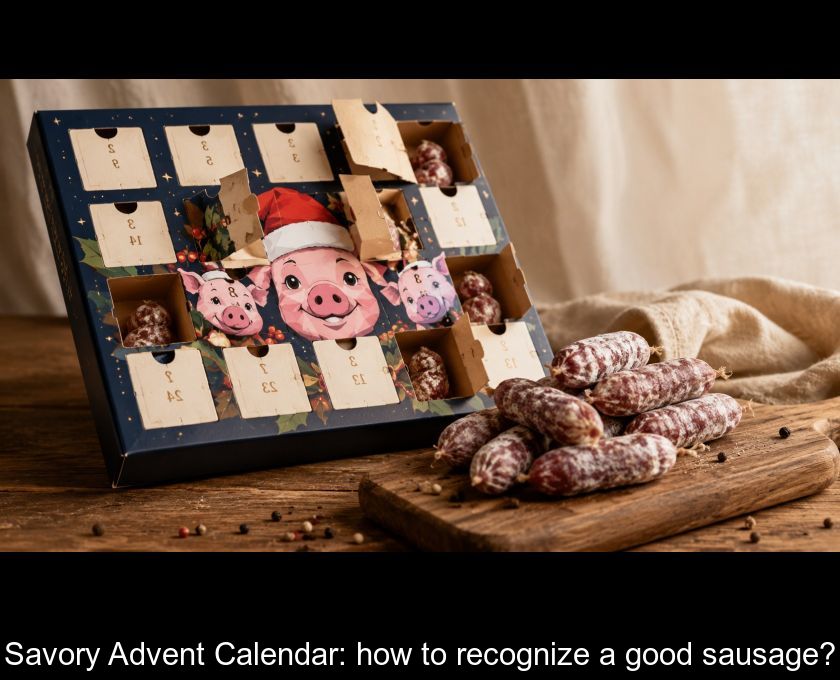
Long reserved for children and their little chocolates, the Advent calendar has changed hands. Today, more than one in two French people plan to buy one, and the compartments are filled with all sorts of things: cosmetics, beers, aged cheeses, and... mini-sausages. But behind a pretty box, the quality can vary greatly. Here’s how to recognize a good dry sausage before gifting it.
Why the Advent calendar has become an adult affair
The figure is surprising: in 2017, only 27% of the French reported buying an Advent calendar. Eight years later, 54% are considering this purchase.
In other words, the practice has doubled in less than a decade.
And it’s not the children driving this trend. Among 25-34 year olds, the proportion rises to 73%. It even reaches 75% among parents of minor children.
The podium of preferred formats clearly reflects this shift: chocolate remains in first place, followed by cosmetics... and salami. Yes, salami.
The Salami Advent Calendar has indeed established itself in just a few years as the most sought-after savory alternative for December, to the point of appearing in news broadcasts every year-end.
It should be noted: chocolate still dominates in volume, with nearly 13 million calendars sold in supermarkets for a turnover of 100 million euros, at an average price of 7.80 euros. The savory option, on the other hand, plays in a completely different price segment, ranging from 25 to 60 euros depending on the generosity of the box.
The savory, a response to the reign of the aperitif.
Why does this shift towards savory work so well? Because it aligns with a ritual that remains strong: the aperitif.
Giving a gourmet calendar to an adult means offering twenty-four little excuses to open a bottle and share something. The discovery format does the rest, with flavors that one wouldn't necessarily buy individually (wild garlic, fig and gingerbread, porcini mushrooms...).
It's worth noting that salami has a serious advantage. It preserves well, is easy to transport, and can be sliced without any special equipment. In short, it's made for the box.
A little historical reminder: the Advent calendar as we know it, made of cardboard with windows, was born in Germany at the very beginning of the 20th century. Chocolate only made its way in much later. The box has never been sweet by nature!
What is really in a dry sausage?
A dry sausage is fundamentally three things: lean meat, fat, and time.
The mixture, that is to say the blend of minced meat, combines lean pieces and fat. And it is precisely on the fat that a good part of the quality depends.
In the most demanding specifications, only hard fats are allowed, those coming from the back of the pig (the back fat) and the belly. The so-called "soft" fats, which are softer and significantly less noble, are strictly prohibited.
The fineness of the grinding is equally important. To qualify for the "superior" label, the grains must measure at least 6 mm, and 8 mm when the product claims a coarse grind.
So take a look at the slice. Well-defined, white, and firm grains of fat are a good sign. A uniform and slightly pinkish paste is much less so.
Drying, the stage where everything happens.
Once embossed in its casing, the sausage goes through a steaming phase at a temperature above 22 °C and in very high humidity. This is where the ferments work and the dough takes on its characteristic red color.
Next comes the drying process, which is much slower. In natural drying, the room temperature must not exceed 20 °C.
How long? It all depends on the size. For a superior dry sausage weighing between 200 to 249 g, count at least 18 days. For a piece weighing 250 to 349 g, it goes up to 24 days.
These durations may seem anecdotal. They are not at all: each additional day of drying costs space, time, and weight for the manufacturer, as the product loses water while drying. This is exactly what you pay for in a good sausage.
And what about that white powder covering the casing? It's the bloom, a noble mold that protects the product during aging and contributes to its flavor. Depending on the production methods, it can also lean towards green or ash gray, without any issue.
Caution: a uniform and powdery bloom is an excellent sign, but black, wet, or foul-smelling spots have no place there.
Natural casing or reconstituted casing?
Here is the detail that is rarely looked at, yet it says a lot.
The natural casing comes from the digestive tract of pigs or sheep. It is irregular, it works during drying, and it gives the sausage that silhouette that is never quite straight.
On the other hand, there are glued, sewn, or reconstituted casings, whose diameter has been artificially made regular. Cheaper, faster to produce, but also much less expressive.
Fun detail: the rosette simply owes its name to the casing used to make it.
Looking for a simple reference? Protected geographical indications require natural casing. This is the case for the Saucisson de l'Ardèche, as well as the dry sausage from Auvergne, recognized at the European level since 2016.
"Artisanal": what the word guarantees, and what it does not guarantee.
Let's tackle the point that deserves the most attention.
The artisan quality is a strictly regulated title. To claim it, one must practice a trade listed on an official list, provide proof of a diploma or three years of experience, be registered in the National Business Register, and employ fewer than 11 employees.
On the other hand, the adjective "artisanal" printed on packaging is not a certified label. There are no specifications, no controlling body, no official logo.
This does not mean it is misleading, far from it. Simply put, it is not sufficient on its own.
The truly useful indicators are elsewhere:
- the origin of the meat, clearly stated
- the name of the manufacturer, not just that of the distributor
- a short and readable list of ingredients
- the mention "superior"
- natural casing
It is on this ground that the boxes are differentiated. An Artisanal Sausage Advent Calendar designed with an identified butcher, awarded in competitions, and working with French pork obviously does not contain the same products as an anonymous box filled at the end of the production line.
How to store it and enjoy it?
Contrary to a persistent misconception, dry sausage does not need to be refrigerated. It primarily requires a cool, dry place away from light, ideally below 18 °C.
When served too cold, it loses a good portion of its aromas. So remember to take it out a few minutes before slicing.
In terms of cutting, a thin slice releases significantly more flavors than a thick chunk. As for the natural casing, it can be eaten without concern, although many prefer to remove it.
To go further, our 5 tips for making a charcuterie and cheese board will help you create a balanced appetizer around these mini formats.
Note Well
Mêlée: the mixture of lean meat and chopped fat that forms the base of the sausage, before being stuffed into the casing.
Bardière: the firm and high-quality back fat of the pig, in contrast to the soft fats known as "de mouille."
Étuvage: a short phase at high temperature and humidity, just after stuffing, during which the ferments develop.
Fleur: noble and edible mold that whitens the surface of the casing during aging. It protects the product from drying out.
Supérieur: a regulated designation that requires hard fats and a minimum grinding size.
IGP: Protected Geographical Indication. An official European sign that links a product to a geographical area and a controlled specification.