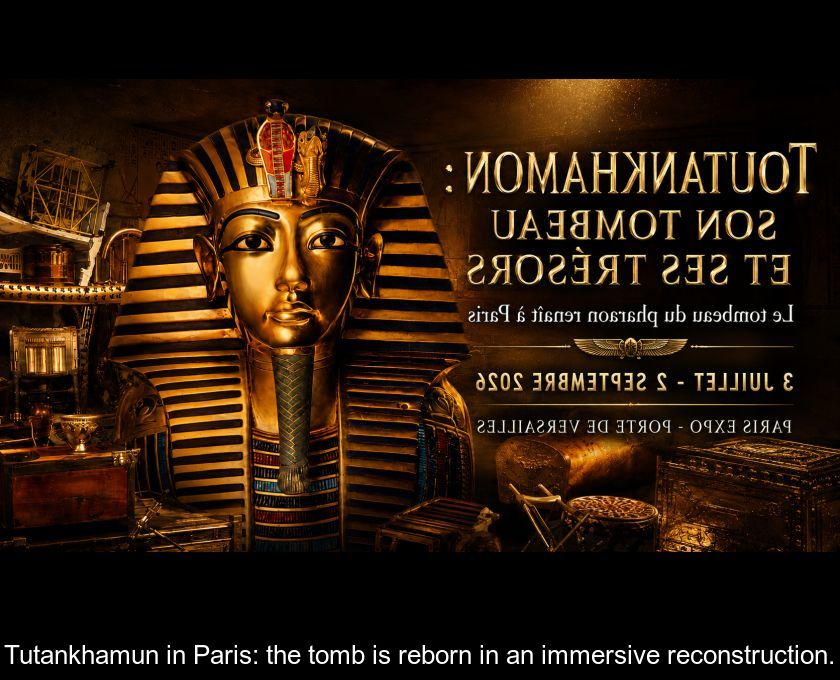
Tutankhamun In Paris: The Tomb Is Reborn In An Immersive Reconstruction.
More than a hundred years after the discovery that revolutionized archaeology, Paris is hosting a spectacular reconstruction of the pharaoh's tomb, enhanced by immersive experiences that extend the visit beyond the exhibited objects.
The tomb takes shape.
The tomb of the pharaoh is reborn in Paris.
On a vast area of over 2,500 m², the exhibition offers a reconstruction of the tomb as it was discovered in 1922. The various burial chambers are presented in their original volumes and sequence, with the original density, allowing us to imagine the profusion of objects and the effect produced when the sealed door was opened.
It is an invitation to momentarily place oneself in the position of a visitor from that time, in front of statues, furniture, and shimmering gold objects (yes, the solid gold mask is referenced in the scenography).
A coherent set
Gathered in their context, around 1,000 objects form a coherent set that is true to archaeological reality.
We find sculptures, royal furniture, ceremonial chariots, chests, weapons, statuettes, and pieces of goldsmithing: all elements that, together, reflect the wealth and complexity of Egyptian civilization.
The journey allows us to understand how these pieces were arranged to accompany the young pharaoh on his journey to the afterlife; the arrangement, density, and succession of spaces are significant, and this is precisely what the reconstruction seeks to make clear.
The adventure of discovery (a short story)
The uncovering of the tomb, as recounted in the exhibition, brings us back to the moment when, through a small opening made in a sealed door, wonders unfolded before wide-eyed spectators.
The journey retraces the path of Howard Carter and the steps that led to one of the most resounding archaeological discoveries of the 20th century. There is something almost theatrical about this ascent from the past (you either believe it or let yourself be carried away), and the staging plays with this tension between the initial surprise and the patient examination of the objects.
A controlled scientific approach
The exhibited works are reproductions made from archives, sketches, notes, and period photographs, as well as from the study of pieces preserved in the Cairo Museum.
These reproductions have been crafted by specialized artisans, under scientific supervision, to accurately reproduce every detail.
This technical approach allows for a faithful representation of the architecture, decor, and significance of the tomb, where the originals no longer leave their territory for conservation reasons.
Devices that extend the visit
The Paris edition is enriched with unprecedented devices designed to enhance understanding: a virtual reality experience and a 360° immersive room.
Virtual reality equips the visitor with a headset to traverse a "time portal," discover the daily life of the pharaoh, follow him into the afterlife, and witness the discovery of the tomb.
The immersive room, on the other hand, plunges into the realms of Egyptian mythology, where life emerges from primordial chaos, and the 360° projection gives visual materiality to concepts that would otherwise remain abstract. These devices complement the journey; they do not erase the objects, they illuminate them.
Show and pedagogy
The exhibition aims to be both spectacular and well-documented, accessible to all audiences. The approach is twofold: to showcase the majesty and abundance of funerary furniture while providing scientific keys for understanding.
The result is an experience where the emotion of discovery intersects with documentary rigor; visitors leave with strong images in their minds, as well as insights into funerary architecture and the symbolic significance of the exhibited objects.
Practice (what we know)
Dates and location are announced: the exhibition will take place from July 3 to September 2, 2026, at Paris Expo - Porte de Versailles.
Ticket sales will open soon.
Why go there?
Because this reconstruction allows us to see, together and in their arrangement, hundreds of objects rarely presented together, because the scenography and immersive devices offer multiple levels of engagement during the visit, and because, let's face it, the story being told—the opening of a sealed tomb and the profusion of treasures—continues to fascinate.
If you love history, staged archaeology, or simply exhibitions that blend knowledge and spectacle, this is an event to mark in your summer calendar.
Note Well
Some useful definitions.
Reconstruction: a deliberately constructed restitution of a place or a set of objects in order to make a historical or archaeological context comprehensible.
Virtual reality: a device that immerses a user, through a headset, in an immersive visual and auditory simulation, giving them the impression of being in another place or time.
360° immersive room: a space equipped with enveloping projections that surround the visitor to create a comprehensive visual and auditory experience.
In short
An exhibition that brings together faithful reconstruction, scientific approach, and immersive devices: this is the stated ambition. It will feature the density of the reconstructed tomb, the richness of about 1,000 objects presented in their context, and contemporary means (virtual reality, 360° projection) to enhance understanding. Ticket sales will open soon, the dates and location are known. If summer in Paris means major exhibitions for you, this one is among the proposed events.