Effective Negotiation: Non-verbal Signals Of Openness And Honesty That Make You Credible.
You have prepared your arguments down to the last word... but your interlocutor is mainly focused on your hands, your face, and the way you shake hands. Here’s how to make your body an ally in a negotiation.
Negotiation and body language: why the non-verbal carries more weight than words.
In a negotiation, body language carries more weight than words because over 55% of a message is conveyed through gestures, posture, and expressions, compared to only 7% through the words themselves. The remaining approximately 38% depends on the tone of voice.
In other words, you can refine every argument, but your interlocutor will form a much clearer idea of your intentions by observing your body. Body language is considered a more reliable indicator of actual attitudes than words or intonation. Non-verbal cues are said to have about four times more impact than words during a conversation.
Another telling statistic: we retain about 10% of information given only orally, 20% of information given only visually... and 80% when both are combined. An argument supported by an appropriate gesture therefore has a much higher chance of sticking in the mind of the person across from you.
Nota Bene: what we call body language (or non-verbal communication) encompasses all signals sent by posture, gestures, facial expressions, and movements, whether voluntary or not. Specialists refer to kinesics for gestures and facial expressions, and proxemics for the way we use space and distance with others.
Openness, honesty, trust: what your actions must demonstrate.
During a negotiation, the opening signals to show are those that demonstrate three qualities: openness, honesty, and trust. When your gestures support these qualities, the other party becomes more willing to cooperate and seek an agreement.
Specifically, openness is first read in your limbs. Do not cross your arms or legs: these positions are perceived as barriers, as if you have already made your decision (and one does not negotiate with someone who seems to have made up their mind). Also, keep a bit of space between your hands instead of clasping them together.
For honesty, show your palms. Palms facing upward signal sincerity and commitment, putting the interlocutor at ease. This is a very ancient reflex: without visible palms, one instinctively remains on guard.
A few simple adjustments complete the picture:
- lean slightly forward to show your interest, without exaggerating (if you lean too much, you appear needy)
- avoid leaning back, which suggests boredom
- remove objects that create a barrier between you, even a simple coffee cup
- orient your head, torso, and feet towards the person speaking to you
Say what you think, think what you say.
To appear honest and credible in negotiation, the safest approach is consistency: truly saying what you think and thinking what you say. Your interlocutor will often unconsciously look for whether your gestures confirm your words.
Even the slightest discrepancy is noticeable. A simple blink can be enough to reverse the meaning of a sentence; that's the essence of irony. Conversely, a person who claims to be very comfortable in the exchange but looks away at every question gives exactly the opposite impression and risks coming across as someone who is lying.
Pretending doesn't get you far. A feigned mood almost always ends up showing through, as the body tends to restore the truth. It is therefore better to ensure that your gestures reflect your true intentions rather than putting on a façade.
How can you practice this? By speaking in front of a mirror, quite simply. This exercise allows you to observe in real-time whether your body supports your speech or tells a different story. The goal is to gradually harmonize the two so that the impression left corresponds to what you really want to say.
Smile, nod, chin up: your expressions under the microscope.
In effective negotiation, smiling and nodding are part of the positive signals to use at every opportunity, as your expressions will be closely scrutinized. Add to that a chin held high and a direct gaze towards the other person.
What to avoid primarily: frowning or wrinkling your forehead, especially in a worried manner. These expressions, often involuntary, can be enough to tense the atmosphere (everyone has heard a "but why are you looking at me like that?" in the middle of a discussion...).
The nodding deserves clarification: it does not mean that you agree with everything. It simply indicates that you are listening. Therefore, you can use it without fearing that you are giving ground.
As for the smile, its sincerity is visible in the eyes. A genuine smile crinkles the skin and creates small "crow's feet" at the corners of the eyes; only the mouth can lie. A useful technique is the pre-reactive smile:
- first, look at the other person's face as if to study it, for a maximum of one second
- then smile while continuing to look them in the eyes
Your smile then seems to arise from the encounter, rather than from a fixed smile given to everyone.
Eye contact: looking at the other person in the eyes with kindness.
In negotiation, looking the other person in the eye conveys openness, sincerity, and trust, provided it is done with kindness and without staring. Avoiding eye contact gives an impression of evasion, even dishonesty, which significantly complicates the discussion.
However, the opposite excess also poses a problem. An overly intense gaze can seem threatening, aggressive, or intimidating, and many people who want to appear sincere fixate on their interlocutor to the point that they end up raising suspicions. The right balance:
- maintain eye contact about 70 to 80% of the time
- on average, eye contact lasts between seven and ten seconds, and tends to be longer when listening than when speaking
- looking away while thinking is completely natural
A tip if direct eye contact makes you uncomfortable: look at the face rather than just the eyes, shifting every couple of seconds from the eyes to the nose, then to the lips. You remain attentive without appearing aggressive.
One last detail that changes everything: when the other person has finished speaking, don’t abruptly break eye contact. Let it detach slowly, as if held by a thread. Slow movements of the eyes and head convey a sense of calm authority.
Hands clasped, fingers fidgeting, legs crossed: the gestures of stress.
Hand and leg gestures that betray stress are well identified: constantly touching your fingers, clasping or squeezing your hands, crossing and uncrossing your legs. They signal a state of tension rather than reflection, which weakens your position.
The face is a sensitive area. Rubbing your face or head comes across as nervousness, and keeping your hand in front of your mouth or eyes gives the impression that you are trying to hide or even lie. The general rule: keep your hands away from your face.
Other gestures send similar signals:
- hands in pockets or behind the back, suggesting that you are hiding something
- rubbing your legs back and forth, a self-soothing gesture that displays discomfort
- fidgeting with a pen, your phone, your hair, or your sleeves
- feet that swing or tap incessantly
What to do instead? Sit with your legs slightly apart, feet firmly on the ground and facing your interlocutor. If your hands fidget despite yourself, place them on your thighs or on the table; it's a neutral position. And if you catch yourself in a nervous gesture, stop, take a deep breath, and then continue.
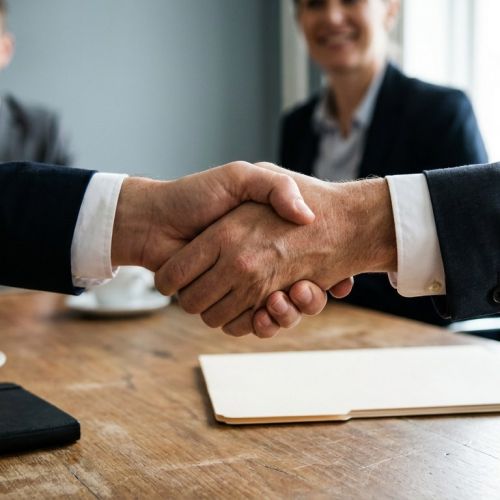
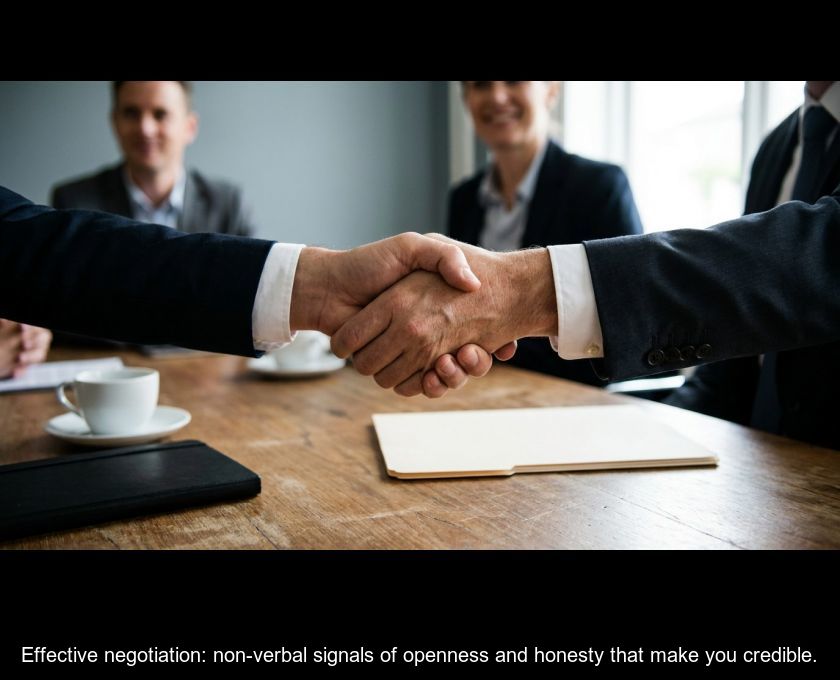
Firm, steady, and measured handshake
A good handshake in negotiation is firm, steady, and strong, but it should not linger, especially with people you know little or who are particular about their personal space. It matters a lot, as it strongly marks the first impression.
The two extremes should be avoided. A limp, sweaty hand or one that barely touches the other gives an image of weakness and lack of confidence. A grip that crushes fingers seems unnecessarily aggressive, even like a display of strength.
Good reflexes:
- Vertical hand: this is a sign of equality. A hand turned down seeks to dominate, while a hand turned up indicates submission.
- Adjusted pressure: if the other person grips less firmly, reduce yours a bit; if they grip more firmly, increase yours slightly to avoid appearing weak.
- Initiative: extending your hand first shows confidence. In front of a more conservative person or someone in a much higher position, wait for their gesture instead, out of respect.
- Two-handed shake: it says "you can trust me," but it seems too familiar during a first meeting.
As for personal space, there is no official distance. The principle is simple: respect the distance set by the other person; it should not be "tested," especially with a stranger.
Punctuality: what a delay says about you
Yes, being late harms a negotiation because it damages the first impression even before you have spoken a word. It is perceived as rude, sometimes even insulting, and ultimately suggests a lack of competence and integrity.
The first impression indeed forms very quickly: the brain takes about 150 milliseconds to determine if it likes a person. In an experiment, participants who had only seen 20 seconds of a job interview judged the candidates' friendliness and confidence almost as well as recruiters who had met them for 20 minutes. Arriving late, therefore, means starting with a difficult-to-overcome disadvantage.
Being late also works against you internally. An upset person is less inclined to seek common ground, and you, on your side, arrive out of breath and nervous. However, a negotiation requires calmness, focus, and self-assurance.
Finally, think about your entrance into the room: shoulders back, strides wide and firm, body oriented toward the person you are meeting. Arriving a little early gives you time to catch your breath before that moment.
Move your hands while speaking: not too much, not too little.
Moving your hands while speaking adds dynamism and strength to your words, as long as you don't exaggerate to the point of distracting attention. Speaking completely still makes the exchange boring, while excessive gesturing muddles it.
Too many gestures mean constantly flailing arms, bitten nails, fingers playing with shirt cuffs or sweater sleeves. The message received: a lack of professionalism and confidence. Pointing at someone is also to be avoided; it's an accusatory gesture that is poorly received.
Not enough gestures is the opposite extreme. By trying too hard to control yourself, you can end up stiff as a board, and the other person may feel that you are deliberately hiding your emotions.
Finding the right balance takes practice:
- keep your arms open in front of you
- make small, calculated movements at waist height
- reserve a specific gesture for important points: the information will be better remembered if anchored by a gesture
- in video conferences, ensure that the camera also frames your hands
Calm and confident face under pressure: the hallmark of emotional intelligence.
In a stressful professional situation, a calm and confident facial expression reassures your interlocutor about your skills and demonstrates your emotional intelligence. It is precisely in these tense moments that you are observed the most.
Some recruiters intentionally place candidates under pressure to see if they can control their reactions, and posture is one of the first things they look at. The same logic applies in negotiations.
Here are a few concrete techniques to maintain control:
- Breathe: take about ten deep breaths from your abdomen before the meeting. During the exchange, inhale when a question is asked, then respond while exhaling.
- Slow down: listen until the end, pause to show that you are thinking, then respond slowly and calmly. This demonstrates both respect and confidence.
- Dare to be silent: a brief pause can create doubt in the other person and sometimes lead them to reconsider their position.
- Adopt the poker player's body language: when you say something important, ignore the itch on your nose or the urge to move your feet.
Quick test: if you have difficulty breathing deeply, it is often because your lower abdomen is contracted due to stress. Relaxing this area helps regain your composure.
Dealing with the right people: reading the signals from the other party.
To read the non-verbal signals of the other party, it is important to keep in mind that negotiation works both ways: you control your own body language, but you also observe that of your interlocutors, even before choosing whom to engage with. This ability to spot someone's state of mind at a given moment is called calibration.
Some useful signals to look out for:
- Crossed arms or legs while you are speaking: the person is resisting your ideas, even if they claim otherwise.
- Mirroring effect: if the other person mimics your postures (crossing their legs when you do, tilting their head like you), it's a good sign; there is rapport.
- Tight jaw, raised shoulders, furrowed brows: discomfort or stress.
- Raised eyebrows without any reason for surprise, concern, or fear: something else is happening behind the words.
- Excessive head shaking: anxious search for approval.
- Smile without wrinkles at the corners of the eyes: they may be hiding something.
To improve, a simple exercise: fixate on a point on the wall for a few moments, gradually widen your field of vision, then listen to all the surrounding sounds. Repeated over several days, it sharpens your perception of others.
A final warning: no isolated gesture proves a lie, and it is estimated that people only detect a lie about 49 to 53% of the time. First, observe how the person behaves when everything is going well, then look for changes, asking yourself instead, "what is bothering them?".
A partly unconscious body language: can we really control it?
One cannot fully control their body language in negotiation, as much of it operates at an unconscious level. However, one can train to better identify bad reflexes and correct them.
This limitation has two sides. On one hand, a spontaneous gesture remains more credible than a learned and forced gesture, and trying to lock everything down makes one stiff and unnatural. On the other hand, the body also influences the mind: adopting a posture of confidence, or simply smiling, eventually makes you feel more confident. It’s a virtuous circle.
Be mindful of intention as well. Learning body language to manipulate others is a dead end that does not lead to success. It primarily serves to help you communicate better and to understand the other person better.
To take action before your next negotiation:
- arrive on time, and even a little early
- keep arms and legs uncrossed, palms visible
- genuinely smile and nod to show that you are listening
- look at the other person 70 to 80% of the time, without staring
- shake hands firmly, with a vertical hand, without crushing or lingering
- talk with your hands, at belly height, without gesticulating
- breathe, slow down, dare to be silent
And practice regularly in front of a mirror. Over time, these gestures will become your own, and that’s when they will be most convincing.