
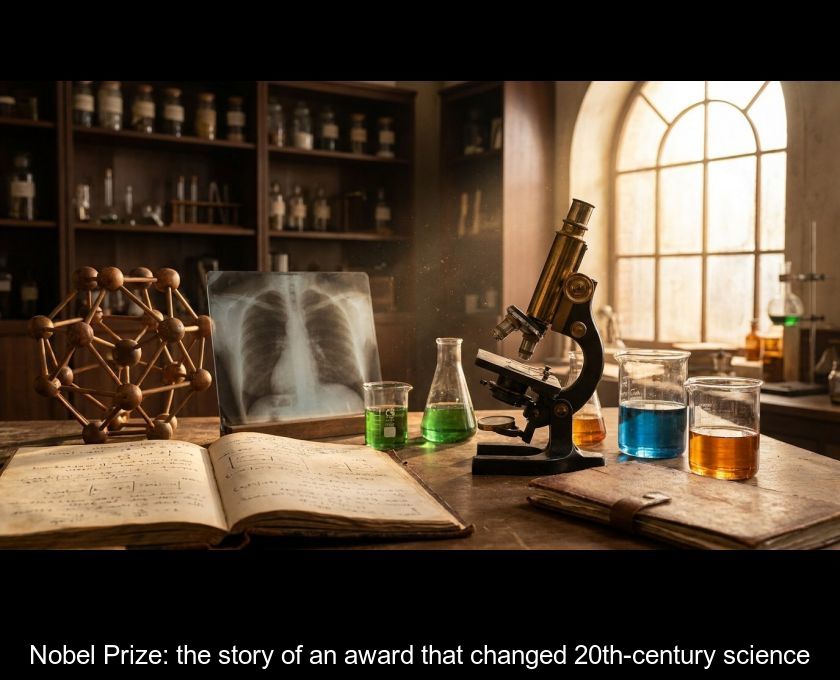
Nobel Prize: The Story Of An Award That Changed 20th-century Science
From dynamite to quantum physics, through DNA and molecular structure, here’s how a Swedish industrialist ended up rewarding an entire century of discoveries.
Alfred Nobel, the inventor behind a global award.
Before being a prize, Nobel is first and foremost a man. Alfred Nobel, born in 1833 and died in 1896, was a Swedish chemist and industrialist who spent his life working on explosives. He is credited with inventing dynamite, patented in 1867, and then an even more powerful version, extra Nobel dynamite, patented in 1875 (a mixture of 93% nitroglycerin and 7% collodion, essentially rubber or plastic dynamite).
It is no coincidence that his name remains associated both with a formidable explosive and with an award that celebrates peace and human progress. Nobel also owned the arms company Bofors, which gives his story an almost paradoxical aspect: the man who armed conflicts ultimately financed the highest scientific and peaceful awards in the world.
His name has even crossed into science itself, as a chemical element now bears the name nobelium in his honor. This serves as a reminder that his contribution is not limited to a prize but directly enriches the scientific field he traversed so extensively.
A colossal fortune at the service of scientific progress.
In his will, Alfred Nobel requests the creation of an institution tasked with rewarding individuals who have rendered great services to humanity each year. To this end, he bequeaths his entire fortune, amounting to 32 million Swedish crowns of the time, to the Nobel Foundation.
The mandate of this foundation is clear: to distribute each year the income generated by this sum in the form of prizes. One important detail is explicitly stated in the will: the nationality of the awarded scholars must never be taken into account in the allocation of the prizes. This idea of scientific universalism was quite ahead of its time.
However, it took several years of indecision and the personal intervention of Nobel's acquaintances before the project could truly materialize. But the essential point remains: a private fortune transformed into a driver of global progress, year after year, for over a century.
The five founding fields desired by Alfred Nobel
Nobel's will does not merely provide for a general reward; it specifies five distinct fields in which prizes are to be awarded each year: physics, chemistry, medicine, literature, and the promotion of peace in the world (what is now referred to as diplomacy or humanitarian action).
This choice reflects quite well Nobel's own personality: a man of hard sciences (physics and chemistry), but also sensitive to medicine, literature, and clearly concerned about the consequences of his own inventions on world peace. This is not an insignificant detail when one considers how much his explosives could be used for military purposes.
It is worth noting that a sixth prize was added much later, in 1968, that of the Bank of Sweden in economic sciences in memory of Alfred Nobel. Unlike the other five, it was not stipulated in the will, but it is awarded under the same conditions by the Royal Swedish Academy of Sciences.
The Nobel Prize in Physics: a tribute to a science dear to Nobel
Awarded annually by the Royal Swedish Academy of Sciences, the Nobel Prize in Physics owes much of its prestige to Alfred Nobel's personal investment in this discipline. It is therefore not just another prize; it is almost a direct tribute to what fascinated him throughout his life.
The list of laureates since 1901 reads like a summary of the history of physical sciences: from the discovery of X-rays to the theory of relativity, including quantum mechanics, radioactivity, and superconductivity. Each year (with exceptions, as the prize has not been awarded in certain years, particularly during the two World Wars), one or more researchers add to this long list.
What makes this prize particularly special is that it often rewards work done decades earlier, as it takes time for their implications to be fully understood and validated by the scientific community. This delay speaks volumes about the sometimes excessive caution of the Swedish jury.
Pioneers of modern physics: Röntgen, Curie, Einstein, and Bohr
The very first winner of the Nobel Prize in Physics, in 1901, was the German Wilhelm Röntgen, awarded for his discovery of X-rays. This breakthrough would revolutionize medicine as much as physics, allowing for the first time to see inside the human body without opening it.
In 1903, it was the turn of Pierre and Marie Curie, along with Henri Becquerel, to receive the award for their work on radioactivity. Marie Curie, who would later receive a second Nobel Prize in Chemistry in 1911, remains one of the most emblematic figures of this scientific adventure to this day.
Next came 1921, the year Albert Einstein was honored, closely followed by the Danish Niels Bohr in 1922. These two names alone summarize the revolution that transformed physics at the beginning of the 20th century: relativity on one side, the structure of the atom and the beginnings of quantum mechanics on the other. Two radically different yet fundamentally important ways of rethinking our relationship with the universe.
The golden age of physics from the 20th century to the 1970s.
Between the two world wars and into the 1970s, physics experienced an extraordinarily rich period of major discoveries. Enrico Fermi was awarded in 1938 for his work that would pave the way for the nuclear reactor. Otto Stern, Wolfgang Pauli, and Isidor Isaac Rabi then contributed to this fruitful period, each adding their piece to the understanding of matter and its particles.
The 1950s and 1960s saw the emergence of new technologies that were almost immediately recognized: John Bardeen, Walter Brattain, and William Shockley received the prize in 1956 for the invention of the transistor, a fundamental building block of modern electronics. A little later, in 1965, Richard Feynman, Julian Schwinger, and Shin'Ichiro Tomonaga were honored for their advances in quantum electrodynamics.
In 1972, John Bardeen (who thus won a second Nobel, a rare achievement), Leon Cooper, and John Schrieffer were awarded for their theory of superconductivity. This accumulation of discoveries over just a few decades illustrates how concentrated this period was in scientific intensity, difficult to match since.
The Nobel Prize in Chemistry: rewarding major molecular breakthroughs
Like the Nobel Prize in Physics, the Nobel Prize in Chemistry is awarded by the Royal Swedish Academy of Sciences. Its purpose is somewhat different: it aims to honor advancements in chemical research, but also their concrete practical applications, making it a prize that is decidedly focused on utility as much as on pure discovery.
In 1901, the Dutchman Jacobus Van't Hoff kicked off the proceedings. This was followed by work on topics as varied as the structure of molecules, industrial chemical reactions, and organic chemistry applied to biology. The chemistry prize is particularly interesting because it often overlaps with other disciplines, especially physics and biology, as the boundaries between these sciences have blurred throughout the 20th century.
Some years remain without laureates due to a lack of discoveries deemed significant enough by the jury (for example, 1916-1917, 1919, 1924, 1933). This serves as a reminder that this prize does not merely reward a career; it primarily seeks to distinguish a specific and meaningful advancement.
Prominent figures in chemistry: Fischer, Joliot-Curie, and Pauling
Emil Fischer, a German chemist, received the prize in 1902 for his work on sugars and proteins, laying the foundations of modern organic chemistry. His research paved the way for a whole generation of scientists who would subsequently dissect the chemical mechanisms of life.
In 1935, it was the turn of Frédéric and Irène Joliot-Curie (the daughter of Pierre and Marie Curie) to be awarded for their work on artificial radioactivity. This discovery directly extends the family legacy and confirms, if it were necessary, the incredible scientific posterity of the Curie lineage.
Finally, the American Linus Pauling received the Nobel Prize in Chemistry in 1954 for his work on the nature of the chemical bond. What makes his journey particularly remarkable is that he also received the Nobel Peace Prize a few years later in 1962 for his campaign against nuclear weapons testing. A double Nobel that wonderfully illustrates how science and humanistic commitment can converge in the same individual.
The Nobel Prize in Medicine and the Rise of Biological Sciences
The Nobel Prize in Physiology or Medicine has accompanied the spectacular rise of biological sciences throughout the 20th century. It rewards both fundamental discoveries about the functioning of the human body and cutting-edge advances in molecular genetics.
Among the pivotal moments, we can highlight the work on the structure of DNA, which paved the way for all modern genetics, as well as research on genetic engineering and recombinant DNA, which allowed for the direct manipulation of hereditary material as early as the 1970s. Closer to our time, laureates like Elizabeth Blackburn and Carol Greider have been recognized for their work on cellular mechanisms related to aging.
This prize illustrates how biology, long a more descriptive than experimental discipline, transformed into a cutting-edge science over the course of the 20th century, as tools for observing and manipulating living organisms improved.
The Nobel Prize in Literature, an extension of Nobel's humanist ideal.
Just like the scientific prizes, the Nobel Prize in Literature fulfills the same initial ambition of Alfred Nobel: to reward benefactors of humanity, but this time through the pen rather than the test tube or microscope. The very first laureate, in 1901, was the Frenchman Sully Prudhomme.
The list of subsequent awardees spans all languages and continents: from the Indian Rabindranath Tagore in 1913 to the American Ernest Hemingway in 1954, including diverse figures such as Albert Camus in 1957 and Gabriel Garcia Márquez in 1982. Some laureates, like Boris Pasternak in 1958 or Jean-Paul Sartre in 1964, even refused the distinction, each for their own reasons.
This prize serves as a reminder that, for Nobel, the progress of humanity was not solely dependent on science: literature, as a vehicle for ideas and sensitivity, deserved to be celebrated each year alongside great scientific discoveries.
The lasting legacy of the Nobel Prize in the history of science.
More than a century after its creation, the Nobel Prize remains an essential reference for measuring the advancement of human knowledge. From quantum physics to molecular genetics, and organic chemistry in between, it has accompanied, year after year, the great scientific revolutions of the 20th century.
What stands out when browsing through the list of laureates is the continuity: isolated discoveries, sometimes spaced decades apart, eventually form a coherent picture of scientific progress. Each prize fills a piece of the puzzle, whether it involves understanding the atom, decoding DNA, or synthesizing new molecules useful for industry or medicine.
Ultimately, the history of the Nobel Prize is also that of a man who, by bequeathing his fortune to science, provided the world with a lasting instrument to identify and celebrate what truly advances human knowledge. A lesson still relevant today on how a single testamentary decision can, over time, transform global scientific recognition.