Chemicals And Cancer: Which Toxins Really Increase The Risk?
Asbestos, benzo[a]pyrene, ionizing radiation... not all toxins are equal when it comes to cancer. Here’s what we really know about the links between chemical exposure and tumors.
385,000 cancers per year in France: a figure that drives the need to understand why.
Every year in France, around 385,000 new cancer cases are recorded, including 211,000 in men and 174,000 in women. A huge figure that is dizzying, but it hides a more nuanced reality than one might think.
Among all the chemicals we are exposed to on a daily basis, only a minority are truly capable of triggering cancer in humans. The others may be irritating, toxic to other organs, allergenic... but not carcinogenic in the strict sense.
The causes of cancers are multiple: some stem from our lifestyle habits (tobacco, alcohol, diet), while others come from our environment, whether professional, domestic, or related to general pollution. Understanding which ones really matter allows us to act where it counts.
What is a carcinogenic agent? The classifications to know.
A carcinogenic agent (or carcinogen) is a substance that has been established, with varying degrees of certainty, to promote the onset of cancers. To clarify this, the European Union has implemented a classification into three categories.
Category 1A includes substances that are known, with solid evidence in humans, to be carcinogenic. Category 1B pertains to those for which there is strong presumption, generally derived from long-term animal studies supplemented by genotoxicity data or suggestive epidemiological studies. Category 2 gathers concerning substances but not yet sufficiently documented to draw firm conclusions.
There is also an international classification that distinguishes between established carcinogens (Group 1), probably carcinogenic (Group 2A), possibly carcinogenic (Group 2B), not classifiable (Group 3), or probably not carcinogenic (Group 4). This classification is based on the intersection of three types of data: indications in humans, those observed in animals, and known biological mechanisms.
Tobacco, alcohol, obesity... the role of behavior in relation to the environment.
Before pointing fingers at factories or pollution, one must acknowledge an obvious fact: tobacco remains, by far, the leading cause of cancer. It is responsible for approximately 29,000 cancer deaths in men (which accounts for 33.5% of male cancer deaths) and 5,500 in women (10%).
Alcohol follows, accounting for about 9% of cancer deaths in men and 3% in women. Together, tobacco and alcohol would explain 28% of cancer deaths in France. Obesity and lack of physical activity, often underestimated, also contribute: about 2% of cancers in men and 5.5% in women.
But the environment is not to be overlooked. According to the World Health Organization, around 19% of cancers are linked to environmental and occupational exposures. This figure, less dramatic than that of tobacco, remains significant, and it pertains to exposures often endured without full awareness.
Asbestos and pleural mesothelioma: when a single toxin explains almost everything.
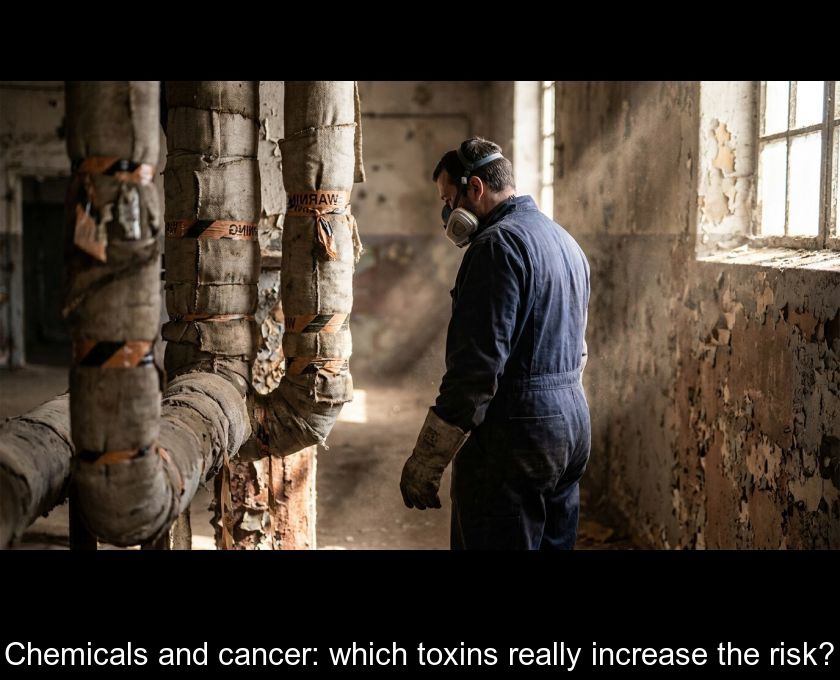
There are cases where the link between a toxin and cancer is so strong that it becomes almost a statistical certainty. This is the case with asbestos and pleural mesothelioma, a rare cancer that affects the membrane surrounding the lungs.
The attributable risk fraction of asbestos for this cancer is about 87% in men and 65% in women. In other words, in the vast majority of cases, it is indeed prior exposure to this mineral fiber that is responsible.
This cancer develops very slowly: it generally takes 20 to 40 years, or even longer, between the first exposure and the onset of the disease. Asbestos exposure is found in about 80% of patients with pleural mesothelioma, which alone accounts for 80 to 90% of all mesotheliomas, far ahead of peritoneal or pericardial forms.
Professional, general, or domestic exhibition: three different entry points.
There are generally three main sources of exposure to carcinogenic agents. The first is environmental in a broad sense: air pollution, indoor air quality in homes, contamination of water or food.
The second is occupational, often the most documented because it is easier to measure: workshops, construction sites, industries, where exposure levels are generally higher and more consistent than in everyday life. The third, domestic, is more diffuse but very real, through certain household products, old building materials, or DIY practices.
To identify a carcinogen, researchers combine several approaches: epidemiological studies comparing exposed and unexposed populations (cohorts) or sick patients to healthy controls (case-control studies), experimental studies in animals, and mechanistic studies in the laboratory, particularly on the genotoxicity of substances. It is the convergence of these three types of evidence that allows for a conclusion.
How a toxin travels through the body before causing damage.
A carcinogenic chemical does not act instantaneously. It enters the body through three main pathways: the respiratory tract (inhalation), the skin (transcutaneous route), or the digestive system. Once inside, its distribution depends on its physicochemical nature and the purification and retention mechanisms specific to each organ.
For inhaled particles, everything depends on their size. Particles larger than 10 micrometers settle in the nose and pharynx. Those between 2.5 and 10 micrometers reach the bronchi, where the mucociliary blanket can still expel them. The finest particles, below 5 micrometers, penetrate deep into the lungs and settle in the alveoli by simple diffusion.
There, two outcomes are possible: elimination, via phagocytosis by macrophages or uptake by the lymphatic system, or long-term retention in tissues, known as biopersistence. Long and thin fibers, such as those from asbestos, particularly evade elimination and can migrate to other sites, including the pleura.
When the body transforms the toxic substance into a more active poison.
A often overlooked point: some xenobiotics are not dangerous as such; it is their transformation by the body that makes them truly carcinogenic. Metabolism, which is supposed to detoxify foreign substances, can sometimes produce the opposite effect.
This phenomenon of metabolism, or metabolic activation, generates metabolites that are more reactive than the initial molecule. It is these active derivatives that will then interact directly with cells and their genetic material, initiating the long process that ultimately leads, years later, to a tumor.
This step partly explains why two people exposed to the same dose of the same product may not necessarily develop the same risk: metabolic capacities vary from one individual to another, depending on genetic factors that are still not fully understood.
Oxidative stress, this discreet mechanism that damages DNA.
Behind many chemically induced cancers lies a common actor: oxidative stress. Some toxins generate reactive oxygen or nitrogen species, highly unstable molecules capable of causing significant damage in a very short time.
The superoxide radical, for example, can be converted into hydrogen peroxide, which, in the presence of certain metals, transforms into the hydroxyl radical through the Fenton reaction, one of the most aggressive species for DNA. These molecules cause single or double strand breaks in DNA and directly oxidize the nitrogenous bases that make up our genetic heritage.
Fortunately, the cell has efficient repair systems: base excision, nucleotide excision, mismatch repair, homologous or non-homologous recombination. The problem arises when these mechanisms are overwhelmed or faulty: mutations then accumulate on key genes, particularly those that control cell proliferation.
Why does the same toxin not affect just any cell at random?
A key point, yet not very intuitive: a carcinogen does not indiscriminately attack any tissue. It preferentially targets certain types of cells in specific anatomical locations.
Asbestos, for example, has a particular affinity for mesothelial cells lining the pleura, rather than for other tissues it may pass through. Polycyclic aromatic hydrocarbons, on the other hand, preferentially affect bronchial or skin epithelium. This specificity can be explained by the conjunction of several factors: the route of entry of the toxin, its ability to reach certain tissues, and the particular sensitivity of certain cells to its effects.
It is this logic that explains why each cancer actually has its own biological story, with mechanisms and vulnerabilities unique to it.
What the mapping of cancers reveals according to the toxic substances involved
By cross-referencing epidemiological and experimental data, researchers were able to create a true map linking certain chemical agents to specific tumor locations.
At the level of the lip, solar radiation is predominant. For the oral cavity and pharynx, alcohol and tobacco, whether alone or combined, play a major role. The lung, in turn, crystallizes the largest number of recognized agents: tobacco, asbestos in all its forms, arsenic, polycyclic aromatic hydrocarbons, radon, crystalline silica, and diesel engine exhaust gases.
Other locations are more specific: the bladder with certain dyes like benzidine or 2-naphthylamine, the skin with UV rays and arsenic, the bones with plutonium or radium, and leukemias with benzene, formaldehyde, or ionizing radiation. This diversity clearly shows that there is not a single chemical cancer, but a multitude of scenarios depending on the toxic agent and the targeted organ.
Polycyclic aromatic hydrocarbons and benzo[a]pyrene: cancers with multiple faces
Among the most studied substances, polycyclic aromatic hydrocarbons, particularly those derived from the combustion of coal tar or tobacco smoke, hold a special place. Benzo[a]pyrene, one of the most representative, is capable of causing cancers in several different locations: bladder, bronchi, and skin.
In fact, it is with this molecule that one of the historical models of carcinogenesis, the initiation-promotion model, was constructed. In the laboratory, the application of benzo[a]pyrene on the skin of mice, followed by repeated exposures to a chemical promoter, leads to the appearance of tumors, whereas neither one alone achieves this.
This model has helped to understand that carcinogenesis occurs in several stages: first, an initial genetic alteration, silent, followed by repeated stimulation of cell proliferation that allows this alteration to manifest as a tumor.
Asbestos fibers: one toxic substance, several possible cancers
Asbestos deserves attention as its mode of action well illustrates the complexity of chemical carcinogenesis. Once inhaled, the fibers settle in the lungs, sometimes migrating to the pleura, and can cause, depending on the case, bronchial cancer, pleural, peritoneal, or pericardial mesothelioma, or even cancers of the larynx or ovary.
Several mechanisms intertwine. First, there is a direct mechanical irritation of mesothelial cells, leading to repeated cycles of damage and repair that maintain chronic inflammation, a conducive environment for tumor development. Next, the production of free radicals occurs, particularly when macrophages attempt in vain to digest the fibers (this is referred to as frustrated phagocytosis): unable to eliminate them, they continuously release reactive oxygen species and inflammatory substances.
The fibers also disrupt the mitotic spindle during cell division, causing abnormalities in chromosome number, and stimulate the expression of proto-oncogenes such as c-fos and c-jun, thereby sustaining the proliferation of already damaged cells. Other natural mineral fibers, such as erionite or fluoro-edenite, share similar properties and have also been associated with mesothelioma in certain regions of the world.
Ionizing radiation: from blood disorders to skin and bronchial cancers
Ionizing radiation forms another major category of established carcinogens, with very varied targets depending on their nature and the route of exposure. X-rays and gamma rays are associated with leukemias, as well as skin or bronchial cancers.
Radioactive iodine, particularly iodine-131, preferentially targets the thyroid, while radon-222, a gas naturally present in certain soils and homes, is recognized as a cause of lung cancer. Other elements like plutonium or thorium-232 are associated with bone or liver cancers depending on their retention mode in the body.
What distinguishes ionizing radiation from conventional chemical toxins is its ability to directly damage DNA through energy transfer, without requiring a prior metabolism step, which explains the diversity of potentially affected organs depending on the type of radiation and its location in the body.
Chemical burns: a risk of malignant degeneration years later
Less known, but very real: a severe chemical burn can, in the long term, evolve into skin cancer. Acids cause protein coagulation that limits the extent of the lesion, while alkaline products lead to saponification of lipids and liquefaction of tissues, promoting deeper penetration.
The immediate reflex in case of accidental contact is to rinse thoroughly with water for at least fifteen minutes, as quickly as possible. Some products then require the application of a specific antidote suitable for the substance involved.
But beyond immediate management, it is important to note a significant point in the long term: on extensive and remodeled scars, there is a risk, albeit delayed by several years, of malignant degeneration, in the form of basal cell carcinoma or squamous cell carcinoma. One more reason never to neglect medical follow-up after a significant chemical burn.
Prevention: what we can really do about carcinogenic toxins.
In the face of this diversity of carcinogens, prevention primarily relies on a better understanding of exposures. This is the whole challenge of regulatory classifications and lists of established or probable agents: they help guide regulation, labeling, and protective measures in workplaces as well as in everyday life.
The ban on asbestos in France in 1997, following the prohibition of spray-on insulation in 1978, illustrates what a public health decision can change in the long term, even if the effects are only measurable after several decades of latency. Reducing personal exposure also involves simple actions: ventilating one’s home, limiting tobacco and alcohol use, being cautious about old materials containing asbestos, and adhering to protective measures in exposed professional environments.
Research is also evolving towards a global approach, known as the exposome, which aims to integrate all exposures experienced throughout a lifetime rather than studying them one by one. This is a promising avenue that requires collaboration among biologists, toxicologists, epidemiologists, and clinicians to better understand, and therefore better prevent, cancers related to toxins.