Solitaire: Game Rules And How To Play The Patience Game
There are games that we play without remembering who taught us. Solitaire is one of those. We have all encountered it at some point, on a corner of a table with an old, slightly worn deck of cards, or on a computer screen during a break. However, when the time comes to explain the rules to someone, we realize that we know them mostly by habit, at our fingertips. So here it is, once and for all, how to play solitaire, also known as patience, this solitary game that has never aged.
Solitaire, a card game played alone.
Let's start by clearing up a small confusion. Solitaire is not a unique game, but rather a whole family of card games played solo. The English refer to it as "patience," the French as "réussite," and the term solitaire has gradually become the standard to refer to the whole. The common principle can be summed up in one sentence: a single player seeks to restore order to a shuffled deck, following specific sorting rules.
Among the hundreds of existing variants, only one has conquered the planet: Klondike. This is the one everyone thinks of, the one on computers, with its columns of cards and four suits to be assembled at the top of the screen. Therefore, this is the one we will detail here, as learning Klondike is already understanding the spirit of all other solitaires.
What you need to get started
The good news is that the equipment amounts to almost nothing. A classic deck of 52 cards is enough, without the jokers. A clear table, a bit of space, and you're off. No opponents to convince, no rules to negotiate, solitaire can be played whenever you want, wherever you want, which probably explains part of its success. And if you don't have cards on hand, an online version will do just fine (we'll come back to that).
Setting up, how to arrange the cards
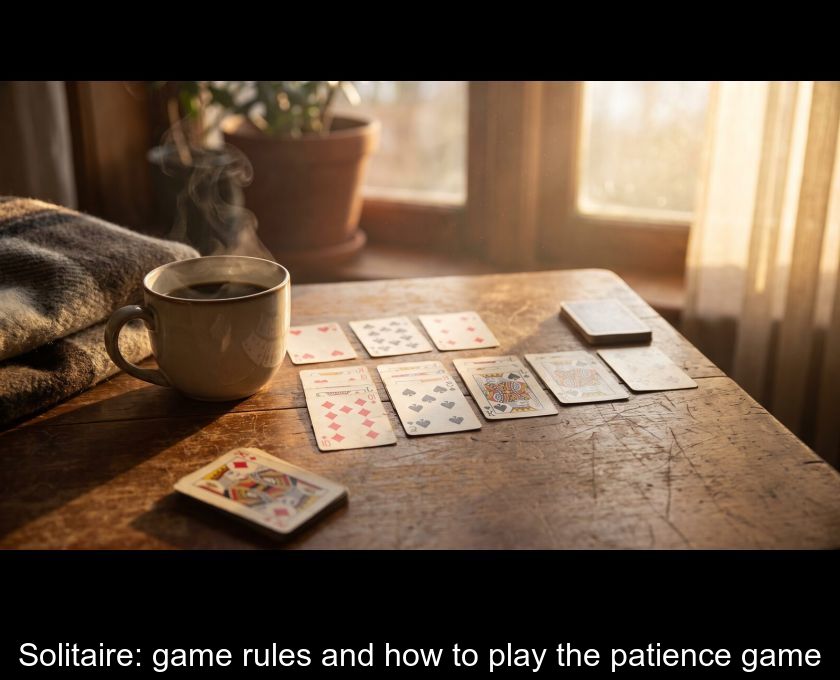
Here is the step that impresses beginners and, once understood, becomes a reflex. After thoroughly shuffling the deck, you build what is called the tableau, which consists of seven columns of cards arranged side by side.
The first column receives one card, the second receives two, the third three, and so on until the seventh, which has seven. In each column, only the top card is turned face up, while all the others remain hidden. This uses 28 cards. The remaining 24 form the draw pile, which is placed to the side, face down.
Finally, you need to reserve four empty spaces at the top of your playing area. These are the foundations, the heart of the game, where victory will be built card by card.
The goal of the game is to reconstruct the four families.
The objective is simple to state. It is to fill the four foundations, one for each suit (spades, hearts, diamonds, clubs), by arranging the cards in ascending order. You must start with the Ace, then the 2, the 3, and continue up to the King. When the four suits are complete, from Ace to King, the game is won. All the cards have found their place, success is achieved.
Stated this way, one might think it's a formality. It's quite the opposite. Between the initial disorder and this perfect alignment, maneuvering will be necessary, and that's where the movement rules come into play.
The movement rules, advancing the game.
On the board, the seven columns are arranged not like foundations, but upside down and alternating colors. Cards are stacked in descending order, alternating between a red card and a black card. Specifically, you can place a black 8 on a red 9, then a red 7 on that black 8, and so on. This rule of red-black alternation is the key to everything, keep it in mind.
When you move a visible card from a column, the hidden card underneath flips over, revealing a new possibility. Gradually, the columns become less populated. If one of them ends up completely empty, it becomes a valuable space, as only a King (or a sequence starting with a King) is allowed to settle there.
When no more moves suit you on the board, you draw. The cards from the draw pile feed into a discard pile, with the top card playable at any time, either to a column or directly to a foundation. And when the draw pile is exhausted, you flip it over to go through it again.
Nota Bene: there are two ways to draw, which radically change the difficulty. In "draw one card," you flip the cards one by one, which is the most accessible mode. In "draw three cards," you take them out in groups of three and can only play the top one, which significantly increases the challenge. Beginners should definitely start with the first method.
Our tips for starting off on the right foot.
Knowing the rules is one thing, playing smart is another. A few simple reflexes quickly make the difference between a stuck success and a smooth game.
- Play the Aces and 2s without delay. They are the foundations of your foundations, clear them as soon as possible.
- Don’t empty the stock too quickly. Each card drawn may be missed later. Work on the tableau as much as possible first.
- Prioritize turning over hidden cards. A column full of face-up but blocked cards is useless; the information is hidden underneath.
- Think before filling an empty column. A well-chosen King opens up the game, while a randomly placed King can close it off.
And above all, do not systematically move your cards to the foundations. A card kept on the tableau remains useful for accommodating other cards, whereas once moved up, it rarely comes back down. Patience, time and again, truly lives up to its name.
A card game that became cult thanks to the computer.
If Solitaire is today the most played game in the world on computers, it owes its success to a funny story. In 1990, Microsoft included a version of Klondike in its Windows 3.0 system. The game was programmed two years earlier by an intern, Wes Cherry, and its cards were designed by Susan Kare, the graphic designer responsible for many of the icons of that era.
The idea was not just to entertain. At a time when many were discovering the mouse, dragging cards from one column to another was the best way to gently learn the famous "drag-and-drop." Millions of people thus tamed their computers by playing Solitaire, often without even realizing it. The little card game had quietly become a remarkable teacher.
Are all parts winnable?
That's the question everyone asks after a few consecutive failures. Rest assured, it's not always your fault. In Klondike, by drawing a card, it is estimated that about 79% of the deals are theoretically winnable, which is nearly eight out of ten. In other words, there are indeed some deals that are lost from the start, but they remain in the minority.
Some variants are much more forgiving. FreeCell, for example, where all the cards are visible from the start, has a solvable game rate close to 99.999%. Of the 32,000 deals in the historic Windows version, only one has proven impossible to complete, deal number 11982, uncovered by computer. This puts into perspective the next game that challenges you...
It's your turn.
You now know everything you need to get started: the setup, the goal, the moves, and some tips to keep from getting lost. The rest is a matter of practice, as solitaire is one of those games that you really learn by playing, one game after another.
The simplest way to practice without having to shuffle the cards is still the screen. There are excellent versions available to play solitaire online for free, with automatic card flipping and the ability to restart a deal with just one click. And when the rules are no longer a mystery to you, you can step up your game by discovering our strategies to win at solitaire more often. Good luck!