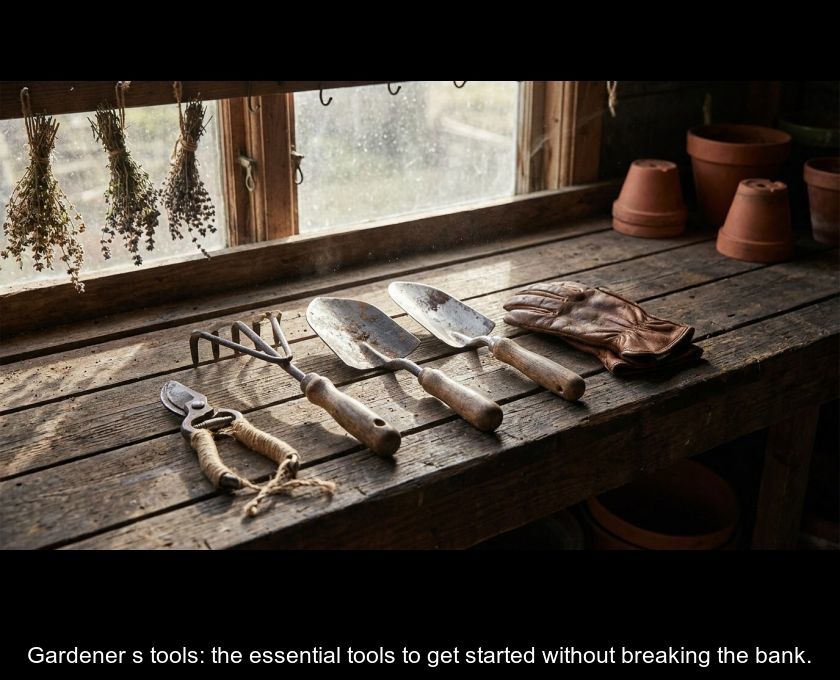
Gardener's Tools: The Essential Tools To Get Started Without Breaking The Bank.
Before turning over any soil, you need to have the right tools. Here’s how to put together a truly useful gardening kit by buying less but buying wisely.
Equipping oneself before diving in: an essential step.
It is often imagined that a garden is conquered with enthusiasm. In reality, it is mainly conquered with the right tools and a minimum of common sense. Whether you have small maintenance tasks or a complete restoration of the land ahead of you, the question of equipment arises from day one.
Two criteria should guide your choices: efficiency and safety. A garden holds more dangers than one might think (thorns, sharp stones, flexible branches that can hit you in the face), and the tools themselves pose risks as soon as they cut or rotate. Poorly chosen equipment can lead to fatigue, discouragement, and sometimes injury.
Good news: the basic toolkit consists of just a few tools, almost all manual. The heavy machinery can wait... or may never need to be purchased. And if a task worries you or frankly puts you off, there is no obligation to play the hero: calling on a qualified professional (or a competent and accommodating friend) remains a perfectly reasonable option.
Leather gloves, the gardener's first line of defense.
This is the least spectacular and undoubtedly the most profitable purchase. Leather gardening gloves should be flexible yet thick: flexible enough not to hinder movement, thick enough to withstand the assault of thorns, sharp objects, and pointed stones. They should be worn at all times, not just for major projects.
Their role is not limited to protecting the skin. They ensure a good grip on tools that vibrate a lot, with chainsaws and brush cutters at the forefront. Specifically, they prevent finger cramping on the handles: you grip better, hold on longer, with less effort. For cutting, prefer gauntlet gloves, which extend up the forearms.
Nota Bene: manufacturers usually accompany their models with pictograms indicating resistance to abrasion, puncture resistance, and waterproofing. When purchasing, rely on these indications rather than the price displayed on the label. A cheap pair that tears at the first bramble won't save you any money.
The shovel, the versatile tool for digging and planting.
It is willingly categorized as "earthmoving," yet it is essential for the garden. It is used to level, move, or remove soil and debris, and it is systematically used when planting trees and shrubs. One could say it will quickly come out of the shed.
What distinguishes it from a spade lies in a detail of its construction. On a spade, the blade is in line with the handle. On a shovel, the socket is angled, which positions the working part at about 50 degrees to the handle: it is precisely this angle that allows you to load and throw soil without straining your back.
For gardening, the model to remember is the mason's shovel, with a rounded blade. Avoid square blades: they do not allow for digging and get stuck at the slightest obstacle, which can be very frustrating on rocky terrain.
The pickaxe, essential for hard and stony soils.
As soon as the ground resists, when the shovel bounces back and the soil proves to be compact or full of stones, the pickaxe becomes essential. It is recognized by its double iron and its eye socket, which allows for a strong fitting, thus holding the head securely even under repeated blows.
Two versions coexist. For gardening, opt for a model with a point and narrow blade: the point breaks into the hard soil, while the narrow blade allows for efficient digging. If you need to clear an overgrown area, a pickaxe with a point and axe is very useful for cutting through stubborn roots.
When used alongside the shovel, the pickaxe also allows you to manually tackle small stumps, which you can expose by digging all around before extracting them. It's time-consuming, it's physical, but it can be done without renting any machinery.
The rake, a basic yet useful tool for everyday use.
Iconic of the gardener, the rake consists of a long handle (ranging from 1.50 m to 1.80 m) that allows for standing work, and a head with fine teeth shaped like a comb, fixed transversely to the handle's axis. It is used to collect debris scattered on the ground, to finely level the soil, and to extract superficial stones.
In terms of size, the standard rake measures 40 cm in width and has 14 teeth that are 7 cm long. This is the right compromise for regular maintenance and preparing a vegetable garden. Models with 10 or 12 teeth, which are narrower, are mainly used for maneuvering through flower beds without crushing everything.
When purchasing, two points to check: choose a forged model and ensure that the socket is sturdy, as this is where cheap tools tend to fail first. For large autumn clean-ups, a leaf rake, also known as a "lawn broom," is a useful addition to the toolkit.
The pruner, a manageable alternative to the chainsaw.
Imagine a giant pruner: a cutting head inspired by the pruner, mounted at the end of a long handle that is operated with both hands. That's exactly what a lopper is. It allows you to cut already significant branches without using any motorized equipment.
Its main advantage is maneuverability. When you need to penetrate a dense bush, where a chainsaw would be unmanageable and dangerous, the lopper goes in and works cleanly. Many models are equipped with a ratchet system that multiplies the effort: you can then cut branches with a diameter of 4 to 5 cm very neatly.
A very simple buying tip: prefer aluminum or composite handles over wooden ones, which are frankly too heavy after ten minutes with your arms extended. The lopper is part of the essential toolkit for any amateur gardener, just like the shovel or rake.
The pole pruner, for safe high pruning.
Sometimes simply called a "pole saw," the pole pruner is a small chainsaw mounted at the end of a telescopic arm. It comes in both electric and gas-powered versions. Its principle is clear: to cut branches located between 3 and 5 meters high while keeping your feet on the ground.
This is its decisive advantage. No wobbly ladder, no precarious balance with one hand on a rung and the other on a cutting tool, no risk of falling. For a beginner, it is by far the safest way to work at height on the lower branches of a tree.
However, a precaution is necessary: when sawing above your head, the projection of sawdust and chips is inevitable. Protective glasses become essential. Choose lightweight and wraparound ones with a good panoramic view; they are easier to forget on your nose.
Powerful cutting tools: precautions to know
As soon as a tool cuts quickly and powerfully, some rules are non-negotiable. The minimum: gloves. Next, no scarves, ties, or jewelry for heavy work, and long hair must be tied back and tucked under a head covering (cap, scarf, or helmet). These three sentences have prevented many accidents.
For serious job sites, complete equipment consists of reinforced safety boots with a steel toe cap and slip-resistant soles (against crushing and slipping), a helmet with a visor and noise-canceling ear protection (also very effective against the whip of thorny branches when clearing tall brambles), and for the chainsaw, a jacket and cut-resistant pants. These garments contain fibers capable of stopping the chain's rotation in the event of accidental contact. For occasional use, simple vests can replace the jacket, but the pants remain essential.
In terms of actions, remember the essentials: always hold the machine with both hands, left thumb tucked under the front handle, attack the wood at full throttle without forcing or moving back and forth, never cut with the tip of the guide (risk of sudden kickback), work alone within a radius of at least 5 meters, and never move while the machine is running. The chain oil reservoir should be filled with every tank of fuel, without exception.
Note: a chainsaw in good condition produces small chips. If it produces sawdust, it means the chain needs sharpening. Finally, the use of these machines is reserved for individuals over 18 years old, with 16-year-olds being able to use them under the supervision of a competent adult.
Rent rather than buy: heavy equipment not to own outright.
Rental companies for equipment are present in most major shopping centers, providing access to high-performance professional equipment at a relatively reasonable cost. It's worth taking advantage of this, especially for machinery that will only be used for a handful of days in a gardener's life.
Typically included in this category are: the rubble skip (from 8 to 40 m³, sometimes with rear-opening doors for very heavy items; be careful, the larger it is, the higher it is and thus more difficult to fill), the garden shredder, the compact loader for moving large volumes of soil, the vibrating plate compactor for stabilizing a driveway, the stump grinder, and the mini-excavator. For the shredder, aim for a larger model than your needs, equipped with a wide hopper and, if possible, a feed roller; otherwise, shredding becomes a chore. For the vibrating plate, a professional model with hydraulic controls, weighing at least 110 kg, does a truly effective job.
Two reflexes before signing: check that the delivery and pickup of the machine are included in the price, and know that if the skip needs to be parked outside the property, written permission from the town hall or police station is required, a document that rental companies demand.
One last point, often forgotten: every machine requires a period of adjustment before being mastered. If you don't feel up to it, hiring a specialized company may cost more upfront, but it often proves economical in the end when considering the time saved, the efforts avoided, the risks, and the quality of the work done.
Investing smartly: which tools to prioritize buying
If your budget is tight, start with this trio: leather gloves, pruning shears, lopper. Then complete with a shovel, pickaxe, and rake. With these, you are capable of planting, cleaning, leveling, and trimming the essentials.
The pruning shears deserve special attention, as they are the tool you really can't do without, the one that lives in your pocket. Their blade is rounded because the cut combines a top-to-bottom movement (like a guillotine) and a forward-and-backward movement: this is known as a "pulling" cut, which avoids crushing the branch's tissues and leaves a clean wound. Remember the rule: classic pruning shears (blade sliding along a fixed counter-blade) for green wood, anvil pruning shears (blade pressing against a thick counter-blade) for dry wood. Models with effort multiplication, featuring pivoting handles, significantly increase hand power.
Two details that enhance comfort in use. The spring: spiral or "Comtois," it needs regular lubrication to maintain its elasticity; coil springs are inexpensive and maintenance-free but can easily get caught in vegetation, while high-end models integrate the mechanism into the cutting head. And the cutting head slightly angled downwards on some shears prevents wrist bending with each cut, thus reducing long-term pain.
Finally, add a claw or rake as soon as you prepare soil: a long handle ending in four curved teeth at 90 degrees, with fine and pointed teeth for the claw, and wider and flatter for the rake. They break up the soil and also help pull tangled vegetation towards you. Choose them forged and check the strength of the handle attachment.
Build an evolving toolkit according to your needs.
The rest is acquired over time as the need arises. If you have to face brambles, the brush cutter (or "bramble cutter") is a fairly large tool, 45 to 55 cm in size, with a crescent-shaped blade whose straight back part is also sharpened, allowing it to be used from right to left like a machete, with one hand. For tall bramble patches and occasional pruning, the pruning crescent, with its semicircular blade of 20 to 28 cm at the end of a long handle, cleanly cuts branches up to 2 cm in diameter. The hoe, with its handle of about 1.10 m and its thick, flat blade forming an angle of about 90 degrees, loosens the soil, uproots herbaceous plants, and breaks hard clods.
Next come the motorized tools. For a truly versatile portable brush cutter, expect a displacement of 30 to 40 cm³. Two-stroke engines are lively, lightweight, and require less maintenance (no oil change), while four-stroke engines are smoother to start, less aggressive on the ears, more durable, and do not require mixing fuel, but they are generally more expensive and heavier. Make sure that the machine can accept real blades: many cheap models sold as "brush cutters" only accept a nylon line head, which is clearly insufficient. The three-blade cutter is the most versatile, the eight-tooth blade is suitable for dry grasses and medium brambles, and the 80-tooth saw blade is essential for thick underbrush and scrub.
As for the chainsaw, it is irreplaceable only for felling, limbing, and bucking. It only cuts hard and rigid wood and does not replace a pruner or lopper in any way. For a private individual, a displacement of 30 to 50 cm³ with a guide bar of 35 to 45 cm covers all needs.
In summary: buy first what you will use every week, rent what will only be used once, and only add a machine when handwork becomes unreasonable. Owning your own equipment has a real advantage; it is always available, but a shed full of tools that are never used has never made a single plant grow.