The Long Neck Of The Giraffe: Myth Or Evolutionary Reality?
Eating the leaves that no one else can reach... or fighting with headbutts? For over a century, biologists have been arguing over the explanation for the most famous neck in the savanna. Here’s where the debate really stands, experience by experience.
A scientific debate about an extraordinary organ
Two meters. That's the length that a giraffe's neck can reach, an absolute record among current land animals. Such a spectacular organ seems to call for an obvious explanation, and for a long time, everyone believed they had one.
Except they didn't. Since the 1990s, this neck has been at the center of a controversy among biologists, with scientific articles responding to each other, contradictory measurements, and field experiments set up specifically to settle the debate. What was once considered a straightforward case study has turned into a hot topic.
And that's precisely what makes the story exciting: we will see here, step by step, how researchers are trying to reconstruct the past of an organ they cannot observe evolving. Spoiler: the answer exists, it is nuanced, and it is not yet completely settled.
The classical theory: eating the high leaves without competition.
Let's start with the explanation that everyone knows. Giraffes feed on tree leaves, particularly from the tops of acacias. With a two-meter neck, a long tongue, and elongated front limbs, they reach a layer of vegetation that no other herbivore can access.
The idea is therefore simple: this long neck would be an adaptation to avoid food competition. While antelopes, wildebeests, or kudus compete for the lower branches, the giraffe calmly feeds above, on a reserve of leaves that no one else is interested in because no one else can reach it.
This reasoning has the advantage of aligning with what we observe: a grazing giraffe is a giraffe that grazes at height. And it relies on a clear evolutionary mechanism, which we will detail now.
Darwin and the historical explanation through small successive enlargements.
Charles Darwin devoted a short passage to the giraffe in the sixth edition of his work on the origin of species in 1872. His explanation is based on a very concrete mechanism, that of natural selection by small steps.
Imagine a population of ancestral giraffes whose necks vary slightly from one individual to another, just as height varies among humans. During times of scarcity, when the lower branches have been stripped, individuals capable of browsing two or three centimeters higher than others still find something to eat. They survive a little better, reproduce a little more, and pass on this slightly greater height.
Repeat this process over thousands of generations: each small advantage accumulates, and the neck gradually lengthens. This is exactly Darwin's reasoning, who emphasized this point: it is the tallest individuals that have been preserved during famines.
Nota Bene: be careful not to confuse this with the false idea that the giraffe elongated its neck by stretching towards the branches. In natural selection, the individual does not improve during its lifetime; it is the population that changes in composition, generation after generation, because some leave more descendants than others.
Necking: when the neck becomes a weapon of combat
In the mid-1990s, biologists threw a spanner in the works. Their objection was factual: according to their observations, giraffes do not use their long necks much for feeding at height. They noted that females can spend up to half of their time with their necks horizontal, even during the seasons when competition for food is fiercest, precisely when they should be exploiting their size advantage.
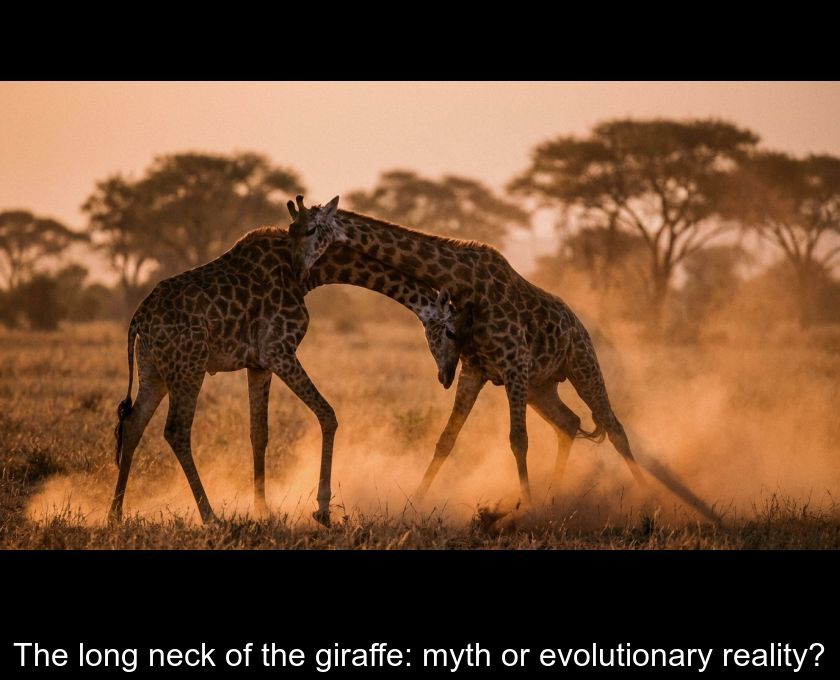
Hence their spectacular counter-proposal: the neck would primarily be a weapon. Among giraffes, males engage in ritualized confrontations known as "necking." They violently clash their necks and use their heads like hammers, swinging their necks to strike their opponents.
This is not a figure of speech: male giraffes have very thick, reinforced skulls, which turn their heads into real mallets. In this logic, having a longer and more massive neck than one's rival becomes a direct advantage, and the best-endowed males reproduce more, driving the evolution of the organ upward. The proposed parallel was clear: the giraffe's neck would play the same role as the horns of antelopes or the antlers of deer.
Deadly fights between males for access to females.
These duels are not mere displays. The blows exchanged during necking are powerful enough to break the opponent's vertebrae, and sometimes the fight ends with the death of one of the two males.
One example illustrates the phenomenon: in Niger, where the giraffe population is very low, two deaths resulting from fights were recorded in 2009. With such a small population, this is not trivial.
The stakes, as often with large mammals, are access to females. A male that dominates its rivals gets to reproduce, while the others wait their turn or leave. Thus, it is understandable why the hypothesis has gained traction: when an organ serves as a weapon in such a decisive competition, selection can indeed shape it very quickly.
The hypothesis of sexual selection put to the test.
A good scientific hypothesis is one that produces testable predictions. The neck-swinging hypothesis produces at least two very clear ones.
First prediction: if the neck has been shaped by competition among males, then males must have a significantly longer neck than females. This is what we observe for most sexual weapons, such as the horns of impalas, which are present in males and absent in females.
Second, more embarrassing prediction: we need to explain why females, who do not engage in necking, also have a huge neck. A costly organ to grow and maintain has no obvious reason to appear in the sex that does not use it for fighting.
Nota Bene: sexual selection refers to the part of natural selection that specifically concerns access to reproduction, through competition among partners of the same sex or through mate choice. It explains the antlers of deer, an evolution that can reach extremes: in the extinct giant deer Megaloceros giganteus, the antlers reached 3.6 meters in span and weighed around forty kilograms.
The mystery of the long neck in female giraffes.
It is the weak point that has drawn the sharpest criticism to the combat hypothesis. Female giraffes also have very long necks, and they do not use them as a club.
Sexual selection, by definition, only applies to competition for reproduction. If the neck were merely a male weapon, we would expect a marked difference between the sexes, as seen in those antelopes where only males have backward-curving horns, which are solely used to fend off a rival during confrontation ceremonies.
This is not at all what the giraffe shows. Whether male or female, the silhouette is the same; the neck is disproportionate in both cases. Any theory that does not account for this fact leaves half the problem on the table.
The genetic correlation between sexes: an insufficient explanation.
Defenders of the combat hypothesis have indeed proposed an answer: females would have long necks due to genetic correlation between the two sexes. Translation: males and females are built on the same blueprint, at least at the beginning of their development, and a trait selected in one is mechanically found in the other, without having any particular function.
This argument is not absurd in itself. It works very well to explain nipples in men: nipples form very early in embryonic development, even before male differentiation, and since they do not bother anyone, selection has never had a reason to eliminate them.
But this explanation has a flaw: it is often used as a last resort when other arguments are exhausted. And it is not universal, far from it. In bovids, for example, it does not explain why female buffaloes and cows have horns while small female antelopes do not. The real reason, in this case, is functional: female buffaloes are large dark animals, impossible to camouflage in tall grass, so they have no choice but to defend themselves, and their horns are formidable enough that the species has inherited nicknames like "widowmaker" or "black death."
In short, invoking genetic correlation for the necks of female giraffes amounted to dodging the issue. Critics did not hesitate to point this out.
Scientific measurements from 2013: males and females compared
The first prediction, regarding the size difference between the sexes, remained to be resolved. It's a matter of measurements, so it's a question that can be settled with a tape measure and rigor.
In 2013, biologists precisely measured the necks and heads of male and female giraffes, comparing lengths and weights. The result: males do have slightly longer necks than females, but the difference is really minimal. Far too small to be attributed to sexual selection.
This is an important point to understand. When an organ is shaped by competition among males, the difference between the sexes is generally spectacular; think of a stag's antlers or an impala's horns compared to females that have none at all. Here, we have a marginal difference in a gigantic organ in both sexes.
Therefore, the central prediction of the neck-arm hypothesis was not verified. This does not mean that necking does not exist; as we have seen, it is indeed real, but it is probably not what caused the neck to grow.
The experience of grilling: the proof by the field in 2007.
The other pillar of the combat hypothesis was the idea that giraffes do not feed as much at height. Once again, researchers decided to verify rather than discuss, using a remarkably simple field device published in 2007.
The principle: isolate certain trees with fencing. The fencing is designed to block herbivores smaller than giraffes, who can no longer reach the foliage, while giraffes can easily pass their necks over the fence and continue to graze.
By then comparing these protected trees to control trees that remained accessible to everyone, researchers were able to measure who was eating what, and where. The verdict: giraffes do indeed feed at height, and they do so even more when competition for leaves is strong.
It was this experiment that largely brought everyone back into agreement. The initial objection, that giraffes keep their necks horizontal, did not withstand direct measurement of access to the resource. On this specific point, Darwin was right.
Fossils and the aridification of Africa 12 to 14 million years ago.
One last argument comes from paleontology, and it complements the picture well. According to fossils, the long neck of giraffes appeared between 14 and 12 million years ago.
This period corresponds to a major upheaval of the African continent: a general aridification, during which forests largely gave way to savannas. In other words, the number of trees decreased significantly.
And what happens when there are fewer trees for the same number of herbivores? Competition for each tree increases. Each acacia becomes a stake, and the ability to exploit branches that others cannot reach becomes a considerable survival advantage.
The coincidence between the appearance of the long neck and this transformation of the landscape thus reinforces the food hypothesis. It is not direct evidence; a fossil does not tell us what the animal was eating that day, but it is a coherent body of evidence.
An evolving scenario still open to future research.
So, who is right? The most honest answer is that both interpretations are not mutually exclusive. Feeding at height is very likely the selective pressure that shaped neck elongation for the entire species, both males and females. And the use of the neck as a club in male duels remains a real evolutionary force, which well explains the significant difference in skull thickness between the sexes.
In addition, there are other hypotheses that biologists have not failed to formulate: the neck would provide a high vantage point facilitating predator detection, it could help regulate internal temperature due to a large surface area for heat dissipation, and some have even suggested that it evolved in response to the elongation of the legs, simply so the animal could continue to reach water from watering holes.
What to take away from this story is the method. In about 140 years, several competing theories have been proposed, defended, measured, tested in the field, and then some have been discarded without being completely excluded. The giraffe's neck serves multiple functions simultaneously, and untangling which one has most strongly directed its evolution requires ingenious experiments, fossils, and a lot of lively discussions.
The next time you encounter a giraffe, whether in a wildlife park or in a documentary, you will know what to look for: the height at which it browses, the skull thickness of males, the minimal difference between the sexes. And you will especially know that a fact as seemingly mundane as a long neck can occupy researchers for a century and a half... and will likely continue to do so for some time.