The Intelligence Of Octopuses: What These Solitary Creatures Teach Us About Animal Minds.
No parents, no group, no teacher to show them the gestures... and yet octopuses are among the most skilled animals. Their case forces us to reconsider our definition of intelligence, from ants to goldfish.
The intelligence of octopuses: a cognition without society
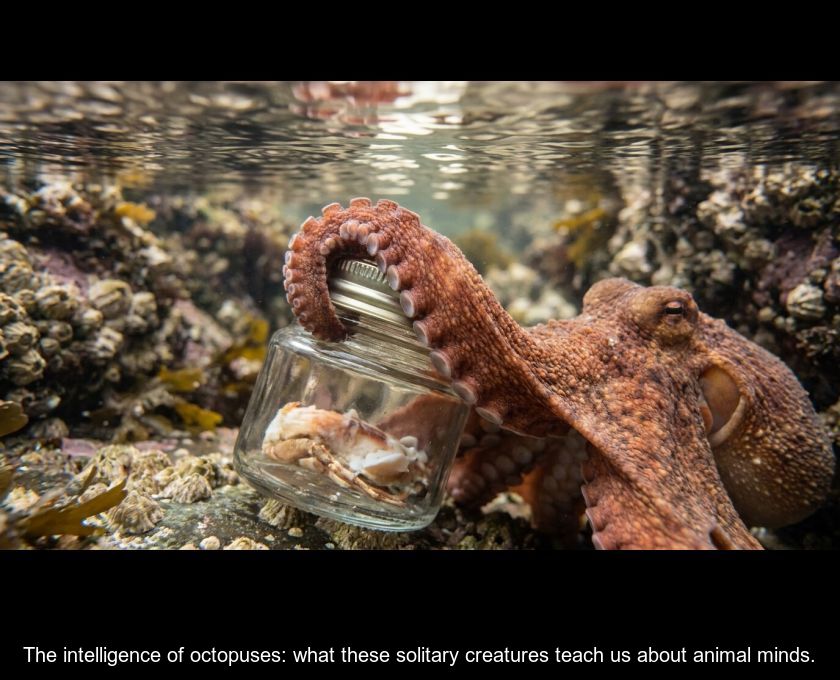
Can a solitary octopus be intelligent? Yes, and the intelligence of octopuses reminds us that a high-performing mind does not need society or a central "leader" to make all decisions: the idea of decentralized intelligence indeed exists in the living world.
For a long time, animal intelligence has been associated with group living. Monkeys, dolphins, corvids... most of the champions mentioned live surrounded by their peers. Cephalopods (the group that includes octopuses and cuttlefish) break this pattern. In cuttlefish, learning is a completely solitary activity: the young have no contact with their parents from birth and still manage to find food and avoid predators.
Some researchers even believe that young cuttlefish begin to learn as early as the embryonic stage, observing their environment through the eggshell. So there are no teachers, but rather an ability to independently extract information from the surroundings. And this lineage is not new: the first cephalopods appeared about 550 million years ago.
Nota Bene: speaking of intelligence "without a center" is not just a poetic image. Biologists already describe distributed intelligence in social insects, with coordination without central control: there is not one brain for all. The case of octopuses invites us to consider a simple idea... intelligence can take forms very different from ours, including the way of manipulating the world with tentacles rather than hands.
Solitary intelligence or collective intelligence: two paths in animals
The collective intelligence of ants and that of swarm robots rely on the same principle: a group of individuals acts as a single intelligent unit, without any of them holding all the information. This is the other great avenue of animal intelligence, in contrast to the octopus that manages alone.
Until the mid-1980s, a colony of ants was viewed as a small human society, with a queen centralizing information and directing the workers. This model has been abandoned. Each ant has access to only limited information and performs only simple behaviors, with a brain of about 100,000 neurons. Here’s how the colony nonetheless solves complex problems:
- An ant that discovers food lays down pheromones (chemical substances comparable to hormones) along the path to the nest.
- Others follow the trail, mark it in turn, and the snowball effect attracts more and more ants.
- If the source dries up, the trail is no longer reinforced and disappears.
- Ants taking the shortest path return faster, so this shortcut becomes more marked... and eventually gets selected.
The same mechanism can be found elsewhere. In a school of fish or a flock of birds, each individual adjusts its direction and speed based on two pieces of information: its own heading and the position of its neighbors. It moves closer to members that are too far away and distances itself from those that are too close. A swarm of bees thus finds its new nest even though only 5% of its members know the destination.
These rules have been translated into algorithms, useful for solving optimization problems when there are far too many solutions to test them all. Robots coordinated in this way can inspect inaccessible or dangerous places. One important point remains: collective intelligence does not erase solitary intelligence; both pathways coexist in the animal kingdom.
Social learning, a missing prerequisite in the octopus?
Social learning, that is to say learning by observing another individual or the product of their behaviors (an abandoned tool, for example), is considered the condition for all cultural transmission among animals. The octopus, solitary by nature, does without it to become intelligent, but it can hardly establish a tradition.
To identify true cultural transmission, ethologists generally check three things:
- a new behavior appears in an individual
- it spreads to other group members through observation
- it persists beyond the life of the inventor, across several generations
The most famous example took place in 1953 on the Japanese island of Koshima. Imo, a young female macaque aged 18 months, began washing her sweet potatoes in a river. Her mother, siblings, playmates, older females, and finally dominant males imitated her. Within nine years, three-quarters of the island's macaques were washing their potatoes (the troop had about 60 members). Fifty years later, long after Imo's death, their descendants still do it... now at sea. Imo also invented sorting wheat in water: the wheat floats, the sand sinks, and 19 individuals imitated her after six years.
Living in groups is crucial in this process. In England, after 1921, great tits learned to pierce the aluminum caps of milk bottles to reach the cream, and by 1949 the behavior was observed in hundreds of cities. Robins, solitary and territorial, never propagated the discovery. Similarly, young chimpanzees raised without adult models build their nests less effectively and use tools less proficiently. This illustrates the limitation of solitary animals like the octopus: intelligence is present, but transmission is much less so.
Why intelligence remains an elusive concept
Defining animal intelligence is difficult because there is no simple and unique definition of intelligence, not even for humans. Depending on the chosen criterion, the same species can range from genius to dunce.
Take humans and ants. Humans know how to use a computer, while ants do not. But desert ants have navigation abilities far superior to ours. Which of these two skills matters more for survival? No one can answer seriously. And there are plenty of candidates for the title of "true" definition:
- responding to new or complex situations
- solving a problem
- learning quickly, reasoning
- innovating, creating
- helping others
In addition, there are the abilities themselves (manipulating, making tools, moving, memorizing, transmitting) and the living contexts, such as forest, desert, presence of predators... Each combination changes the game. That’s why a cautious approach is to see intelligence as an adaptive strategy: each species is intelligent in its own way, in its environment, for one or more abilities.
To judge for yourself a statement like "this animal is smarter than that one," ask three questions: in what context? For what behavior? For what performance? If the answer is not specified, the comparison doesn’t mean much.
Persistent skepticism regarding animal intelligence
If there is still doubt about animal intelligence, it is mainly because intelligence has long been thought of as a boundary between humans and the rest of living beings. The use of tools, for example, was considered a human specificity until it was discovered that chimpanzees regularly make and use them.
This discovery challenged the very definition of humanity. However, rather than seeking to understand why certain species use tools and how this behavior has evolved, some research continues to track what distinguishes human tools from those of other animals, with the (sometimes unconscious) idea of proving superiority. The reflex is so ingrained that specialists themselves roll their eyes when discussing the study of the evolution of intelligence.
Skepticism does have a legitimate side, and it must be acknowledged. Animal intelligence has fueled real myths: the horse that can count, "talking" monkeys... Serious researchers therefore insist on rigorous methods and a simple rule: do not attribute human behavioral characteristics to animals. Observing for a long time, quantifying, being wary of one's certainties: this is what allows for the separation of actual abilities from nice stories.
Finally, it should be noted that this doubt depends heavily on culture. In Japan, for example, the burden of proof is almost reversed: it would be necessary to demonstrate more that animals are not intelligent.
Cooperation, bipedalism, imagination, memory: the criteria of human exception.
What is uniquely human? This is the question posed by Japanese primatologist Tetsuro Matsuzawa during a conference at the International Primatology Society congress in Cancun in the summer of 2012, based on four criteria: cooperation, bipedal posture, imagination, and memory.
For an hour, the researcher reviewed human capabilities compared to those of chimpanzees. The result: in some areas, humans perform better, while in others, they do worse. There is no blanket superiority, but rather a mosaic of strengths and weaknesses.
The most telling detail lies in an absent word. At no point during the conference did Tetsuro Matsuzawa utter the word "intelligence." For this specialist, the pertinent question was not who is more intelligent, but to precisely describe what each species can do.
The method can be applied to your own reflections: instead of asking if an animal is "intelligent," consider whether it cooperates, how it moves, what it memorizes, and what it seems to anticipate. This way, you obtain a comparison criterion by criterion, which is much more honest than an overall ranking.
Manipulating a tool: what human cultural comparisons reveal
The manipulation of tools has long been studied as a marker of human cultures, and the techniques of one people are often compared to those of another. However, the same comparison, applied between groups of the same animal species, reveals real cultural differences in the way tools are manipulated.
In chimpanzees, it is estimated that there are about 40 socially acquired behaviors. Some communities use tools, while others do not, even though they have access to the same raw materials. To crack the same nuts, one group uses wood, while another uses stone. In Taï Forest, Ivory Coast, a population used branches for generations until a female named Eureka adopted a stone: after being observed, her method spread throughout the population in just a few generations. Comparisons between groups of gorillas that do not interact but eat the same foods also show different manipulation strategies.
These gestures are learned slowly. A young chimpanzee needs more than four years to fish for termites and three to five years to crack nuts. In Taï, mothers show their 6-7 year old offspring the correct position of the nut on the anvil and sometimes perform the gesture in slow motion. Among capuchin monkeys, the best nutcrackers reposition the nut between strikes to aim for its most fragile side: the more they reposition it, the fewer strikes are needed.
Nota Bene: Hitting a nut against a hard surface is called a proto-tool use, as the object used is not detached from the environment. To compare very different species, researchers prefer identical manipulation tasks. Capuchins and blue-and-yellow macaws have thus been confronted with boxes that required pushing, pulling, or turning the lock, using hands on one side... and a beak on the other.
A bushy evolution, without a hierarchy of species.
Evolution is bushy: it goes in all directions and does not lead to a peak occupied by the human species, and intelligence follows exactly the same pattern. There is no linear evolution of intelligence, just as there is no linear evolution in general.
A good clue: very distant animals have developed the same complex behaviors, such as tool use, with hands, beaks, legs, tentacles, or trunks. Biologists refer to this as convergence. Insects, cephalopods, birds, and primates have each achieved this in their own way, at different times. Tracing these appearances remains tricky, as behaviors do not fossilize: one can only infer what an ancestor had the potential to do based on the current animal.
The scale of time also puts things in perspective. Humans have existed for about 3 million years. Ants have lived and survived for 120 million years, and other animals have been around for over 600 million years. As for bacteria, which appeared about 3.5 billion years ago without hands or brains, they have found ways to resist antibiotics created in the last fifty years, some of which contain molecules absent from nature.
To break out of the pyramid reflex, a simple exercise: mentally draw a bush rather than a ladder. Each branch carries its own solutions, and none is "above" the others.
The goldfish, more complex than humans?
Yes, on a specific point: the goldfish has far more bones in its skull than a human being. According to this criterion, its skull is more complex than ours, while its lineage is much older.
This small anatomical fact is enough to debunk a widespread idea, that complexity would regularly increase over the course of evolution, from "primitive" species to "advanced" species. Fish appeared about 500 million years ago, humans about 3 million years ago, and yet the older of the two surpasses in the number of cranial bones.
However, be careful not to fall into the opposite excess. More bones do not mean more intelligence, just as a large brain does not guarantee all performances. The example of the goldfish proves only one thing: complexity depends on the criterion we choose to measure.
By the way, fish are not mere extras in the story of intelligence. There are countless examples of social learning among them, and schools of fish execute coordinated collective turns that rank among the most beautiful examples of collective intelligence.
These birds with small brains but rich in neurons.
Some birds have more neurons than primates despite having smaller brains, even though they appeared before them, around 150 million years ago compared to 65 million for the first primates. Therefore, brain size does not fully determine capabilities.
Corvids provide spectacular evidence of this. Presented with a transparent tube filled one-third with water, with a mealworm floating out of reach, a jackdaw throws stones one by one until the water rises. Over the trials, it chooses the largest stones to achieve this faster with fewer stones. A crow named Kitty went even further with two connected tubes acting as communicating vessels: she dropped stones into the wider tube, which had no food, to raise the piece of meat placed on a cork in the too-narrow tube.
Birds also innovate in their daily lives. English great tits have learned to pierce the caps of milk bottles and to distinguish, by the color of the cap, whole milk from skimmed milk. And among macaws, faced with an unfamiliar locked box, an individual named Bigboss cautiously approached within 1 meter and inspected it while its companions screamed at the other end of the aviary... proving that curiosity also varies from one individual to another.
To remember: there is indeed a correlation between tool use and brain size, both in primates and birds, but the number of neurons and their organization matter at least as much as volume.
Chance, a possible origin of intelligence
Intelligence may not always have emerged to fulfill a specific function: it may have, in some cases, arisen by chance during evolution, like many other functions. The origins of intelligence are multiple, and chance is part of the serious possibilities.
Chance already plays a role at the individual level. Some innovations arise accidentally or after multiple trials and errors. Among capuchin monkeys, a dominated female, excluded from the best supports, began to crack her nuts on a metal nail driven into the end of a log. Another, too young and too weak, attempted to slide a nut under a shoe and jump on it. These discoveries can aid survival without being inheritable, as their dissemination depends on changing conditions... and still on chance.
Other hypotheses coexist, and it is important to know them for a balanced view:
- the social hypothesis: living in groups, cooperating, and facing competition would promote intelligence
- the ecological hypothesis: finding fruits whose availability varies with the seasons, or memorizing hiding places, would enhance abilities
- the genetic hypothesis: mice carrying the human FOXP2 gene find food faster in a maze
A significant constraint also explains why intelligence is not "free." The human brain weighs only about 2% of the body but consumes 25% of glucose, 20% of oxygen, and 15% of cardiac output. An organ this costly must yield significant returns... which makes the idea that some of our abilities arose from a simple evolutionary roll of the dice all the more intriguing.
Conclusion: the absurdity of having to prove animal intelligence.
Is it still necessary to prove the intelligence of animals? No: animal intelligence is a fact, and having to demonstrate it is a true aberration. From ants to crows, from macaques to octopuses, examples of navigation, memory, innovation, cooperation, or empathy are piling up.
The list could go on. Elephants, chimpanzees, bees, birds, or lizards know how to choose what they ingest to heal themselves, eliminate parasites, or digest better. On the cunning side, small male cuttlefish take on the appearance of females to outsmart larger males, or display male coloration on one side of their body and female on the other. Cephalopods, once again, where we least expect them.
What should be remembered, to view animals differently:
- no species is more intelligent than another, especially not based on a single criterion and out of context
- intelligence can be solitary (octopus, cuttlefish) or collective (ants, bees)
- complexity does not necessarily increase over time (goldfish, birds rich in neurons)
- patient observation, confronting one's certainties, and not attributing human traits to animals remain the best tools
The stakes go beyond curiosity. Nearly two centuries ago, the naturalist Lamarck was already concerned about humans making the globe "uninhabitable." Today, global populations of vertebrates have declined by 58% between 1970 and 2012, and half of the 207 vulnerable primate species risk disappearing in three generations. Shifting perspective, like Copernicus shifted the Earth in favor of the Sun, may be the first form of intelligence we can exercise: the next time you encounter an ant, a tit, or an octopus in an aquarium, take the time to truly observe it.