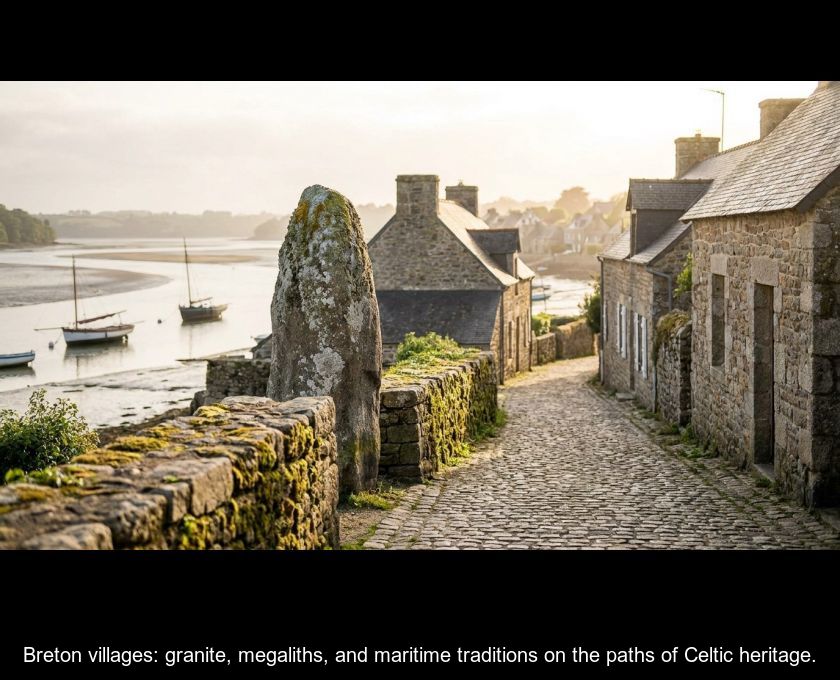
Breton Villages: Granite, Megaliths, And Maritime Traditions On The Paths Of Celtic Heritage.
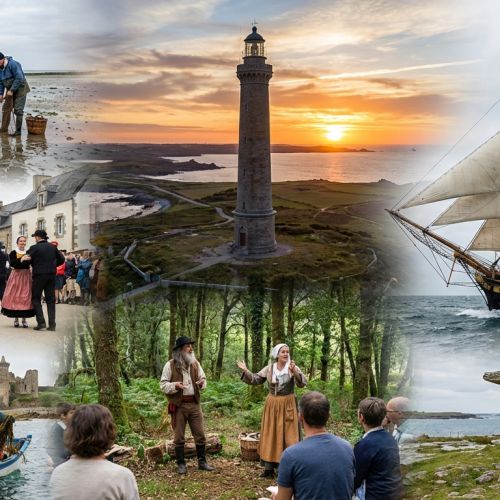
Granite walls surrounding the gardens, a menhir nicknamed Gargantua's Tooth, a Virgin facing the sea to watch over the cod fishermen... Here’s how to explore, step by step, two Breton villages that tell the story of an entire country.
Saint-Suliac, a Breton village nestled between land and sea.
Situated on the banks of the Rance estuary in Ille-et-Vilaine, Saint-Suliac has a population of 961 and rises to an altitude of 21 meters. It’s safe to say that everything here revolves around the water: the village lives to the rhythm of the tides, and its panorama of the estuary is one of the widest in the region.
What strikes you first is the layout of the streets. A true maze of narrow alleys lined with fishermen's houses and that enclose the gardens. Take the time to get lost: this is a village that cannot be explored in a straight line; you must accept dead ends and detours.
Beyond the village, several paths lead to sites you might not expect: the Beauchet tidal mill, the former Guettes salt pans created in 1736, the menhir of Chablé, or even the remnants of a Viking camp. The fishing and pleasure port constantly reminds you that many men from here were sailors.
Practical advice: from June to September, the village can be explored through guided tours (06 70 25 18 61), and the tourist office for the Saint-Malo - Mont Saint-Michel destination can be reached at 02 99 56 66 99. Cancale is 18 km away, Dinan is 22 km away: enough to build an entire day.
The granite, an identity material of the Celtic villages of Brittany.
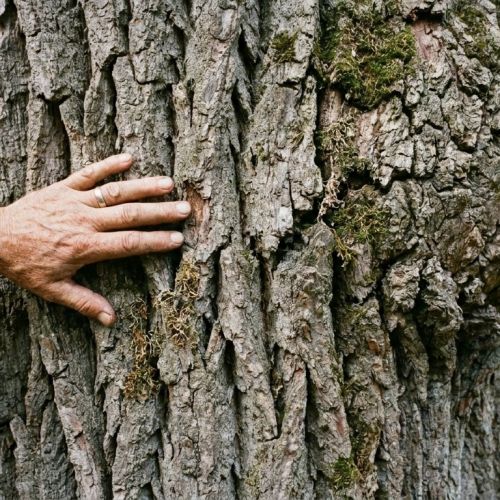
In Brittany, granite is not just a decoration; it is the raw material for everything. In Saint-Suliac, it forms the low walls that delineate gardens and alleys, it rises in the facades of fishermen's houses, and it supports the church's bell tower. In Locronan, in Finistère, the entire village seems literally draped in gray stone.
How to observe it intelligently? First, look at the masonry, that is, the way the stones are laid on top of each other: squared blocks aligned on well-kept buildings, rough stones simply propped up on the boundary walls. Next, identify the carved elements - door frames, lintels, window sills - which reveal the wealth level of the builder. Finally, note the patina: granite is covered with light lichens that change the facades from gray to pale yellow depending on the light.
Not all Breton stones are suitable for sculpture. In Locronan, the cenotaph of Saint Ronan, from the 15th century, was carved from Kersanton stone, a Breton material valued by sculptors because it allows for fine details and withstands the test of time. Elsewhere in the region, granite sometimes combines with schist: in Rochefort-en-Terre, in Morbihan, the private mansions of the 16th and 17th centuries play on this contrast, with facades of granite and richly flowered schist.
Nota Bene: a "mineral" village does not mean an austere village. The flowering, colorful shutters, and hollyhocks growing at the foot of the walls are enough to warm the whole scene - and it is precisely this contrast that makes the photo.
The parish enclosure of Saint-Suliac and its 13th-century church.
In the center of the village, the Church of Saint-Suliac, dating back to the 13th century, overlooks an old cemetery with its imposing bell tower. Together, they form a unique parish enclosure in Upper Brittany: it is the true heritage curiosity of the town, and it can be visited in ten minutes... provided you know what to look for.
Nota Bene: a parish enclosure is a closed religious complex where the church and the cemetery (and sometimes a calvary, an ossuary, a monumental gate) are gathered within the same grounds. They are mainly found in Lower Brittany, particularly in Finistère and its surroundings, which explains the rarity of the one in Saint-Suliac, located much further east.
Inside the church, look for three things: the stained glass windows, the wooden sculpture, and especially the maritime ex-votos. These are offerings made in gratitude for a wish fulfilled, often after a safe return from the sea. In a fishing village, they speak volumes more than any discourse on the anxiety of departures and the relief of returns.
To extend your visit, push open the door of La Maison des Collections (06 12 24 10 80), a small museum dedicated to the history and traditional life of the Bretons and fishermen. It is the perfect place to understand what daily life was like behind those granite facades.
The menhir of Chablé, a megalith nicknamed the Tooth of Gargantua.
Away from the village, accessible by the paths that crisscross the communal territory, stands the menhir of Chablé. The locals have long referred to it as the Tooth of Gargantua - a nickname that aptly describes the effect produced: a stone planted vertically, isolated, which irresistibly evokes the molar of a giant that has fallen there.
Nota Bene: a menhir is a large stone intentionally erected vertically by humans in very ancient times. The term megalith (literally "large stone") refers to all these monuments made of raw stone. Their exact function remains debated: territorial marker, landmark, commemorative monument... No one really decides, and that's part of their charm.
For the visit, here are some useful tips: wear closed shoes, as the access path is not a sidewalk, walk around the stone to see how its silhouette changes depending on the angle, and take note of the landscape it overlooks. These monuments have almost always been placed with regard to a horizon, a valley, or a water source.
This type of site is not isolated in Brittany: the region is dotted with standing stones and megalithic sites, such as those found near the rocks of Marlin, in a completely different part of France. But in Saint-Suliac, the interest lies in being able to combine in a single walk the Neolithic stone, the tidal mill, and the salt marshes: several millennia of uses of the same shoreline.
On the enigmatic traces of a Viking camp in Saint-Suliac
The village also preserves the enigmatic remnants of a Viking camp. The word "enigmatic" is not just a stylistic choice: the site is far from being a spectacular monument and offers little certainty. One can discern some land modifications, stories of a presence are told, and the rest belongs to interpretation.
To avoid disappointment, change your perspective: don’t look for a backdrop, seek a position. Ask yourself what the place offered to crews coming from the sea - a sheltered anchorage, an unobstructed view of the estuary, the possibility to navigate up the Rance inland. The estuary is a natural gateway, and it is this geographical logic that makes the site meaningful.
Nota Bene: at many modest archaeological sites, the essential is not visible on the surface. Stay on marked paths, do not move any stones, and do not dig: these are fragile remnants, and even the slightest disturbance can result in the loss of information.
The most enjoyable part remains to explore the curiosities of the territory along the paths: Viking camp, Chablé menhir, Beauchet tidal mill, former salt marshes of Guettes from 1736. Allow plenty of time, as one often stops to watch the water rise or fall.
Locronan, an ancient weaving city draped in granite.
Heading to Finistère, at the other end of Brittany: Locronan, 790 inhabitants, perched at an altitude of 145 meters, 7 km from Douarnenez and 15 km from Quimper. Here, the former weaving town has retained a monumental square, surrounded by stone houses, which creates a striking effect as soon as you arrive.
The village owes its name to Saint Ronan, the hermit who founded it. Thanks to the Dukes of Brittany, Locronan became one of the jewels of Breton Gothic art in the 15th century: the priory church was built between 1420 and 1480, and its 15th-century stained glass, statuary, and treasure are worth entering rather than just taking a photo of the façade.
Nota Bene: "Gothic art" is the old way of saying "ogival art." The ogive is the pointed arch that replaces the round arch of the Romanesque period, with a decisive technical advantage: it allows for taller structures and larger windows.
This elegance, both Renaissance and mineral, has naturally attracted cinema: Philippe de Broca filmed Chouans! here, and Jean-Pierre Jeunet shot A Very Long Engagement. The village can also be visited on guided tours, for groups as well as individuals (information at 02 98 91 70 14).
Saint Ronan and the druidic roots of the Névet woods
Before the church and before the town, there is the forest. The wood of Névet, still inhabited by the memory of druidic worship, hosts the hermitage of Ronan in the 6th and 7th centuries. This represents one of the most common patterns of Breton heritage: an ancient place of worship, then a founding saint who settles there, followed by a parish that grows around it.
The memory of Ronan has remained at the heart of the village. Adjacent to the church, the chapel of Pénity, from the 15th and 16th centuries, houses his tomb effigy: a 15th-century cenotaph carved from Kersanton stone. Also worth seeing is the chapel of Notre-Dame-de-Bonne-Nouvelle from the 16th century, with its modern stained glass windows by Alfred Manessier, its calvary, and its washhouse - the blend of an ancient building and contemporary stained glass works very well.
This past is still reenacted today on foot during the Troménies. The Petite Troménie takes place every year in July, on the second Sunday, in the form of a pardon. The Grande Troménie, on the other hand, only occurs every six years, over a week, and takes the form of a long procession through the countryside.
Nota Bene: a pardon is a traditional Breton pilgrimage that combines mass, procession, and local festivities. The Troménie of Locronan is the most impressive version, as it involves walking a circuit outside the town. For walking outside festival periods, note that the GR 38 passes through here and that the wood of Névet is equipped with marked trails, including a loop accessible to people with motor disabilities, as well as mountain biking routes.
The golden age of Locronan thanks to the East India Company.
During the Renaissance, Locronan changed in scale. The town's weaving factory extended its reputation far beyond Cornwall: the East India Company favored it, and Locronan's hemp fabrics outfitted the ships of the Royal Navy. In other words, this small village supplied the sails for large boats.
You can see this prosperity directly in the square. The East India Company hotel and the 17th-century homes of the king's notaries and merchants still stand there. The landmark to look for is simple: the more a house features dressed stone, large regular openings, and sculpted ornaments, the more its owner was involved in this thriving trade.
To understand the technical gesture, visit the Charles Daniélou Museum of Art and History (02 98 51 80 80). There, you can see an 18th-century loom, the making of traditional costumes, a collection of fabrics from about fifty painters of the early 20th century, Breton costumes, and temporary exhibitions.
And the thread is not broken: the village still has active weavers, alongside other crafts. It is one of the few places where you can see the old loom in the museum in the morning and a living workshop in the afternoon.
The Virgin of Grainfollet, tribute to the Breton fishermen.
Return to Saint-Suliac, and this time looking up. Above the village stands the oratory of the Virgin of Grainfollet, patroness of the terre-neuvas. It bears witness to the heavy toll that these "shore farmers" had to pay to the sea to ensure the livelihood of their families: many men from here were sailors, and not all returned.
Nota Bene: the term terre-neuvas refers to the fishermen who went to catch cod on the banks of Newfoundland, off the coast of Canada. These expeditions lasted for long months, far from their families, in extremely harsh conditions. Understanding this word is key to understanding why a statue of the Virgin watches over a Breton estuary.
The viewpoint of the oratory is accessible via the coastal path, but be careful: only at low tide. In practical terms, check the tide schedule before you leave, calculate your return with some leeway, and do not improvise the crossing if the water begins to rise. This is the basic rule on all coastal paths in Brittany.
Devotion is still alive: a gathering dedicated to Grainfollet brings the village together in mid-August. And in September, on the last weekend, the nautical festival of Copeaux d'abord brings boats and the port atmosphere back to the center of the village.
Flavors and know-how, the living heritage of Breton terroir.
A Breton village is as much about tasting as it is about visiting. In Saint-Suliac, local products can be summed up in two simple and remarkably effective words: cider and buckwheat pancakes. In Locronan, you can add galettes, Breton cake, and kouign-amann, the buttery caramelized sugar cake that should be eaten warm, without counting the calories.
Nota Bene: "buckwheat" is the Breton name for buckwheat. It is not wheat at all, and it contains no gluten. It gives the savory pancakes their dark color and slightly nutty flavor, in contrast to sweet wheat crêpes.
In terms of craftsmanship, the two villages operate in different registers. Saint-Suliac embraces the world of the sea, featuring a watercolor painter and a gallery of marine objects. Locronan boasts a density of workshops that is quite rare for its 790 inhabitants:
- weavers and textile work,
- ceramicists, wood sculptors,
- leather, tin, and steel work, leather goods,
- watercolorist, painters, art photographer,
- antique dealer and Celtic bookstore.
To plan your visit, align yourself with the markets. In Saint-Suliac, there is a summer market every Tuesday from mid-June to mid-September, starting at 4 PM. In Locronan, there is a market on Tuesday mornings at the Town Hall square, and the Star Markets, evening markets combining crafts and local products, on Thursdays from mid-July to mid-August.
In summary: start with the granite and the alleys, enter the church for the ex-votos and statuary, walk to the menhir or through the Névet woods, and finish with a workshop and a galette. Just check the tide times for the Grainfollet coastal path, and inquire in advance with the tourist offices (02 99 56 66 99 for Saint-Suliac, 02 98 91 70 14 for Locronan): this little reconnaissance transforms a pleasant stroll into a true dive into Breton heritage.