Online Trading: Between Real Opportunities And Risks To Manage
Buying Apple stocks, betting on gold or the euro-dollar pair from your couch in just a few seconds... What used to be the domain of trading floors is now accessible to anyone with a smartphone. Online trading has rapidly democratized, driven by increasingly user-friendly platforms. However, behind the promise of quick gains lies a much more nuanced reality. We offer you an overview of the opportunities, the risks (which are real), and the good practices to adopt before getting started.
Online trading, what exactly are we talking about?
Trading involves buying and selling financial products with the aim of profiting from fluctuations in their prices. The internet has completely changed the game by opening up markets to individuals through simple platforms and mobile applications. To navigate this, many beginners are on the lookout for the best trading app, like the one offered by a broker such as XTB, which combines access to a wide range of assets in a single tool. Because we are no longer limited to just stocks.
Today, from a single account, you can trade on:
- stocks and ETFs (these funds that replicate an index or a basket of values),
- stock indices like the CAC 40 or the S&P 500,
- commodities (gold, oil, gas...),
- currencies on the foreign exchange market known as Forex,
- CFDs, contracts that allow you to bet on both rising and falling prices.
Note: some of these products, particularly CFDs, rely on leverage. They are significantly riskier than simply buying stocks and require a true understanding of how they work.
Markets accessible from a simple smartphone.
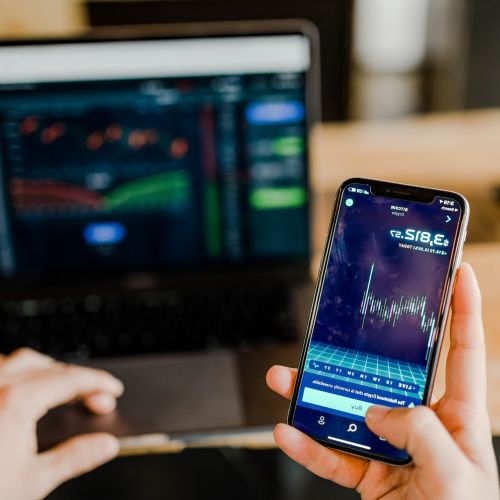
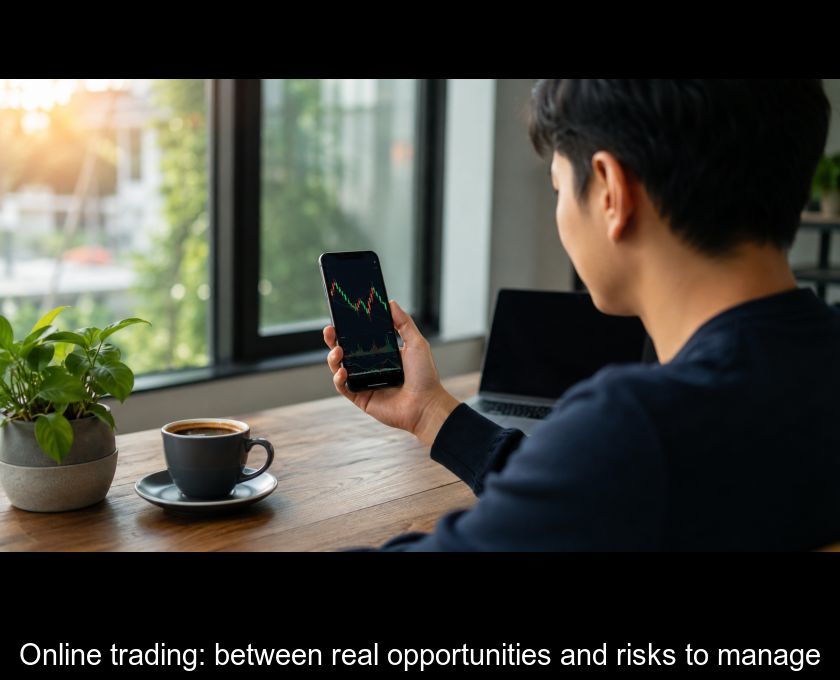
Not so long ago, following the markets required being seated in front of multiple screens. Today's trader can check their positions on the subway. The mobile application has become the natural extension of the trading platform, and this is undoubtedly what best explains the enthusiasm of individuals for this activity.
A worthy application generally offers real-time charts, technical analysis indicators, customizable price alerts, and quick order execution. The best ones also include a demo account and educational content. The xStation platform from XTB, for example, focuses on a clean interface combined with more advanced tools (screeners, economic calendar, indicators...), catering to both beginners and more experienced traders.
Warning: while ease of access is a tremendous advancement, it has a downside. Trading in just a few clicks, anywhere and anytime, can lead to impulsive operations. However, impatience can be costly in the markets.
The opportunities offered by online trading.
Let's start with the glass half full, as the advantages are real. The first is accessibility: you can now start with just a few dozen euros, whereas the stock market seemed reserved for an elite twenty years ago. Fees have also decreased. Competition among online brokers has driven prices down, with fee structures often more transparent than before.
Next comes diversification. Being able to invest in French and American stocks, commodities, or currencies from the same place allows for spreading investments (and thus, in theory, risks). Forex alone illustrates the vastness of these markets: nearly $9.6 trillion is traded there every day, making it the most liquid market on the planet, far ahead of stock markets.
Finally, and this point is often underestimated, online trading comes with a real educational dimension. Webinars, market analyses, explanatory articles, video tutorials... Serious brokers, including XTB, offer free resources to learn progressively. This is a valuable asset to avoid moving forward blindly.
The risks that one would be wrong to underestimate.
Let's now turn to the half-empty glass, as it would be dishonest to present trading as a paradise. The first danger has a name: **leverage**. It allows you to take a position much larger than your capital. Gains are multiplied... but so are losses, and just as quickly.
The numbers are here to bring us back to reality. Over a four-year observation period, the **Financial Markets Authority** found that nearly **9 out of 10 individuals** lose money on CFD and Forex trading. Among the most active investors, the average loss even exceeded **18,000 euros**. These instruments, the regulator concludes, remain poorly suited to the vast majority of individuals.
Fortunately, the framework has significantly tightened to protect savers. Since 2018, under the impetus of the European regulator (ESMA), several rules apply in France:
- leverage is **capped at 30 to 1** on major currency pairs, and much lower on more volatile assets,
- **negative balance protection** ensures that you will never lose more than the deposited capital,
- binary options are **prohibited** from being sold to individuals,
- brokers must **clearly display** the percentage of their clients who lose money.
**Note:** these safeguards only apply if you go through a regulated broker. Platforms based outside of Europe, which promise excessive leverage, escape these protections and account for most of the scams reported each year.
The right habits to start confidently.
Should we therefore flee online trading? No, but it should be approached methodically rather than greedily. Here are some common-sense principles.
- Start with a demo account. It allows you to practice with fake money in real market conditions. It's the best way to get familiar with a platform without risking a dime.
- Check the broker's regulation. A serious player is registered with the AMF or an equivalent European regulator. In case of doubt, the Regafi register can confirm this.
- Educate yourself before investing. Understanding a spread, a stop order, or leverage is not optional; it's a prerequisite.
- Only invest what you can afford to lose. This rule is repeated everywhere because it is true.
To go further on the basics, our tips for investing in the stock market as a beginner provide a good starting point. Our file on online stock trading usefully complements the picture.
Conclusion
Online trading is neither the dreamed-up sure thing nor the systematic trap that some describe. It is a powerful tool that rewards rigor and punishes improvisation. Opportunities do exist, provided you keep in mind that the majority of overly eager individuals end up losing. The good news is that caution, education, and a reliable broker can radically change the game. Take the time to learn before going all in; your wallet will thank you.
Note Well
Some useful terms to avoid getting lost in the jargon:
- CFD: Contract for Difference. A derivative product that allows speculation on the rise or fall of an asset without owning it, most often with leverage.
- Leverage: A mechanism that allows investing an amount greater than one's actual capital. It amplifies both gains and losses.
- Forex: The foreign exchange market, where currencies (euro, dollar, yen...) are traded.
- Spread: The difference between the buying price and the selling price of an asset. It is one of the main sources of income for brokers.
- ETF: An exchange-traded fund that replicates the performance of an index or a basket of assets, with low fees.
- Demo account: A practice account funded with virtual money, ideal for testing a platform and its strategies without risk.