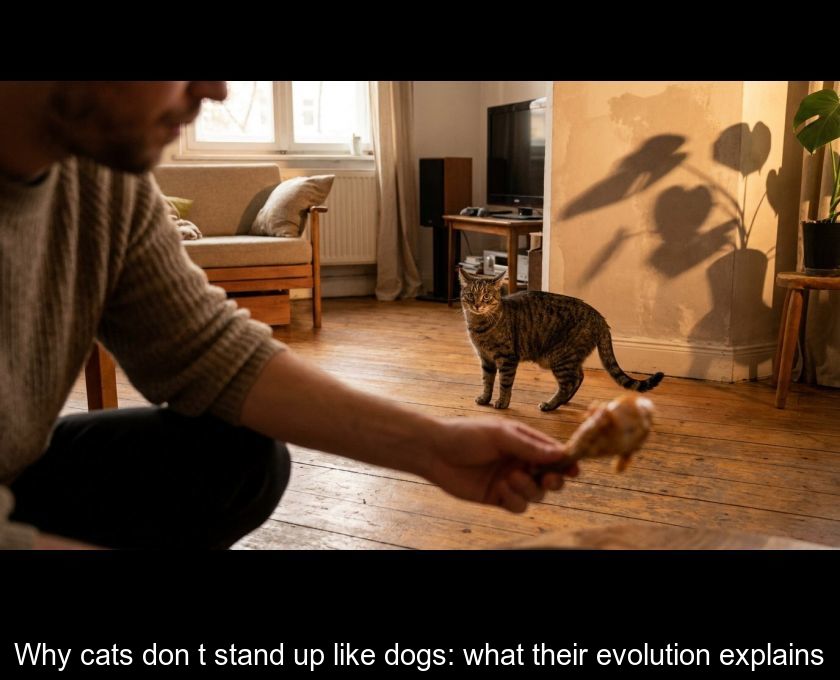
Why Cats Don't Stand Up Like Dogs: What Their Evolution Explains
Your cat watches you, clearly understands, and doesn't move a muscle. No, it's not mocking you: its brain, its past as a solitary hunter, and its genetics dictate something entirely different than a dog's. Here is, concretely, why and how this changes the way to approach it.
Operant conditioning: the mechanics of all training
All animal training, whether for dogs or cats, is based on a simple principle: the animal does something, and a predictable consequence follows. A good consequence (a bite of food) leads to the behavior being repeated. A bad consequence causes it to disappear. This is called operant conditioning, and it is the foundation of everything professional trainers do.
In practice, we proceed through successive approximations, which is known as positive reinforcement. Let's take a telling example: most cats, quite reasonably, will never jump over an obstacle they can go around. To get a jump on command, we first reward the cat simply for stepping over a stick placed on the ground, then for jumping over it when we lift it a little, and finally, with the stick raised higher, we only reward actual jumps.
Once the behavior is acquired, trainers further reinforce it by rewarding only one success out of two or three. This may seem counterintuitive, yet animals concentrate more when the outcome is slightly uncertain than when it is guaranteed (slot machines exploit exactly the same mechanism in humans). For more complex sequences, we start from the end: if you want a cat to spin around and then give its paw, teach it the paw first, and only then the spin that precedes it. This backward chaining works much better, which says a lot about the animal's limited anticipation abilities.
Nota Bene: There are two main learning mechanisms. Respondent conditioning (also known as Pavlovian) associates two events that occur almost simultaneously, such as the can opener and the smell of food, for example. Operant conditioning, on the other hand, associates an action of the cat with its consequence. The first teaches the cat how the world is made, while the second teaches it how to act upon it.
Fewer raw behaviors to sculpt.
The first reason for the cat's reputation for indocility: training an animal is not about inventing behavior; it's about shifting the signal that triggers a behavior it already possesses. Nothing is created from scratch; we take raw material and put it under control.
However, the cat provides little that is useful to us. The dog, on the other hand, is full of it: the work of a herding dog is merely an assembly of sequences derived from the hunting behavior of the wolf, its ancestor—the pursuit, the encirclement, the control of the herd's movement—of which the killing aspect has been disabled. These are building blocks that are already there, just waiting to be reorganized.
In the case of the cat, apart from its hunting talent, there is almost nothing that training can improve in a truly useful way. And its hunting talent, precisely, works perfectly without us: it will go catch the mice in the attic or warehouse whether we ask it to or not. Thus, it mainly remains a source of entertainment, which explains why the only people who actually train cats are professionals who prepare them for film and television.
The dog watches us, the cat looks elsewhere.
Second reason, and probably the most decisive: the cat is naturally much less attentive to people than the dog. This is not arrogance; it’s history. For millennia, nearly all the uses that humans have made of dogs have favored those who could read our intentions over those who could not. The result: the dog has become an exceptional observer of what we expect from him.
The cat has known nothing of the sort. It follows a simple gesture indicating a direction very well, so it’s not a matter of acuity. But place it in front of a problem it cannot solve: it does not turn to its owner for help. A dog does this automatically, almost immediately.
This difference changes everything in a learning session. Training assumes that the animal seeks information from the human, that it waits for the signal, that it scrutinizes your hand and your voice. The cat, on the other hand, behaves as if it instinctively misunderstands how humans operate, and that is the case: almost everything it knows about us, it has learned through associations, one by one, without any hereditary instruction manual.
A lasting scientific blind spot
An unexpected factor must be added: we have studied cat intelligence much less than that of dogs. Cats were very popular subjects for experiments in the 1960s and 1970s, but they were largely overshadowed by man's best friend, for a very prosaic reason: dogs are easier to train, and therefore easier to test.
This imbalance perpetuates the misunderstanding. Researchers working on canine cognition have only recently begun to design tests suited to the particular way a dog interprets the world. For cats, this work is still largely to be done, and it is possible that the few situations in which they have been tested are precisely those where their evolution has led them to rely on simple, short-term learning.
One example: cats have been taught to pull a handle connected by a string to a treat slipped under a grid. Many succeed easily, so it is believed that they "understand" the connection. However, when a second handle was added, with only one connected to the food—a perfectly visible difference—cats continued to pull randomly, unable to predict which one would work. They failed just as much when the strings were crossed. In other words, pulling the handle was for them merely an arbitrary action followed by a reward: pure operant conditioning, not reasoning about causes.
A caress doesn't pay: the cat wants something concrete.
Third reason, very practical: a dog works for a pat. A simple stroke from its owner is a powerful reward for it, and this often suffices to support an entire learning process. Very few cats operate this way. Human attention, in itself, does not motivate them.
This is why cat trainers are often left, so to speak, with food rewards. And since giving a treat for every correct response is not very manageable, they rely heavily on secondary reinforcers: a signal that is initially completely neutral, which becomes rewarding because it has been associated, again and again, with the arrival of food.
The clicker is the most common tool in this category, and any owner can use it. The principle: you click at the exact moment the cat performs the correct action, then give the treat. After enough repetitions, the click itself marks the behavior with a precision that no hand can achieve, and the cat instantly knows what has just been validated.
One crucial detail: associations only form if the two events are almost simultaneous, with a maximum gap of one or two seconds. Scolding a cat several minutes after a misdeed does not connect anything to that misdeed; it connects your annoyance to what just happened, usually your entrance into the room.
What the dog owes to the wolf
The dog descends from a cooperative hunter specialized in large prey. Hunting together requires coordination, following another's initiative, and reading their intentions from the slightest body movement. This entire social machinery has been inherited by the dog, and we have subsequently connected it to ourselves.
It is also a gregarious species that lives in stable groups, like us. In a stable group, emotional honesty is not penalized: one can afford to display what they feel. The dog therefore openly expresses its emotions, and we react in ways that benefit it - we back away when it growls, we pet it when it wags its tail. The dialogue sustains itself.
The consequence is clear: an unsupervised dog is a problem, a trained dog is a tool. We take responsibility for directing its attention towards the "prey" that interests us, whether it's a herd, game, or an object to retrieve. It is made to receive this direction. The cat, however, is not.
A solitary hunter that cannot be directed.
The cat, on the other hand, descends from a solitary hunter that tracks small prey, alone, without consultation. No one has ever told it what to catch, and its brain is not equipped to receive that kind of instruction. When its hunting instinct and a human command contradict each other, the instinct almost always wins.
One experiment illustrates this beautifully. In a corridor just over two meters long, a speaker emitted a high-pitched, clicking sound at one end, while food appeared at the other end—and disappeared if the animal did not run fast enough to reach it. Rats learned this very quickly and reliably: they would sit, wait for the sound, and dash in the right direction.
Cats, however, needed hundreds of repetitions. They understood perfectly that the sound signaled food, but they almost always started by running toward the sound instead of away from it. Some became so confused that they refused to eat the food even when they reached it in time. And even once the task was mastered, they would still glance at the speaker before leaving.
This does not mean that rats are more intelligent. It means that for a hungry cat, a high-pitched sound means "prey," and that is information far too important to be ignored. For the rat, the same noise was just an arbitrary signal, as neutral as a can opener is to us.
Independence, that flaw we adore.
The wild cat lives alone and manages on its own, except during its very first weeks. For the male, success comes through competition, not cooperation: convincing a female, driving rivals away. Hence a behavior characterized by posture, bluff, and emotional discretion—cats hide their emotions, not so much from us as from each other.
This autonomy also explains the reserve for which they are often criticized. The domestic cat depends on us for food, shelter, and protection, but not for long enough to have developed the enthusiastic welcome of the average dog. It’s not that they are incapable of attachment; their means of expressing it are simply more limited.
And then, in a delicious irony, it is often the cat that trains us. Wild cats are remarkably silent and meow very little among themselves, while meowing is the emblematic cry of the pet cat. It is directed at humans because we are not very observant creatures, with our noses in our screens and books, but who look up at the slightest unusual noise.
Some cats then refine their requests, exactly as a trainer would: meowing by the door to go out, in the middle of the kitchen to eat, modulating their intonation according to the result obtained. These meows vary from one cat to another and are truly decodable only by their owner, proving that they are learned and arbitrary sounds—a private code, not a universal language.
Anthropomorphism, our favorite bias
The big trap when judging a cat's obedience is to attribute our own reasoning to it. An old example sums it all up: a cat that learned to lift the outdoor doormat and let it fall, producing a sort of "knock knock." One immediately concludes that it is knocking to enter, thus it has a goal, a plan.
Now take those cats that open lever-handle doors by jumping on them. The trick seems clever, but it can be explained very simply. Lever doors are not part of the world in which the cat evolved: the perfected version cannot therefore be innate. It all starts with a common reflex - when a cat cannot go where it wants, it jumps to a higher point to see if there is another way. From the ground, the lever looks like a platform. It jumps, the lever gives way, it loses its balance... and the door opens. Exploring a new room is in itself a reward for a territorial animal. After various attempts, it eventually retains the most economical gesture: one paw, a downward pressure.
Even caution applies to emotions. Many people are convinced that their dog takes a "guilty look" when its misdeed is discovered. A clever experiment settled this: owners were asked to deny their dog a treat and then leave, and unbeknownst to them, some dogs were encouraged to eat it, others were not. Upon returning, all owners were told that their dog had stolen the treat - and all dogs immediately took on a guilty look, whether guilty or not. They were not reacting to a wrongdoing, but to their owner's body language.
The cautious rule that animal psychology has long followed is this: never explain a behavior by a higher mental faculty when a simpler one suffices. It’s frustrating, but it prevents one from saying nonsense.
Not less intelligent, differently intelligent.
Ultimately, these differences do not place the cat below the dog. They show that its intelligence is suited for a different role. The cat finely assesses relative sizes, which is essential for deciding whether to attack a nearby small rat or to steer clear of a distant large rat. It reconstructs a partially hidden shape; a mouse's snout and tail behind a plant still represent a single mouse. Outside, in a familiar territory, it takes shortcuts, proving that it has built a true mental map, and when faced with two paths, it chooses the shortest one.
On the other hand, its memory of where a prey has disappeared lasts only a few seconds—beyond that, it has either fled or burrowed, and insisting is pointless. It also does not perceive social relationships with the finesse of a dog. Much of its intelligence is focused on two objectives: obtaining food and defending territory.
What to do with all this, concretely? Forget about petting as a reward, work with bites of food, possibly using a clicker, and reward within a second. Only ask for variations of gestures it already performs, in small steps, starting from the end for sequences. Keep sessions very short, and alternate toys instead of fixating on the same one: it’s the toy that bores the cat, not the game—a slightly different model, another color, another texture, another scent, and the desire returns all at once.
And above all, stop expecting the cat to ask for your permission. Its independence is neither a whim nor a lack of affection: it is the operating manual of a solitary hunter that thousands of years of shared life have not rewritten. It is also, let’s admit it, exactly what we love about it.