
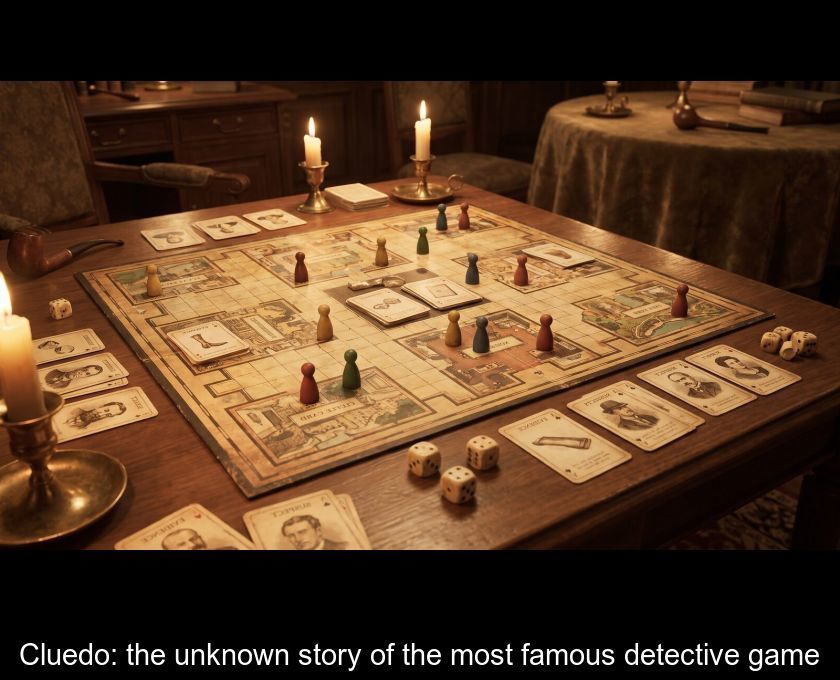
Cluedo: The Unknown Story Of The Most Famous Detective Game
Colonel Mustard, in the library, with the candlestick. Who has never uttered this solemn accusation over a Cluedo board on a rainy day? For more than seventy-five years, this board game has ruled family mystery nights without competition. We think we know everything about it, yet its history holds many surprises, including bombings, a forgotten patent, and an inventor who fell into complete anonymity. Here is the little-known story of the most famous crime game.
The game that the whole world knows
It's hard to find someone who has never played Cluedo. Sold in dozens of countries and available in countless versions, it is one of those timeless classics that smoothly transcends generations. The premise is known to all: a murder has been committed in a mansion, and you must discover who did it, with what weapon, and in which room.
This clear formula has traveled around the globe. In the United States, the game is called Clue, while elsewhere it's Cluedo, but everywhere the pleasure remains rigorously the same—the joy of stepping into the shoes of a detective for the duration of a game. Its enduring success is such that one might almost forget that it had to be invented from scratch at some point.
For behind its apparent simplicity, Cluedo is a small marvel of ingenuity. Combining the thrill of a detective novel, the joy of deduction, and the conviviality of a game among friends was no easy feat. It required finding the right balance between the randomness of movement and the logic of reasoning, carefully dosing the clues, and making the whole experience accessible without oversimplifying it. A subtle blend that its inventor nearly achieved on the first try, and that no one has ever truly managed to improve since.
A game born under the bombs
The story begins in World War II England. Its creator, Anthony Pratt, is far from a professional game designer. He is a musician and factory worker who hosts musical evenings at private homes in his spare time. There, he observes his hosts enjoying murder mystery games for fun. A great reader of detective novels, especially those by Agatha Christie, he comes up with a brilliant idea.
Forced into inactivity during curfews and air raid alerts, Pratt develops, around 1943, a game where the objective is to uncover a murderer. His wife, Elva, helps him refine the rules and the board. Unbeknownst to them, the couple has just created one of the greatest successes in the history of board games.
From
In 1944, Anthony Pratt filed a patent for his invention, which he initially modestly named Murder. The couple presented the game to Waddingtons, a renowned British publisher, whose leader immediately sensed a good deal. He bought it on the spot and gave it a much more clever name, Cluedo, a nice portmanteau formed from clue, the English word for hint, and ludo, Latin for I play.
The patent was granted in 1947, but post-war shortages delayed its release. It wasn't until 1949 that Cluedo finally hit the shelves in British stores before embarking on a journey to conquer the entire world. The success was immediate, and above all, it never waned over the decades.
Nota Bene: A sad irony of history, Anthony Pratt never made a fortune from his invention. Having relinquished his rights, he only received a modest sum for a long time before fading into obscurity, far from the global triumph of his game. He passed away in 1994, and it is said that his neglected grave was restored much later by grateful admirers.
Six suspects, six weapons, nine rooms.
The genius of Cluedo lies in a mechanism of disarming simplicity. To win, one must answer three questions: who, with what, and where? For this, there are six colorful suspects, from Colonel Mustard to Miss Scarlet, six weapons, from the revolver to the candlestick, and nine rooms to explore. By patiently cross-referencing the clues, each player eliminates possibilities one by one until the truth is revealed.
Interestingly, Pratt's original game was much more elaborate, featuring around ten characters and far more exotic weapons. The publisher wisely chose to streamline it, retaining only the essentials. This elegant reduction of six, six, and nine likely partly explains the game's extraordinary longevity, being as accessible for a child as it is engaging for an adult.
A few tips to win.
Behind its apparent simplicity, Cluedo hides a well-strategic heart and rewards methodical players. The first instinct is to keep your notes with the precision of a watchmaker, as the game sheet is your best ally. The second is to carefully observe the reactions of others, as a player unable to refute a hypothesis gives you valuable information.
Also, think about asking clever questions, even if it means inquiring about cards you already hold, in order to confuse your opponents. Ultimately, winning at Cluedo comes down to thinking like a true detective, cross-referencing clues, tracking revealing silences, and methodically tightening the noose around the culprit.
Much more than just a board game
Over the decades, Cluedo has largely transcended the confines of the board game to become a genuine cultural phenomenon. Its numerous special and themed editions transport the investigation into the worlds of famous films, series, or video games. The original mansion has thus transformed into a spaceship, a wizarding school, or a medieval city, much to the delight of collectors.
The game has even inspired cinema. As early as 1985, a wacky American comedy brought Cluedo to the screen, featuring several alternative endings depending on the theater, a mischievous nod to the game's mechanics. Over time, this film has become a cult classic, firmly establishing Colonel Mustard and his accomplices in popular culture.
This extraordinary longevity is undoubtedly due to a simple secret. Cluedo relies neither on luck nor on knowledge, but on a universal and timeless pleasure: the joy of conducting an investigation and catching the culprit solely through logic. Both young and old find common ground, which is why it continues to bring families together around the table, generation after generation. A remarkable feat for a game born in an English living room during the darkest days of the war.
The crime in the living room comes to the screen.
Today, there's no need to gather five players around a table to conduct an investigation; computers and phones have taken over. Digital mystery games offer everyone their own little pocket mansion, available at any time, with a fresh puzzle to solve at their leisure.
This is the whole premise of Onisogo, the online investigation game, which captures the spirit of Cluedo: a location, suspects, clues, turning it into a pure logic challenge free from any chance. The modern heir to the parlor game, in a way. And if you feel like going for a live-action experience, find out how to organize a successful murder party. The fun of Cluedo, but this time in real life and with friends.