
Buddhism: Four Noble Truths And Monastic Life Explained Simply
From suffering to awakening, through life behind the walls of a monastery: this is what you really need to understand about Buddhism, without unnecessary jargon.
Buddhism, a major religion in Asia
In the West, there is a tendency to categorize Buddhism as a 'philosophy of life' rather than a 'religion.' This is somewhat reductive. Buddhism is indeed a fully-fledged religious tradition, with its texts, rituals, monastic communities, and hundreds of millions of practitioners around the world.
What immediately distinguishes it from the three major monotheistic religions (Judaism, Christianity, Islam) is the absence of an all-powerful creator god. Here, there is no deity to pray to for salvation: it is up to the individual to do the work, through their own practice and understanding of reality.
This religion developed in Asia and remains deeply rooted there today, while also having spread well beyond its place of origin.
Situate Buddhism among the major Asian religious traditions.
Asia has never been a religiously uniform continent; quite the opposite. Buddhism has coexisted for centuries with Hinduism, Japanese Shintoism, and other equally vibrant local traditions.
What is interesting is that Buddhism did not arise in a vacuum: it emerges directly from the Indian spiritual soil, in reaction to and in dialogue with the already well-established Hinduism. It adopts certain concepts (karma, the cycle of rebirths) while reinterpreting them in its own way.
Thus, Buddhism can be seen as one of the great Asian spiritual paths, neither entirely separate nor simply a variant of another religion. It has its own coherence, its texts, its schools.
The historical origins of Buddhism
Buddhism finds its origin in the teachings of a man, Siddhartha Gautama, better known as the Buddha (literally 'the Awakened One'). He is believed to have lived in Northern India, in a region corresponding to present-day Nepal and northeastern India.
The story, partly legendary, recounts that he was born a prince, shielded from all suffering by his father, before discovering upon leaving his palace old age, illness, and death. This existential shock drives him to leave everything behind in search of an answer to the problem of human suffering.
After years of extreme asceticism and then meditation, he attains enlightenment, what is called nirvana: the liberation from the cycle of rebirths. It is this experience, and the teachings that arise from it, that form the foundation of Buddhism.
The context of the emergence of Buddhism in Asia.
Buddhism arises in a spiritually vibrant India, where many schools of thought seek to answer the same fundamental questions: why do we suffer, how can we escape the cycle of rebirths, what is the meaning of existence.
Hinduism already largely dominated the religious landscape with its castes, sacrificial rituals, and complex cosmology. Buddhism appears partly as a challenge to this system, particularly to the caste hierarchy, by proposing a path open to all, regardless of birth.
From this Indian cradle, the religion then spread to Sri Lanka, Southeast Asia, and later to China, Tibet, Japan, and Korea, transforming along the way into several major schools.
The doctrinal foundations of Buddhism
At the heart of Buddhist doctrine is a simple yet radical observation: existence is marked by suffering, and this suffering has a cause that can be identified and eliminated.
This religion does not rest on faith in a revealed dogma but on a method of observation and understanding of one's own mind. The term dharma is often used to refer to both the teachings of the Buddha and the universal law he uncovered.
This doctrinal foundation is traditionally summarized in four main assertions, known as the Four Noble Truths. It is somewhat the backbone of all Buddhist thought, the framework upon which everything else is built.
Presentation of the Four Noble Truths
The Four Noble Truths constitute the first teaching given by the Buddha after his enlightenment. They function somewhat like a medical diagnosis: one recognizes a problem, identifies its cause, asserts that a remedy exists, and then describes that remedy.
These four truths are, in order: suffering exists, suffering has an origin, suffering can cease, and there is a path that leads to this cessation.
This very structured logical framework explains why Buddhism is sometimes perceived as a 'pragmatic' religion, almost clinical in its approach. One is not asked to believe; one is invited to observe and verify for oneself.
The first truth: suffering
The first truth states that life is intrinsically marked by suffering, called dukkha. It is not just about physical pain or obvious misfortune, but a deeper dissatisfaction, lurking even in moments of pleasure.
Being born, aging, falling ill, dying: these are inevitable sufferings. But there is also the suffering of not getting what one desires, or conversely, being separated from what one loves.
This truth is not pessimistic in itself; it aims to be clear-sighted: recognizing suffering is the essential first step before one can act upon it. One does not heal a malady one refuses to name.
The second truth: the origin of suffering.
The second truth addresses the cause of this suffering. According to Buddhist teaching, the root of evil lies in desire and attachment, this thirst (tanha) that constantly drives us to want to possess, hold on to, or escape.
We desire what we do not have, we cling to what we have for fear of losing it, we reject what displeases us: this mechanism perpetuates an endless cycle of dissatisfaction. It is this dynamic of desire and aversion that also fuels the cycle of rebirths.
Understanding this origin is not about judging desire as a moral fault, but rather observing its functioning in order to better free ourselves from it.
The third truth: the cessation of suffering.
The third truth states something important: suffering is not a fatality. Since it has a cause, we can act on that cause and thus put an end to it.
This state of cessation of suffering is precisely what is called nirvana. It is not a paradise in the sense that it is generally understood, but rather the extinction of desire and ignorance that keep the wheel of suffering turning.
This truth gives all its meaning to Buddhist practice: if liberation is possible, then it is worth committing to the path that leads to it.
The fourth truth: the path to liberation.
The fourth truth precisely describes this path, known as the Noble Eightfold Path. It consists of eight elements generally organized into three main categories: wisdom, ethical conduct, and mental discipline.
It includes right view and right intention (wisdom), right speech, right action, and right livelihood (ethics), followed by right effort, right mindfulness, and right concentration (mental discipline, including meditation).
This path is not a dogma to be recited but a practice to be embodied in daily life, in one's words, actions, and mind. It is this very concrete dimension that explains the central place of meditation in the lives of Buddhist practitioners.
Monastic life in Buddhism
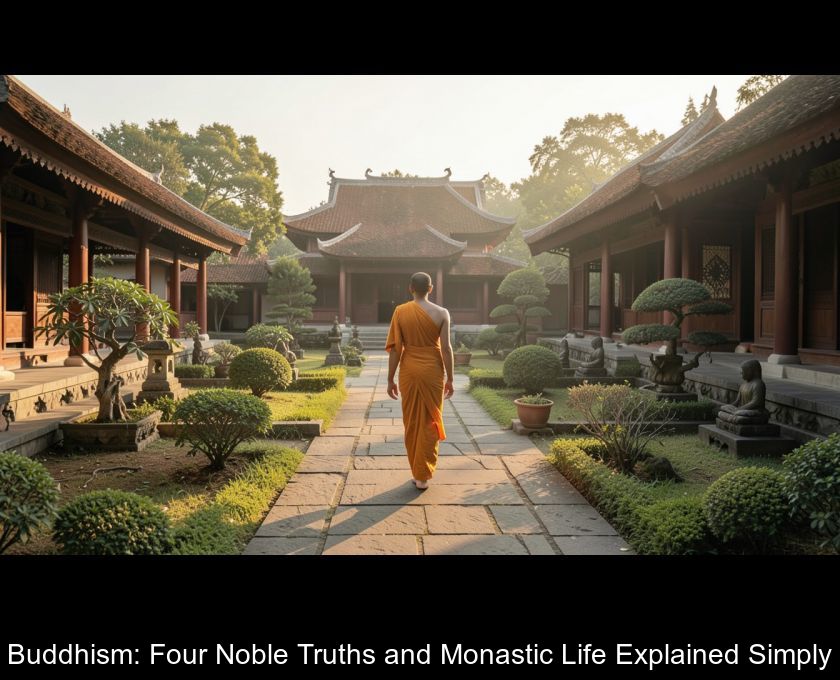
For many practitioners, fully following the Noble Eightfold Path implies leaving secular life and committing to an existence entirely focused on practice. This is where monastic life comes into play, a historical pillar of Buddhism since its origins.
The community of practitioners, known as the sangha, includes both monks, nuns, and laypeople. However, it is the monks and nuns who embody the most radically liberation-oriented lifestyle.
This organized religious life has allowed Buddhism to transcend centuries and borders, passing down texts, teachings, and practices from one generation to the next.
The structural organization of Buddhist monasteries
A Buddhist monastery is not just an isolated building; it is a small organized society with its own operating rules. It typically includes spaces dedicated to meditation, teaching rooms, communal living areas, and zones reserved for daily life.
The monastic community often operates in a fairly hierarchical manner, with older monks mentoring newcomers, transmitting texts, and ensuring adherence to collective discipline.
Historically, these structures have also played a role as intellectual and spiritual centers for the surrounding populations, far beyond mere religious practice.
The role of monks and monastic discipline
The life of a Buddhist monk or nun is framed by a precise code of discipline, which governs both behavior and the material possessions allowed. The general idea is to minimize attachments and distractions in order to fully dedicate oneself to practice.
On a daily basis, this translates into hours of meditation, the study of texts, participation in collective rituals, as well as very concrete tasks related to community life.
This strict framework of life is not an end in itself: it aims to create the most favorable conditions for progressing on the path described by the fourth truth, the one that leads to the cessation of suffering.
Buddhism and other religions of Asia (Hinduism, Shintoism)
Buddhism has never evolved in a vacuum: it has constantly engaged in dialogue, borrowed from, and sometimes confronted other major religious traditions in Asia. With Hinduism, from which it is directly derived, it shares concepts like karma and the cycle of rebirths, while distinguishing itself on the question of the individual soul and the rejection of the caste system.
In Japan, however, Buddhism arrived in a landscape already occupied by Shintoism, the local animist religion centered on the kami, the spirits that inhabit nature. Rather than excluding each other, the two traditions eventually coexisted and blended in the daily practices of the Japanese people.
This ability of Buddhism to adapt and overlay local beliefs largely explains its immense spread across the entire Asian continent.
Summary: understanding Buddhism in general religious culture
At its core, Buddhism offers a rather unique interpretation of the religious phenomenon: no creator god to worship, but a diagnosis of the human condition and a method for liberation from it. The Four Noble Truths are its logical heart, and monastic life represents its most accomplished expression.
Retaining the structure of these four truths (suffering, its cause, its possible cessation, and the path leading to it) allows for an understanding of the essence of the Buddhist approach, far beyond clichés about meditation or inner calm.
To go further, it may be useful to compare this approach with that of Hinduism or the major monotheistic religions: it is often by confronting traditions with one another that one best grasps what makes each one unique.