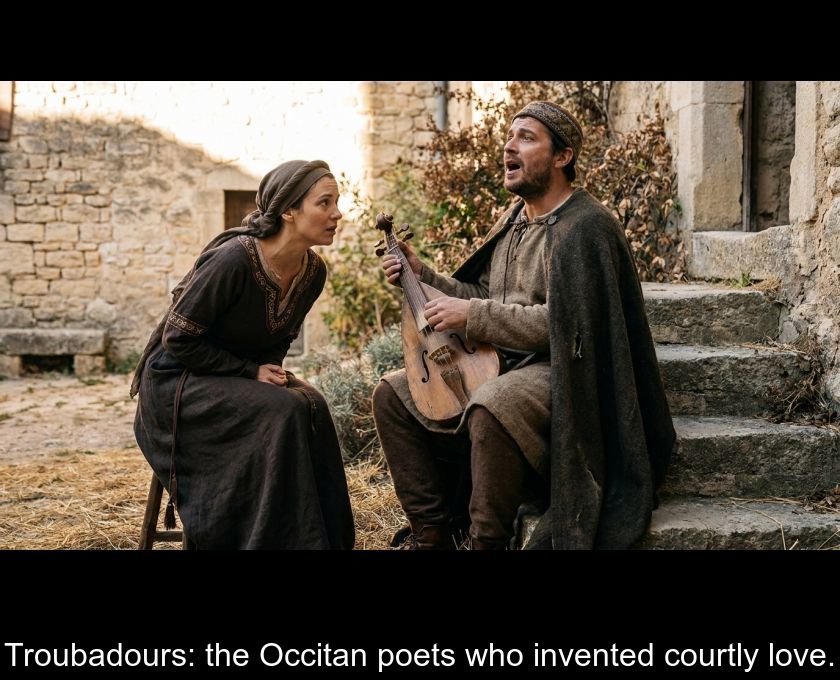
Troubadours: The Occitan Poets Who Invented Courtly Love.
Singers, composers, virtuosos of rhyme: the troubadours made the Occitan language the first great poetic language of Europe. Here’s how they worked, what they sang, and why their art still resonates.
Who were the troubadours? Origins of an Occitan poetic movement.
The word says it all: troubadour comes from the Occitan verb trobar, which means "to find," in the sense of finding one's words, melody, and form. A troubadour is therefore not just a reciter; he is an inventor: he composes both the text and the music of his pieces.
This movement originated in the South of France, in the lordly courts of the Occitan-speaking regions - Aquitaine, Limousin, Toulouse, Provence - and flourished during the 12th and 13th centuries. It includes everything: great lords who compose for their pleasure, sons of minor nobility, clerics, and also men of modest means who live by their talent among the powerful.
They must be clearly distinguished from another genre, older and more northern: the chanson de geste. Emerging around the 9th century and primarily developed in northern France, especially in Normandy, it recounts in sung verses the heroic deeds of the past (the Latin word gesta means "exploit"). The Chanson de Roland and the Chanson de Guillaume, around 1100, are the oldest preserved examples.
The troubadours, on the other hand, turn their backs on battles. Where the chanson de geste exalts the collective hero, they place a personal voice, a "I" who loves, suffers, and hopes, at the center of the poem. It is this revolution of perspective that will change everything.
Courtly love, an ideal at the heart of troubadour poetry.
The major invention of the troubadours has an Occitan name: fin'amor, the perfect love, which is today translated as "courtly love." It is not a vague feeling; it is a code, with its rules, its stages, and its vocabulary.
The principle is simple and paradoxical. The poet chooses a lady (domna) who is socially superior, often the wife of his lord, and declares himself her vassal, just like a vassal towards his suzerain. He owes her service, loyalty, obedience, and he expects from her a reward that, most of the time, will not come. The unfulfilled desire becomes the very engine of the song.
From this arise the values that recur from one song to another: mezura, this self-control that prevents desire from turning into vulgarity, patience, absolute discretion - the poet often designates his lady by a code name to protect her reputation - and joi, an exalted joy that is not possession but the impulse towards the beloved. Love, in this system, makes one better: it refines manners, sharpens language, and ennobles the one who practices it.
This ideal quickly overflowed from the sung poem to permeate the narrative. The Knight of the Cart, written in 1181 by Chrétien de Troyes at the request of Countess Marie of Champagne, depicts the courtly love of Lancelot in the Arthurian world. And the story of the two unfortunate lovers, Tristan and Isolde, reconstructed from fragments by Béroul and Thomas of England, gives the most tragic version: to love there is a fate from which one does not recover.
Music and song, inseparable companions of the troubadour's verse.
We often forget the essential: these poems were not meant to be read in silence, but to be sung. The troubadour composed words and melody together, and one does not go without the other.
Lyric poetry carries this name because it was, since ancient Greece, sung with the accompaniment of the lyre: music was inseparable from the text, in the form of short songs. The troubadours reconnect with this practice, using simple instruments - vielle, harp, lute - and a light accompaniment that supports the voice without overpowering it, somewhat like that which carried the epic songs.
Two professions correspond to each other, and it is better not to confuse them. The troubadour creates: he finds the text, the melody, the stanza. The jongleur interprets: he goes from castle to castle, memorizes the repertoire, sings it, and sometimes accompanies it with acrobatics or tricks. Some have performed both functions throughout their lives.
What has come down to us is due to a happy accident: manuscript collections, the chansonniers, copied the texts and, for some of them, the musical notation. It is thanks to these copies that we can today hear some of these melodies again, restored by early music ensembles.
An innovative language and poetic form
First boldness: the language. While Latin dominates scholarly writing, the troubadours compose in **Occitan**, the spoken language of the South, and give it a new literary dignity. They forge a common poetic language, sufficiently unified to be understood from one court to another, from Limousin to Provence.
Second boldness: the form. The chanson de geste was content with "laisses," stanzas of variable length built on assonance, that is, the simple repetition of the last vowel. The troubadours, however, demand **full rhyme**, invent complicated stanzaic schemes, play with the return of the same rhymes from one stanza to another, and often close the piece with a short envoy stanza addressed to the lady or the recipient of the song.
They also multiplied the genres, each with its conventions:
- the canso: the love song proper, the noble genre par excellence,
- the sirventes: the poem of political or moral satire, often sung to a borrowed melody,
- the tenson: the debate in verse, where two poets confront each other stanza by stanza,
- the aube: the lament of lovers separated by the rising of the day,
- the pastourelle: the meeting, in a lighter mode, of a knight and a shepherdess.
Nota Bene: two ways of composing oppose each other, and it is beneficial to know them. The trobar leu refers to the "light" manner, clear, immediately understandable. The trobar clus refers to the "closed" manner, deliberately obscure, laden with implications, reserved for connoisseurs. A third way, the trobar ric, focuses on sound richness and rare rhymes. Finally, let us recall that the syllable count structures all our poetry: ten-syllable verses (decasyllables) and eight-syllable verses (octosyllables) are particularly favored in the Middle Ages, before the twelve-syllable alexandrine became dominant from the 16th century onwards.
The great figures of Occitan poetry
The first troubadour whose songs have been preserved is a very great lord: William IX, Duke of Aquitaine. This fact deserves to be noted, as it says a lot about the movement: it is not an art of outsiders, but a courtly game practiced at the top of society.
Among those whose names have crossed the centuries, we remember Jaufré Rudel and his motif of "love from afar," this passion for a lady never seen, which pushes courtly paradox to its limits. Marcabru, biting and moralistic, mocks false lovers. Bernart de Ventadorn is considered the most musical, the clearest of love poets. Bertran de Born excels in the warrior and political sirventes. Arnaut Daniel, finally, pushes formal work to such an extent that he will fascinate Italian poets.
One point too often overlooked: women composed and signed. They are called trobairitz, and the most famous remains the Countess of Die. Their pieces overturn the usual perspective, as it is then the lady who speaks of desire, disappointment, and waiting.
These voices do not resemble each other, and that is their interest: the same code of fin'amor produces sometimes sweetness, sometimes sarcasm, sometimes revolt.
The influence of the troubadours beyond Occitania.
A courtly art travels with the courts. Royal marriages, the movements of retinues, and the Crusades have spread Occitan songs far beyond their region of origin, and the patronage of great ladies played a decisive role in this - as seen with Countess Marie of Champagne, who commissioned Chrétien de Troyes.
In northern France, in the langue d'oïl, the **trouvères** take up the model: the same word, the same idea (to find, to compose), the same primacy of love songs, but in another language and with a stronger taste for narrative. In the German Empire, the **Minnesänger** - the "singers of love" - transpose fin'amor into their own tradition.
The model also crosses the Pyrenees, reaching Catalonia and the Iberian Peninsula, and crosses the Alps into Northern Italy, where some troubadours settle and compose. This diffusion explains why the same vocabulary of love can be found, with a few variations, from one end of Europe to the other.
In other words, in a century and a half, a regional poetry has become a common sentimental grammar. Few literary movements can claim the same.
The legacy of the troubadours in European literature
The first legacy is thematic. Throughout the ages, lyrical poetry maintains the same themes: love, death, fear, pain. The troubadours did not invent these subjects, but they gave them a form and a tone—the personal confession, the address to the beloved, the elegant lament—from which Western love songs have never truly detached.
The second legacy is formal. The Italians of the 13th and 14th centuries read the Occitans, claim them as their own, and push their work on the stanza further: it is from this lineage that the sonnet and the learned love poetry emerge, which will dominate the European Renaissance.
The third legacy is romantic. Courtly love nourishes the medieval novel, from Lancelot to the versions of Tristan and Isolde, and for a long time establishes the figure of the faithful lover until death. These texts themselves are fragile—the manuscript of Béroul, found in very poor condition, has only survived in fragments, so the Tristan and Isolde that we read today is a modern reconstruction.
Finally, there is the very idea of the poet as a craftsman aware of his trade. Among the troubadours, technique is discussed, challenges are embraced, and mastery is judged. This professional awareness of poetic work will be found again, under different names, several centuries later.
From the Pléiade to Parnassus: a distant echo of poetic demand
In 1553, Ronsard selected seven poets from the disciples of the humanist Jean Dorat: this is the Pléiade. Four years earlier, in 1549, these young men had signed a manifesto, the Defense and Illustration of the French Language, under the aegis of Joachim du Bellay. Their program: to renovate poetic forms, to deliberately enrich the language, and to break with the inherited forms of the Middle Ages by imitating the Ancients.
The break is real, but the gesture is strangely familiar: defending a vernacular language, deeming it worthy of great poetry, and making work on form a profession in its own right. Three centuries earlier, the troubadours had made the same move for the benefit of Occitan.
The Parnassus, in the 19th century, radicalizes this demand. A reaction against Romanticism, it groups around Théophile Gautier - with Théodore de Banville, Leconte de Lisle, José Maria de Heredia, Sully Prudhomme, François Coppée - and gathers in 1866 in the magazine Le Parnasse contemporain. Its slogans: the absence of any personal involvement in the poem, the cult of hard work, the pursuit of a beauty deemed inaccessible.
Gautier published in 1857 a manifesto in the form of a poem, "Art," which gives essential place to form and relegates the idea to the background, while his collection Émaux et Camées (1852) gave birth to the theory of Art for Art's sake. The distance is notable: the troubadours never renounced the "I" or sentiment. But the old conviction remains - a poem is primarily a crafted object, and overcoming difficulty is part of the pleasure.
Why the poetry of the troubadours still resonates today
Because she invented something we practice every day without thinking about it: the love song, text and melody fused, where a "I" addresses someone who is not there. The codes have changed, but the structure has remained.
Because it also reminds us that poetry was not born in books but in voice. If the subject interests you, start by listening: ensembles of early music regularly record the melodies preserved in songbooks, and one understands a canso sung better than deciphered on paper.
Then, read while keeping two or three reference points in mind - the vocabulary of fin'amor, the difference between canso and sirventes, the opposition of trobar leu (clear) and trobar clus (hermetic). Look for the envoy stanza at the end of the piece: it is often there that the poet reveals themselves. You will see that these texts from eight hundred years ago are neither naive nor boring, but constructed, ironic, sometimes frankly twisted.
And then there is the language. Rediscovering the troubadours is remembering that a great European literature was written in Occitan, and that this poetry from the South has gradually nourished the way the West speaks of love. Just open a bilingual anthology to realize this: the first line takes you further than expected.