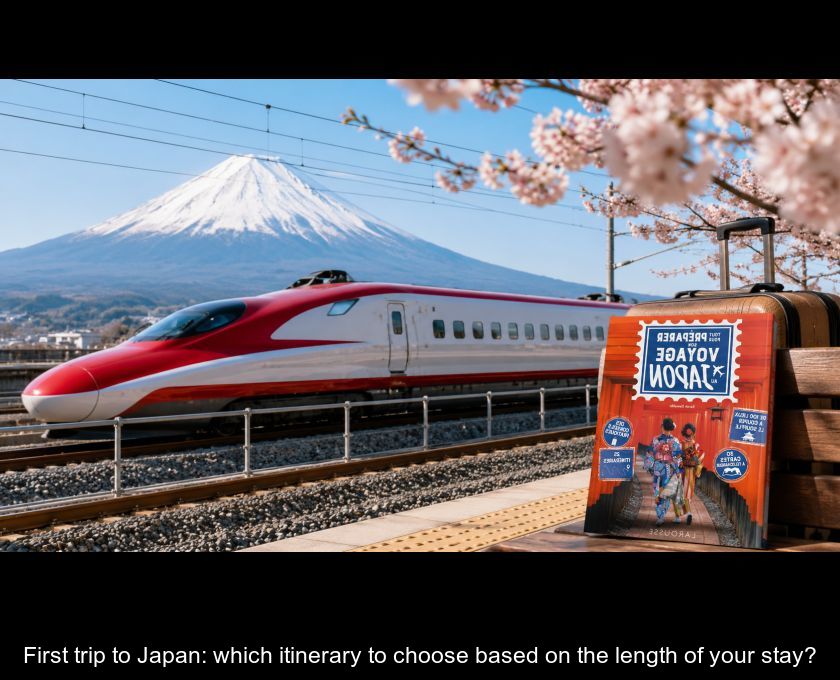
First Trip To Japan: Which Itinerary To Choose Based On The Length Of Your Stay?
With 42.7 million foreign visitors welcomed in 2025, a record high, Japan has never been more of a dream destination for travelers from around the world. France is no exception: the archipelago attracts more and more tourists from France each year, captivated by this unique blend of ancient traditions and futuristic modernity. However, preparing for a first trip to Japan is not straightforward. Should you stay for ten days, two weeks, or a month? Focus on the big cities or venture out to explore the countryside? Here are our tips for creating an itinerary in Japan tailored to the time you have available.
Japan, a destination that requires planning.
First of all, it is important to understand a geographical reality: Japan is a long archipelago stretching nearly 3,000 kilometers from north to south. Between the snows of Hokkaido and the subtropical beaches of Okinawa, the climates and landscapes can sometimes be completely different.
As a result, wanting to "see it all" in one trip is a classic mistake made by first-time travelers. It is better to accept making choices, even if it means coming back (and believe us, we always return to Japan...).
The good news is that the country is extremely well organized. Transportation is legendary for its punctuality, safety is excellent, and signage, often translated into English, greatly facilitates travel. The only thing left is to plan your itinerary based on the actual duration of your stay, including flight time (count on nearly 14 hours of direct flight from Paris).
10 days in Japan: the golden triangle Tokyo - Kyoto - Osaka
This is the ideal itinerary for a first discovery. In about ten days, there is time to explore what is often called the "golden route," which is the most iconic trio of cities in the archipelago.
It usually starts in Tokyo, a sprawling metropolis where ultra-modern neighborhoods (Shibuya, Shinjuku) coexist with peaceful temples (Asakusa). Three to four days are not too much to grasp its energy.
Next, head to Kyoto, the former imperial capital, a true open-air museum with its thousands of temples, zen gardens, and geisha district. This is where the heart of traditional Japan beats.
Half an hour by train, Osaka offers a more popular and festive counterpoint, renowned for its street food and warm atmosphere. You can also fit in a trip to Nara and its famous free-roaming deer.
This route has a major advantage: the distances are short and the cities are connected by the Shinkansen, the Japanese high-speed train.
Two weeks in Japan: expanding to Hiroshima and the Japanese Alps.
With two weeks on site, you can seriously expand the golden triangle without rushing.
Several extensions are available to you:
- Hiroshima and Miyajima: the martyr city, its moving Peace Memorial, and the sublime island of Miyajima with its grand torii standing in the water.
- The Japanese Alps: Takayama, with its streets lined with wooden houses, and the village of Shirakawa-go, classified as a UNESCO World Heritage site for its traditional thatched-roof farms.
- Kanazawa: often referred to as "little Kyoto," featuring one of the most beautiful gardens in the country.
- Mount Fuji: a detour to the five lakes region offers, on clear days, unforgettable views of Japan's most famous peak.
Two weeks is also the duration that allows for a variety of experiences: a night in a traditional ryokan, a soak in an onsen, a culinary stop... In short, taking the time.
Three weeks or more: heading north or south.
Do you have the chance to spend three weeks or more? This is an opportunity to step off the beaten path and discover another side of Japan.
Two main options are available to you.
The North Japan, with the island of Hokkaido, will delight lovers of wide open spaces: national parks, volcanoes, hot springs, and in winter, some of the best powder snow in the world for skiing.
The South Japan, with the island of Kyushu and its volcanoes, and further on, the subtropical archipelago of Okinawa, will charm those who dream of turquoise beaches and relaxation. A radically different atmosphere from the rest of the country.
It is also with this long format that one can consider a true road trip, by renting a car in regions where trains are less frequent.
Looking for authenticity? Japan off the beaten path.
No matter the length of your stay, it is always possible to include a more off-the-beaten-path stop. Overtourism indeed affects a handful of very popular sites (with Kyoto at the forefront), but the country is full of hidden gems that are still preserved.
Among the ideas that are increasingly appealing to French travelers:
- Shikoku Island and its famous pilgrimage of 88 temples, a Buddhist route of over 1,200 kilometers that can be partially explored.
- The Kumano Kodo, a UNESCO-listed network of pilgrimage paths, one of the few in the world alongside the Camino de Santiago.
- The artistic islands of the Inland Sea, such as Naoshima, which have become a major hub for contemporary art.
- The Tohoku region, in the north of the main island, following in the footsteps of the samurai.
These detours require a bit more organization but offer a complete change of scenery, far from the crowds.
Train, plane or car: how to connect the stages?
The mode of transport largely determines the construction of the itinerary. In Japan, the Shinkansen remains the most practical and fastest way to connect major cities.
Many travelers automatically think of the Japan Rail Pass, this unlimited pass reserved for foreign tourists. However, caution is advised: since the significant price increase in October 2023, this pass is no longer systematically cost-effective. For example, the 7-day ordinary class pass now costs 50,000 yen (about 310 euros), compared to less than 30,000 yen previously.
In practice, the JR Pass is only interesting if your itinerary includes several long train journeys (typically, at least three trips on the Shinkansen during the period). For a simple round trip from Tokyo to Kyoto, it is better to buy individual tickets. There are also regional passes, which are often much more advantageous if you stay within a single area.
For very long distances, such as reaching Hokkaido or Okinawa, domestic flights are often faster and more competitive. As for rental cars, they make the most sense in rural areas, where public transport is more limited.
When to go to Japan? The calendar changes everything.
The last parameter to consider in your itinerary is the season. Japan has four distinct seasons, each with its own advantages.
Spring (March-April) is the star period, known for the cherry blossom bloom. Autumn (October-November) sets the landscapes ablaze with red and gold, making it one of the most beautiful seasons to travel. Summer is hot, humid, and stormy, but it's the only window to climb Mount Fuji. Finally, winter attracts ski enthusiasts and those who enjoy hot baths in the snow.
One piece of advice: if possible, avoid the Golden Week (around April 29 to May 5), a holiday period when Japanese people travel in large numbers. Transportation is crowded, accommodations are in high demand, and prices soar.
An illustrated guide to creating a customized journey.
Building an itinerary in Japan can quickly become overwhelming due to the numerous possibilities. To help navigate this, the guide "Everything to Prepare for Your Trip to Japan", authored by Sarah Dawalibi and published by Larousse, serves as a valuable resource.
This travel journalist and blogger, who has a deep understanding of the archipelago, offers 25 thematic routes to create based on personal preferences, budget, and length of stay: spiritual Japan, pop culture, nature and vast spaces, gastronomy, traveling with children... It also includes over 100 places to discover, 30 downloadable maps, cultural insights into Japanese traditions, and a wealth of practical advice on accommodation, transportation, and etiquette.
Priced at 16.95 euros, this illustrated guide is a great starting point to turn a simple desire for Japan into a concrete and achievable itinerary.
Note Well
Shinkansen: name of the Japanese high-speed train, sometimes nicknamed "bullet train" due to the streamlined shape of its locomotive. Renowned for its near-perfect punctuality, it connects the major cities of the country.
JR Pass (Japan Rail Pass): transportation pass reserved for foreign tourists, allowing unlimited travel on the JR network for 7, 14, or 21 days. Must be booked before or during the trip.
Visit Japan Web: official online platform that allows travelers to pre-fill immigration and customs forms before arrival. Not mandatory but highly recommended to save time at borders. Note: French nationals do not need a visa for tourist stays of less than 90 days. However, an electronic travel authorization called JESTA is expected to be announced by 2028.
Onsen: Japanese hot spring, fed by volcanic hot springs. A true local institution, it follows a specific etiquette (complete washing before the bath, nudity required).