Nice Unusual: 10 Bizarre And Surprising Discoveries To Know.
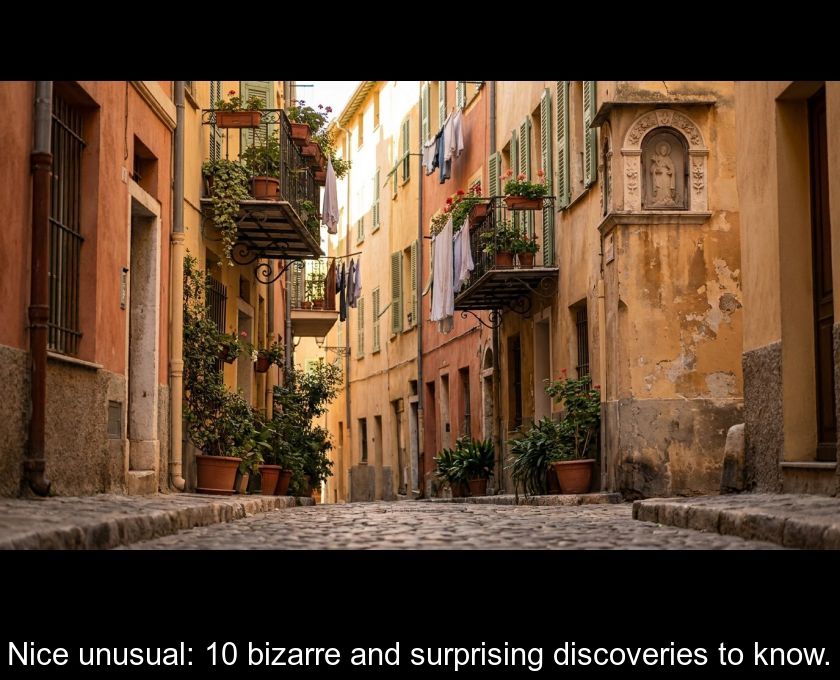
Behind the ochre facades and palm trees of the Promenade, Nice hides a wealth of unlikely stories, from the window of a legendary burglar to a chapel perched on the first floor. Follow the guide for an overview of the curiosities that few visitors know about.
Nice, a city of a thousand unusual surprises.
Nice is known for its Promenade des Anglais, its Belle Époque palaces, and its flower market. But beneath this polished postcard lies another city, more secretive, made up of outrageous anecdotes and details that can only be noticed by looking up or turning the right corner.
A burglar escaping through a simple window, a chapel tucked away on the upper floor of a building, cannonballs embedded in the walls since the 16th century... the city is full of these little stories that often reveal more about its soul than any official monument.
We have gathered ten of these curiosities for you, collected from the alleys of the old town, the port, and the surrounding hills. Enough to see Nice with fresh eyes the next time you stroll around the area.
The mysterious pyramid of Falicon and the cave of bats.
In the hills overlooking Nice, near the village of Falicon, lies a geological curiosity that is sure to intrigue the passerby: a rock formation shaped like a pyramid, hollowed out in its heart by a natural cave. Nothing artificial here, just a play of geological chance that has ended up resembling a human construction.
This place, with its somewhat surreal atmosphere, is home to a colony of bats that have made it their residence for generations. The ambiance, almost theatrical, reminds some visitors of the sets of a film like Last Year at Marienbad, as the silence and strangeness of the site contrast sharply with the hustle and bustle of the seaside, just a few kilometers away.
If you enjoy walks off the beaten path, this corner of the Nice area is worth a detour, if only for the feeling of having discovered a secret that few tourists know.
The window through which the famous burglar Spaggiari escaped.
The Nice courthouse, located on Rue de la Préfecture, has a sober and somewhat austere appearance. Nothing suggests that one of its windows was the scene of one of the most outlandish escapes in French criminal history.
It all begins on the weekend of July 16 to 18, 1976: Albert Spaggiari organizes and leads the heist of the century, the burglary of the vaults of the Société Générale in Nice, by entering through the sewers after having a tunnel dug for nearly three months by a team of over-equipped men. Arrested at Nice airport upon his return from Japan on October 27, 1976, he is incarcerated.
On March 10, 1977, summoned to the office of Judge Richard Bouazis, Spaggiari requests to have his escort removed under the pretext of revealing information about local personalities. The judge agrees. Spaggiari then hands him sketches of the tunnel scribbled on three sheets of paper, and while the magistrate leans over them, he jumps out the window.
He lands on the roof of a car parked eight meters below and escapes with the help of an accomplice on a motorcycle. His flight, which will take him to Chile, Brazil, and then Argentina, lasts twelve years, until his death from cancer in Italy in 1989. His remains were even clandestinely repatriated in a caravan to his mother’s home in Hyères before his burial in the Hautes-Alpes.
An unusual chapel perched on the first floor of a building.
On Garibaldi Square, at number 7, lies one of the most astonishing features of Nice's religious heritage: a chapel located not on the ground floor, but on the first floor of a building. This is the Chapel of the Holy Sepulchre, known as that of the Blue Penitents, still owned by the archconfraternity of the same name, one of the four Nice confraternities still active today.
This chapel, dedicated from its inception to the care of orphans, was built between 1782 and 1784 by contractor André Laurenti, based on plans by the Ticinese architect Antonio Spinelli, as part of the grand urban project for Vittoria Square (now Garibaldi Square), initiated by King Victor-Amadeus III of Sardinia in 1780.
From the outside, only the monumentality of its façade, with its pediment and colossal order, betrays its purpose. But once inside, the space reveals itself to be surprisingly cramped, which forced the architect to adopt a wide plan and semi-dome ceilings to gain volume.
An additional curiosity: Nice has only one other religious building situated in the same way on the upper floor, the Russian Orthodox Church of Saint Nicholas-Saint Alexandra on Longchamp Street. Two exceptions that prove even places of worship in Nice sometimes like to break the mold.
Strangely scattered cannonballs on the facades.
The siege of Nice led in 1543 by the Turkish fleet against the city not only forged the legend of Catherine Ségurane. It also left a very real and visible mark on the walls of the old town: half a dozen cannonballs, fired from the Pasha's ships, are still embedded in the facades today.
They can be spotted on the facade of the Chapel of the Holy Sepulchre, in the Saint-Martin-Saint-Augustin church, or at the corner of Rue de l'Abbaye and Rue Colonna-d'Istria. The most famous of all remains the one embedded in the wall of a building forming the corner of Rue de la Loge and Rue Droite.
A funny detail: some overly Cartesian minds point out that a cannonball fired from the sea would have a hard time ending its course on the first floor of a house, in such a narrow street. But the attachment of the Niçois to their history withstands this kind of logic, and these cannonballs remain a must-see for anyone wanting to feel the weight of time in the alleys of old Nice.
Nota bene: Rue de la Loge is named after an old communal palace from the 15th century, featuring a lodge known as the cistern, which was destroyed in the early 16th century.
A deity armed with a plumb line in the streets of Nice.
At 22 Avenue Jean-Lorrain stands a curious little building shaped like a prismatic eagle's nest, named Cap des Anges. Its street-facing facade initially appears quite modest, except for a strange statue that reigns over its terrace: a protective deity armed with a plumb line.
This figure has been jealously guarding the entrance of the house since 1936, the year when a certain Mr. Albrespit, then over 70 years old, designed the plans himself and oversaw the construction. To ensure the perfect verticality of the walls, he had himself tied by the waist to a rope and swung along the wall using his feet while the worker built the masonry.
It is most likely in homage to this unorthodox construction method that the statue with the plumb line still watches over the entrance of the building today, as a nod to the artisanal ingenuity of its amateur builder.
The pilou, a juggling game that originated in China, has become a symbol of Nice.
Among the playful traditions of the County of Nice, the pilou holds a special place. This juggling game, whose distant origins are attributed to China, has acclimatized over time within the popular culture of Nice, to the point of becoming one of the living symbols of local folklore.
Even today, enthusiasts continue to uphold this practice and introduce it to the public through demonstrations, keeping alive a tradition that has crossed borders and centuries to take root on the shores of the Mediterranean.
It is somewhat reflective of Nice as a whole, a city that has always managed to absorb influences from elsewhere—Italian, Provençal, or even more distant—to create something distinctly local.
A Lilliputian house in the heart of the old town.
On the hill of Cimiez, not far from the historic center, there lies an architectural curiosity that the locals affectionately call the house of the Dwarfs. Its small size, almost miniature compared to the surrounding buildings, has earned it this nickname that has been passed down through generations.
This kind of atypical small construction, wedged between two more imposing buildings, serves as a reminder that Nice's architecture is not limited to the grand palaces by the sea: it is also full of these human-scale details, sometimes quirky, that add to the charm of a stroll without a specific itinerary in the heights of the city.
If you pass through this neighborhood, take the time to look up: it is often in these less prominent corners that the most beautiful surprises of the local heritage are nestled.
A traveling cloister, an architectural curiosity of the local heritage.
On the side of Nice West stands a building with an almost enigmatic name: false abbey, true cloister. As often in Nice, the exterior appearance of a building does not tell its entire story, and this one is no exception to the rule.
This cloister, whose architecture evokes great monastic complexes, has never actually housed a true abbey. A discrepancy between form and function that makes it one of those curiosities known only to the locals.
This kind of hybrid building, where the architectural style tells a different story from that of the place, is ultimately quite revealing of the Nice spirit: a city that enjoys blurring the lines between the sacred and the profane, the ancient and the reinvented.
A miraculous icon and a Madonna for desperate cases.
On the hill of Pessicart and Righi, a revered icon considered miraculous has long attracted faithful individuals seeking comfort, proving that the popular fervor of Nice is not limited to the grand churches in the city center.
But it is in the chapel of the Annunciation, on Rue de la Poissonnerie, that the most sought-after Madonna in the city can be found: that of desperate cases. The building, originally Saint-Jacques chapel in the 13th century, was handed over to the monks of Saint-Pons and then to the Carmelites starting in 1558, and underwent a profound Baroque transformation between 1677 and 1685.
In 1934, Father Bianco, a priest of Italian origin, introduced the cult of Saint Rita of Cascia there, at the request of a parishioner very attached to this saint. The innovation did not please everyone at first, but it quickly gained extraordinary success, to the point that the name of Saint Rita today refers, in the minds of the people of Nice, to the entire church.
Her altar, prominently visible at the entrance, is overwhelmed with ex-votos: love, healing, return of affection, fortune, protection against epidemics... nothing seems to escape the patroness of lost causes. The inscriptions engraved in stone, with a touching simplicity, testify to a popular faith that remains very much alive.
Adam and Eve dancing at the front, an unusual facade.
At the end of Rue de la Poissonnerie, just before reaching Cours Saleya, all you have to do is look up to see a rather delightful relief frieze adorning the first floor of a house dated 1584. It depicts a man and a woman, clearly in a joyful mood, dressed in simple vine leaves.
This frieze has earned the building its nickname of Adam and Eve's house. This type of decoration was once quite common in the streets of old Nice, but this one is said to be the last example that has survived to this day, having recently undergone restoration to regain its original freshness.
It's one way to conclude this unusual stroll: in Nice, often all it takes is to slow down and look up to stumble upon a detail that tells, in its own way, five centuries of local history. The next time you wander through the old town, keep your eyes on the sky; the city still has many secrets to show you.