Sherlock Holmes: The Secrets Of His Deduction Method
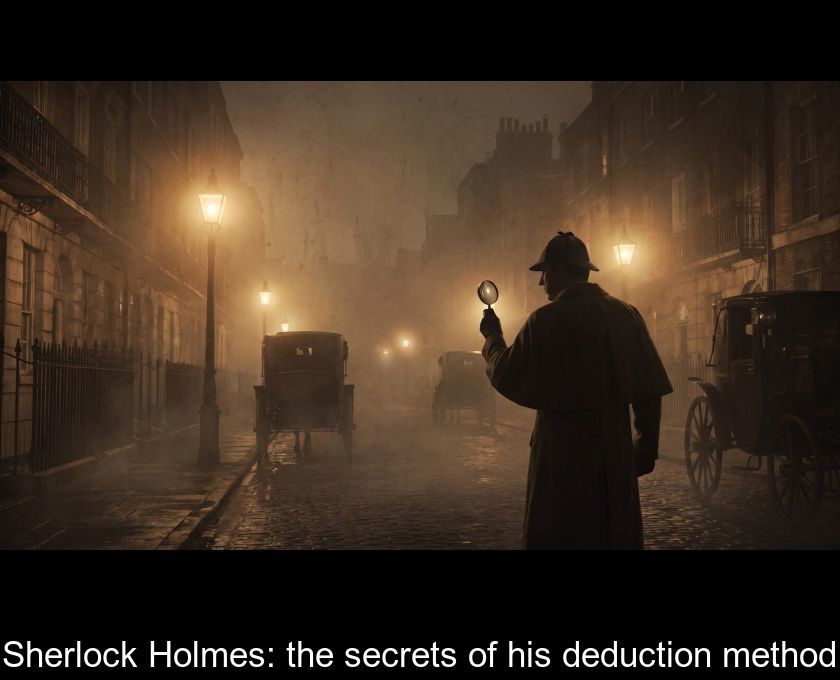
A double-brimmed hat, a curved pipe, a magnifying glass focused on a clue, and that now-iconic line, elementary, my dear Watson. In just a few signs, the whole world recognizes Sherlock Holmes. For over one hundred thirty years, the Baker Street detective has fascinated readers with his almost supernatural ability to unravel the most opaque mysteries. Yet, his famous genius is nothing magical. Behind the character's exploits lies a very real method, made up of meticulous observation and relentless reasoning. We invite you to uncover its secrets as well.
A paper detective entered into legend.
Before becoming a myth, Sherlock Holmes was born from the pen of a Scottish writer, Arthur Conan Doyle. It was in 1887, in a novel titled A Study in Scarlet, that the detective made his very first appearance. The success was overwhelming. Holmes would return in four novels and fifty-six short stories, to the point of completely overshadowing his creator, who eventually grew tired of his creation to the extent of wanting to make it disappear.
His fictional address, 221B Baker Street in London, has become so famous that it still receives mail from admirers around the world today. Few fictional characters have achieved such notoriety. Holmes has long since left the pages of books to settle permanently in the collective imagination.
The real Sherlock Holmes was named Joseph Bell.
It is often overlooked, but the detective indeed had a flesh-and-blood model. To create Holmes, Conan Doyle was inspired by one of his former medical professors, Dr. Joseph Bell, whom he had encountered at the University of Edinburgh around 1877. This surgeon had a gift that left his students astonished.
With a mere glance, Bell could deduce the profession, origins, and habits of his patients. A calloused hand, a particular accent, a trace of tar on a shoe—everything became a valuable source of information for him. The young Conan Doyle, who was once his assistant, never forgot these astonishing demonstrations. A few years later, he would make them the trademark of his fictional detective.
What does his method actually consist of?
One readily summarizes Holmes's method with the single word deduction, but the reality is a bit more subtle. The detective proceeds in three stages. First, he observes a multitude of small details that others do not even notice. He then connects these clues to draw the most probable explanation. Finally, he tests his hypothesis by confronting it with the facts.
Everything relies on the first step, observation. Where the average person is content to see, Holmes truly examines. He does not just look at a man; he notes his complexion, his gait, the wear on his sleeves, the dried mud on his shoes. Each of these details tells a story, provided one knows how to read it. The genius of the detective, ultimately, lies in an attention that is truly extraordinary.
Nota Bene: the famous elementary formula my dear Watson, which is spontaneously associated with Holmes, actually appears nowhere in Conan Doyle's novels. It was popularized much later by adaptations in theater and cinema. A fine example of a cult line that its supposed author never wrote down.
Once the impossible is eliminated...
If there were only one principle to retain from the Holmes method, it would be this one, formulated by the detective himself: once you have eliminated the impossible, whatever remains, no matter how improbable, must be the truth. The formula seems obvious, but it proves to be remarkably effective.
Rather than immediately seeking the culprit, Holmes methodically dismisses everything that doesn't hold up. This suspect had a verifiable alibi, so he is eliminated. This hypothesis contradicts an established fact, so it is crossed out. Little by little, the field of possibilities shrinks until only one explanation remains, however surprising it may be. It is this uncompromising rigor that hits the mark every time.
An heir to the science of his time.
Holmes' triumph is no coincidence. At the end of the 19th century, science is advancing by leaps and bounds and captivating the general public. The police are just beginning to take an interest in fingerprints, forensic medicine is in its infancy, and there is a dream of uncovering the secrets of crime through pure reason. Holmes perfectly embodies this spirit of the time, that of an investigator who replaces intuition and coerced confessions with a genuine scientific method.
The detective also dabbles in chemistry, analyzes tobacco ashes, and writes learned monographs. He anticipates, by several decades, the techniques of modern forensic science. This astonishing modernity partly explains why the character has never really aged.
A multifaceted character
Reducing Sherlock Holmes to a mere deduction machine would be an insult to him. The character imagined by Conan Doyle is much more complex and endearing than he appears. Between two investigations, the great detective becomes terribly bored, plays the violin at odd hours, and sometimes falls into deep melancholy. His relationship with the loyal Dr. Watson, characterized by gruff affection and friendly condescension, adds further depth to his character.
It is undoubtedly this humanity, woven with flaws and little quirks, that explains the lasting attachment of readers. A hero who is too perfect would quickly become tiresome. Holmes, on the other hand, is brilliant yet unbearable, dazzling yet terribly lonely, and it is precisely this that makes him unforgettable. Conan Doyle understood an essential truth: a great character is defined as much by their flaws as by their exploits.
A constantly reinvented myth
Proof of his extraordinary vitality, Sherlock Holmes has never ceased to be adapted. Cinema, television, and theater have seized the character hundreds of times, making him one of the most frequently portrayed fictional heroes in history. Each era reinvents its Holmes, from the classic detective in Victorian costume to the modern, tormented genius of recent series.
Some adaptations even dare to transpose the myth to our time, from London to New York, sometimes turning the faithful Watson into a woman. This is a sign that the character lends itself to all reinterpretations, as his mechanics are universal. One never tires of seeing a brilliant mind restore order to chaos.
And what if you conducted the investigation yourself?
Reading the adventures of Holmes provides an intact pleasure, but there is another, even rarer one: slipping into the shoes of the detective yourself. This is exactly what investigation games offer, entrusting you with a case to solve solely through reasoning, just like the master of Baker Street.
If you feel the urge to put your logic to the test, you can conduct the investigation on Onisogo, a mystery game where you must identify the culprit purely through deduction, without any element of chance. And to extend the enjoyment, discover our selection of the greatest unsolved criminal mysteries. Who knows, you might be a much better sleuth than you imagine.