Preparing Your Trip To Quebec: The Complete Guide To Organizing Your Stay
With its vast spaces, vibrant forests, and cities with such a unique accent, Quebec captivates many French travelers. However, organizing a trip to the Beautiful Province is not always an easy task: the distances are immense, the climate varies greatly depending on the season, and the experiences offered are so numerous that it can be overwhelming. Here are the essential tips to calmly prepare for your first trip across the Atlantic.
Quebec, a destination three times the size of France.
The most visited province in Canada, Quebec spans a vast territory, about three times the size of mainland France, with only 8.6 million inhabitants.
This extensive area includes 27 national parks, over a million lakes, thousands of rivers, and some must-see natural icons like the Saint Lawrence River, which is 1,800 kilometers long.
It is safe to say that it is unrealistic to want to see everything at once. Most travelers focus on a route from Montreal to Quebec City, Charlevoix, and Gaspésie, with the intention of returning later to explore more remote regions like Nunavik, Abitibi, or the North Shore. Hence, it is important from the start to clearly identify one's desires... and priorities.
When to go to Quebec? Very contrasting seasons.
The Quebec continental climate requires careful selection of your visit period, as each season offers a radically different experience.
- Summer (June to September): short but sunny, with temperatures ranging from 20 to 30°C. This is the peak tourist season, ideal for hiking, canoeing, and the major festivals in Montreal and Quebec City.
- Autumn (October-November): the most photogenic period, marked by red maples and the famous Indian summer. Temperatures remain mild, and parks are crowded on weekends, especially around Thanksgiving (Quebec's Thanksgiving, early October).
- Winter (December to March): harsh but magical. Temperatures can drop to -25°C, even -30°C. This is the season for skiing, dog sledding, snowmobiling, and the legendary Ice Hotel in Quebec City.
- Spring (April-May): a short transition marked by snowmelt and the sugar shack season, an iconic event that Quebecers eagerly await.
Note: Quebec winters require preparation. As the local saying goes, "there's no bad weather, only bad clothing." You need to plan for thermal underwear, a down jacket, a hat, insulated gloves, and insulated boots... or risk having a bad time.
Entry requirements: passport, eTA, and time difference
Quebec is a privileged gateway to French-speaking Canada. The formalities are now fully digitized for citizens of the European Union and Switzerland. To enter Canadian territory, you need:
- A valid passport covering the entire duration of your stay.
- An Electronic Travel Authorization (eTA), to be obtained before departure on the official website canada.ca. It costs CAD 7, is issued within minutes (sometimes up to 72 hours depending on the applications), and remains valid for 5 years, or until the passport expires.
Regarding the time difference, expect 6 hours in winter and 5 hours in summer compared to Paris: a flight from the French capital takes about 7 hours and 30 minutes and arrives in Montreal in the early afternoon, local time. The two international airports in the province, Montreal-Trudeau (YUL) and Quebec Jean-Lesage, are well served. From YUL, the 747 shuttle (CAD 11) connects to downtown in about twenty kilometers, while a taxi to the center costs approximately CAD 41 at a fixed rate.
How to get around in Quebec: car, camper van, bike or trails
Another essential point: the mode of transport. In Quebec, distances are long and public transportation is limited outside major cities. Therefore, the car remains the most practical way to travel across the province freely.
All major international agencies are present at airports and offer all types of vehicles, from compact cars to SUVs, including camper vans. The RV is increasingly appealing to the French: it allows travelers to avoid booking accommodation every night in a country where camping is an integral part of the local culture.
For more active travelers, Quebec boasts one of the most beautiful cycling networks in North America. The Green Route, with its 5,000 kilometers of marked paths, crosses the province and connects cities, villages, and national parks. The Véloroute des Bleuets, which circles Lake Saint-Jean over 256 kilometers, is a very popular family loop. As for hiking, enthusiasts will not be disappointed: the National Trail and the Quebec section of the legendary International Appalachian Trail offer some of the most spectacular routes on the continent.
Where to sleep? A range of unusual accommodations.
The accommodation options in Quebec are particularly diverse. They range from classic roadside motels to transparent domes set deep in the forest, including log cabins, fishing lodges by the lakes, family inns, yurts, and floating chalets.
The fishing lodges, a true Quebec institution, offer comfortable accommodation in remote locations, ideal for fishing, hiking, or wildlife observation. The hotels and motels in the major cities, which are more standardized, will suit urban stays in Montreal or Quebec City.
Good to know: during peak season (July-August and autumn weekends), accommodations are in high demand, especially in national parks. A reservation several months in advance is highly recommended.
Budget: anticipate expenses ... and tips
Life in Quebec is slightly more expensive than in France. The most significant expense is undoubtedly accommodation, especially during peak season. You also need to consider:
- Taxes not included in the displayed prices (about 15% extra on the bill).
- A nearly mandatory tip at restaurants, in taxis, and for certain services, usually ranging from 15 to 20% of the pre-tax price.
- A higher average cost for car rentals compared to France, although the price of gasoline remains significantly more advantageous.
The local currency is the Canadian dollar, and Visa and Mastercard are accepted almost everywhere. One last important point: since Canada has no social security agreement with France, it is highly recommended, if not essential, to purchase a travel insurance covering medical expenses and repatriation.
A reference guide for planning your itinerary.
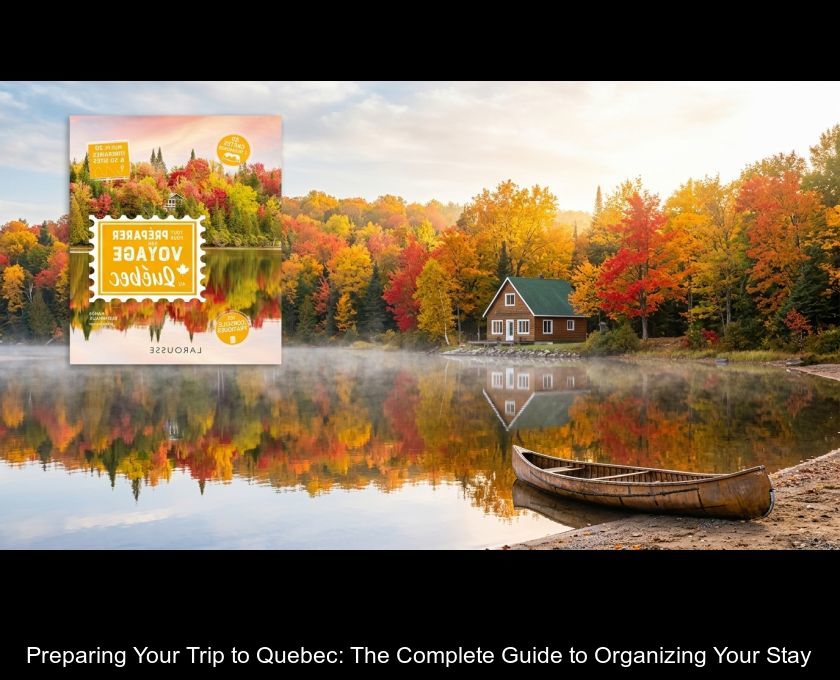
To delve into the details of preparing for your stay, Larousse Editions will publish an illustrated guide titled "Everything to Prepare for Your Trip to Quebec" on March 25, 2026, authored by Amélie Blondiaux (also known as @Hellolaroux on social media).
This photographer-author, who lived in Montreal for several years, offers 22 thematic itineraries to be tailored according to personal interests, length of stay, and mode of transport: family-friendly, cultural, gourmet, historical, quirky...
It also includes 30 downloadable maps, practical insights into Quebec traditions (maple syrup, poutine, Montreal bagels, beaver tails), and a wide selection of favorites, from Montreal to the Magdalen Islands, including Indigenous villages and Nunavik.
Priced at €16.99, this softcover, richly illustrated guide provides a solid foundation for anyone looking to create a customized itinerary without getting lost in the vastness of Quebec.
Note Well
AVE (Electronic Travel Authorization): not to be confused with a visa. It is a simple electronic document linked to the passport, required for visa-exempt nationals entering Canada by air.
Indian summer: a period of unseasonably warm weather that usually occurs in late September or early October, following the first frosts. The foliage then takes on spectacular colors (red, orange, golden yellow), a phenomenon particularly pronounced in Quebec.
Sugar shack: a spring tradition in Quebec. This is the time when maple sap is harvested to make syrup. The shacks open to the public offer a typical meal followed by a tasting of taffy on snow.