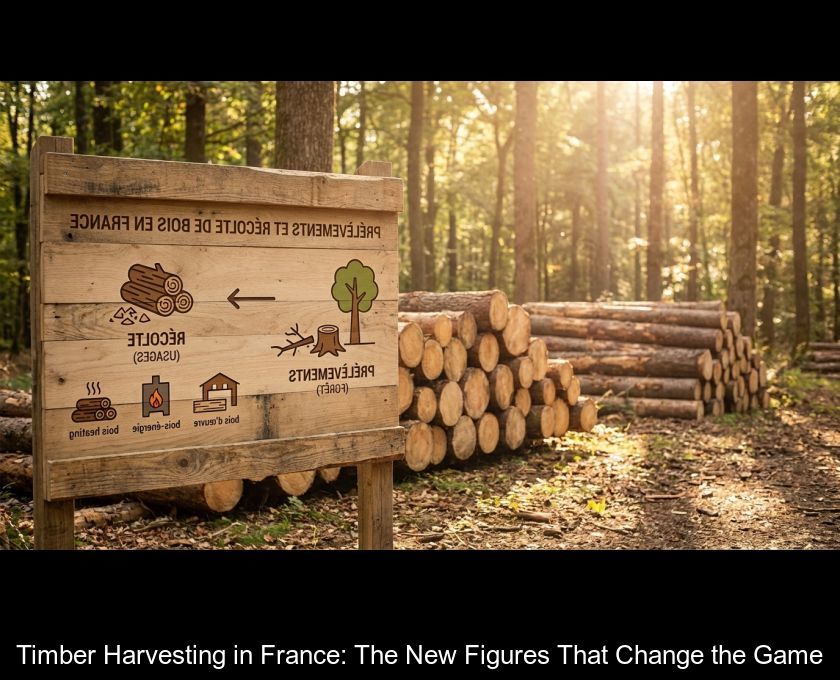
Timber Harvesting In France: The New Figures That Change The Game
Amidst the rise of the bioeconomy, climate pressures, and soaring wood prices, the latest data from the French Forest Observatory comes at just the right time: it finally reveals who is cutting what, where, and why.
Why is this publication causing so much buzz?
December 2025: The French Forest Observatory publishes a detailed study on timber harvesting and logging in France. The announcement is accompanied by a webinar, scheduled for January 22, 2026, at 2 p.m., which promises to decipher the figures, with methodologies to support it. Perfect timing: while the wood industry accounts for more than 60 billion euros in annual turnover, the need for transparency has never been greater.
Sampling vs Harvesting: Two Thermometers, One Forest
A subtle difference that changes everything: the harvesting is assessed by the National Forest Inventory (NFI) through permanent plots scattered throughout the country. The actual yield, on the other hand, comes from economic surveys (EXFSRI, sawmills, operators) and reflects the wood that is truly removed from the forest.
Two independent approaches, therefore complementary: one measures what is cut, the other what arrives on the market.
A sector that weighs heavily, really heavily.
With nearly 440,000 direct and indirect jobs, the forestry and wood sector accounts for 1.7% of the French GDP. According to the latest INSEE data, the apparent consumption of sawn wood and industrial wood hovers around 50 million m3 per year, driven by timber construction (+12% over five years) and the demand for pallets (+9%).
3 to 4 percent of French forests are cut down every year.
The IFN estimates that between 2020 and 2024, 3% to 4% of the forested area, or about 700,000 ha, has been logged. In other words, on a forest massif of 25 million hectares, this represents the equivalent of a department like Isère... every year. The Grand Est and Nouvelle-Aquitaine regions lead the way, driven by vast private forests and a well-established sawmill tradition.
Which species are the most sought after?
- Spruce & Fir: 27% of the volumes, despite the devastation caused by bark beetles accelerating sanitary logging.
- Douglas Fir: +18% over five years, favored by the construction industry.
- Oak: 14% of the harvest, but a record high added value in exports (barrels, high-end parquet flooring).
- Beech, Poplar, Various Hardwoods: the rest of the basket, often destined for paper pulp or wood fuel.
Wildfires 2025: A Mixed Outcome
The summer of 2025 saw 21,000 hectares go up in smoke according to EFFIS, a decrease of 35% versus 2022 but still twice the average from 2006-2016.
The Southwest remains the epicenter (47% of the burned area), followed surprisingly by the Rhône Valley where the spring drought dried out the underbrush.
A game-changing climate pressure
More frequent storms, recurring droughts, proliferation of wood-boring insects... The volume of sanitary logging has doubled in ten years. In 2024, one out of three spruces harvested was due to deterioration. Therefore, the industry must balance immediate profitability with reforestation that anticipates +2°C by 2050.
Sustainable Management: Where Do We Stand?
Good news: 97% of French public forests are PEFC or FSC certified. In the private sector (which covers 75% of the national area), certification is still capped at 39%. The goal set by the Ministry of Agriculture is to reach 50% by 2030 through tax incentives and the development of simple management plans.
January 22, 2026: Save the date
The Bioeconomy club will orchestrate a free webinar to put these figures into perspective, detail the methodology of the IFN, and give the floor to sawyers, NGOs, and public policymakers. Online registration on the Observatory's website, be aware that virtual seats are limited.
What can the general public do?
- Prioritize French wood, certified by PEFC or FSC, when purchasing furniture or parquet.
- Support participatory reforestation initiatives (e.g., "Plant 1 million trees").
- Limit the use of barbecues during heatwaves: 11% of fires start from festive activities.
Nota Bene
• **Harvesting**: volume of trees felled, including those left in the forest (tops, residuals).
• **Yield**: actual volume extracted and reported by operators.
• **Sanitary cut**: logging for health reasons (insects, fungi, storm).