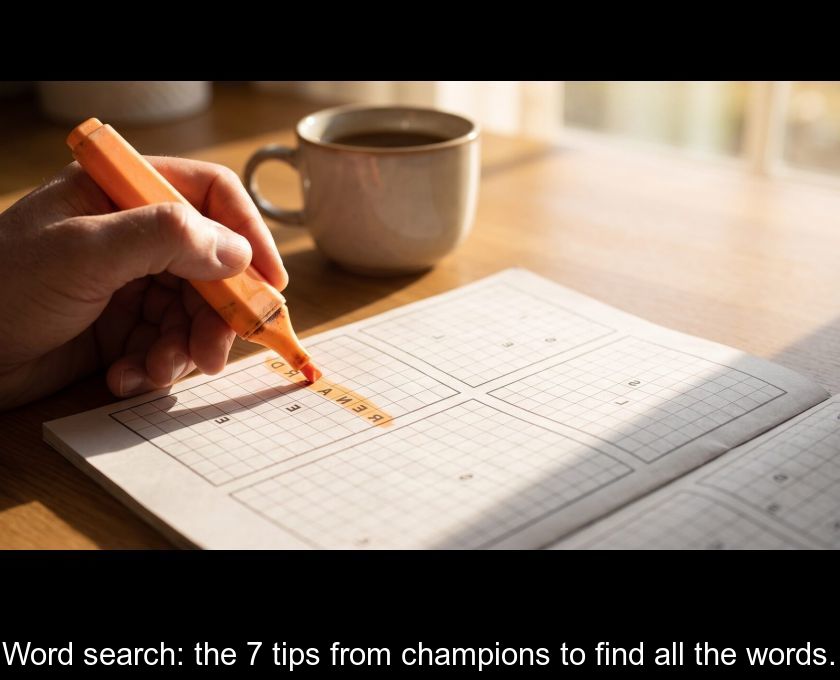
Word Search: The 7 Tips From Champions To Find All The Words.
Everyone knows how to play word searches, but few people know how to play quickly. When faced with a grid of letters, most of us let our eyes wander aimlessly, hoping that the hidden words will eventually appear. Regulars in speed competitions, on the other hand, apply specific techniques that turn the search into a walk in the park. Good news: these tips can be learned in five minutes. Here are the 7 reflexes that will make you a master sleuth of letter grids.
1. First, track down the rare letters.
It’s the best-kept secret of champions: don’t look for a word, look for its rarest letter. K, W, X, Y, and Z are infrequent in French, both in the words to find and in the filling letters of the grid. If the list contains KAYAK or WAGON, scan the grid for K or W: there will only be a handful, and one of them must belong to your word.
Once the rare letter is located, examine its eight neighbors to find the second letter of the word, and you’re done. This technique turns notoriously difficult words into easy prey: the more exotic a word seems, the quicker it can be spotted.
2. Identify the doubled letters
In the same family, the doubled letters create visual patterns that stand out: the two T's in CHOUETTE, the two L's in VANILLE, the two S's in HERISSON... Two identical letters side by side are much easier to notice than a single isolated letter. When a word from the list contains them, use it as your entry point.
3. Start with the longest words
Intuitively, we often attack the small words, thinking they will be quicker to find. It's exactly the opposite. A word of ten or twelve letters has very few possible positions in the grid: it needs space, and the grid doesn't offer that much. A four-letter word, on the other hand, can hide just about anywhere.
The long words found first also provide great assistance for what comes next: their letters often intersect with other words on the list and serve as reference points for mapping out the grid. Save the short words for the end, when the playing field has shrunk.
4. Sweep the grid as you read a book.
For words without distinctive signs, adopt a methodical scanning approach: memorize the first two or three letters of the word you are looking for, then go through the grid line by line, from left to right and top to bottom, as if you were reading a novel. Your eye should only seek out that small group of letters, not the entire word.
Each time the group appears, check the possible directions around it. This disciplined approach has immense merit: it covers the entire grid without ever going over the same spot twice, where random searching goes in circles. For vertical words, repeat the same scanning column by column.
5. Learn to read backwards
In the intermediate and difficult grids, words can be written from right to left or from bottom to top. Instead of twisting your neck, use the mental mirror: flip the word in your head and look for it in the normal reading direction. SERPENT written backwards is TNEPRES forwards: so look for a T followed by an N.
Another approach that works well: search for the word by its last letter. Regulars eventually stop distinguishing between the two reading directions, a mental exercise that, by the way, is an excellent workout for the brain.
6. Work on the theme.
The best grids are thematic: all the words to find belong to the same universe, such as animals, cooking, astronomy... Use them! Reading the entire list before starting prepares your brain: the words from the theme are preloaded in your memory, and their letters catch the eye on their own during scanning.
This is a well-known phenomenon among psychologists called priming: after reading PLANET and GALAXY, your eye spots COMET much faster. Players who discover themed grids all confirm this: you regularly find words that you weren't even looking for yet.
7. Check, cross out, organize
Last tip, the simplest and most overlooked: keep your list updated. Cross out each word found immediately, without exception. Nothing wastes more time than searching for a word... already found five minutes earlier. On paper, a pencil line is enough. Online, good sites take care of it for you: the word gets crossed out in the list as soon as you highlight it in the grid, and each found word appears in a different color.
Take the opportunity to mentally group words that share the same first syllable: if MUSHROOM, CHAMOIS, and CHAPEL are on the list, every CHA encountered in the grid deserves three checks at once.
The classic beginner's mistake
Before concluding, a word about the trap that almost all casual players fall into: simultaneous searching. Wanting to look for the entire list at once, letting your eyes wander across the grid in hopes that any word will appear, is the worst strategy. The brain cannot effectively monitor fifteen words at once: it ends up searching for none, and the same area of the grid is scanned ten times for nothing.
Fast players do exactly the opposite: one word at a time, a technique suited to that word (rare letters, length, scanning), and then move on to the next. The only exception concerns words sharing the same initial letters, which can be searched for in groups. This discipline may seem less fun on paper, but it is actually much more rewarding: words fall one after another, and the grid progresses rapidly.
Training your eye, a test of endurance
Last piece of advice from a regular: speed comes with consistency. Grid champions are not born with a gift; they simply played enough games until the letter patterns became recognizable on their own. One grid a day is more than enough to make progress, and the daily format is perfect for it: the same theme for everyone, comparable times, and a little friendly competition as a bonus. After a few weeks, you will surprise those around you by spotting the words even before you finish reading the list.
It's your turn.
Like all good techniques, these are only valuable through practice. The next time you encounter a challenging grid, go back to the list in order: rare letters, double letters, long words, systematic scanning... You'll notice the difference from the very first game.
And if you don't have a collection on hand, know that there are excellent free word search puzzles online today, with themed grids available and three difficulty levels to progress at your own pace. The most methodical among you can even delve deeper into each technique in this comprehensive guide to solving a word search puzzle. With a stopwatch in hand, the word hunt can begin!