Soil Quality: Recognizing Sandy, Clayey, Or Limestone Soil And Choosing The Right Crops.
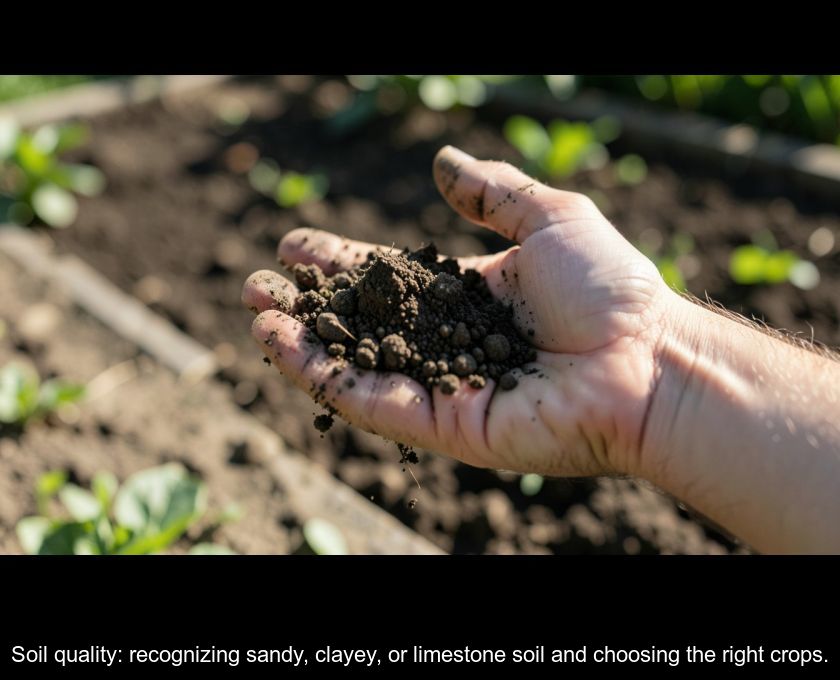
Before planting anything, a handful of soil often speaks volumes more than a long speech. Here’s how to identify your soil and give it what it truly needs.
Why it's important to know the nature of your soil before gardening.
The earth is not just a simple medium that can be turned over with a spade without thought. It is a living environment, in fragile balance, that compacts under rain, dries out in the wind, cracks in the sun, and crumbles under frost. In other words, it needs a careful gardener to regain its balance.
What changes everything is that each garden has its own soil signature. Sandy, clayey, calcareous, or humiferous, it will never behave the same way in response to water, heat, or the roots of your plants.
Knowing what type of soil you are dealing with avoids many disappointments. A yellowing rosebush, a rotting lavender, a rhododendron that refuses to bloom... the cause almost always stems from poorly identified soil that is therefore ill-suited to the plant's requirements.
Arable land and subsoil: the two essential components of the garden.
Beneath your feet, the garden actually hides two distinct layers. The topsoil, dark in color, is the one that is commonly worked: it is where the fine roots reside, those that draw water and the mineral elements necessary for plant growth.
Just below lies the subsoil, lighter, less rich, but equally essential. It allows deep roots to anchor the plant well and serves as a reservoir of water when the surface layer dries out.
This distinction has an important practical consequence: when creating a garden, it is necessary to integrate soil improvement from the initial planning phase. Massive additions of plant compost and fertilizers made from manure and seaweed provide, regardless of the initial quality of the soil, the best starting conditions for future plantings.
Recognizing fertile land: the basic components of soil
The agronomic quality of a soil depends on several elements that work together: minerals, organic matter, microorganisms, as well as the way all of this is arranged (particle size, structure, porosity) and how it reacts chemically (pH, ion retention).
Porosity plays a key role. For soil to allow water to penetrate well, solid particles must occupy about 50% of the soil volume. Water then settles in the finest pores, called capillaries (less than 1 micron), where it remains retained until evaporation or absorption by roots. For soil to be agronomically satisfactory, 100 grams of soil must retain between 8 and 30 grams of water once the excess has been drained.
Another essential indicator is pH. This measurement ranges from 1 (very acidic) to 14 (very basic), with most plants preferring neutral soil, between 6.5 and 7.5. Acidophiles like rhododendrons require a pH of 4 to 5.5, while calcicoles like cabbages thrive around 8. Note that each point of difference represents a factor of 10: a soil with a pH of 5 is ten times more acidic than a soil with a pH of 6.
The key role of organic matter and humus
Organic matter comes from the decomposition of plants (roots, leaves, straw) and animal waste (manure, guano, blood, bones, feathers). It is literally teeming with life: one kilogram of forest soil, the richest environment, contains about 1 trillion bacteria, 1 billion protozoa, 500 million algae, up to 50,000 springtails and mites, several thousand nematodes, not to mention earthworms, woodlice, and millipedes.
When this organic matter binds with other soil components, it is called humus. Combined with clay, it forms what is known as the clay-humic complex, an electrically negatively charged structure that retains positive ions such as potassium, ammonia, calcium, or magnesium.
It is this discreet yet fundamental mechanism that explains why soil rich in humus remains fertile year after year, even without a constant supply of fertilizers.
Use a colorimetric analysis kit to test your soil yourself.
Before sending a sample to the laboratory, it is quite possible to get a preliminary idea of the chemical qualities of your soil using commercially available analysis kits. These tools operate on the principle of colorimetry: a chemical reagent changes color upon contact with the soil, revealing certain characteristics of the soil.
The process is simple. You place the soil in the provided test tube, add the reagent, shake it, and let it sit for about ten minutes. The solution then takes on a particular hue.
You simply need to compare this color with the reference chart included in the kit to approximately determine the pH or the levels of nitrogen, phosphorus, and potassium in your soil. It is not as precise as a laboratory analysis, but it is more than sufficient to guide your initial planting choices.
How to properly collect a soil sample for reliable analysis
A good result depends primarily on a good sample. The soil must be dry and collected between 5 and 25 cm deep, exactly at the spot you wish to test, not elsewhere in the field.
Once you have the sample, place it in the tube provided with the kit, add the reagent, shake vigorously, and then let the mixture sit for about ten minutes without disturbing it.
This protocol, simple yet rigorous, ensures that the colorimetric result truly reflects the composition of the tested soil, rather than an approximate mix of surface soil that is too dry or too wet.
The complete laboratory analysis of pedology: the ultimate reference.
For those who really want to know everything about their land, nothing replaces a complete analysis conducted by a soil science laboratory. It details the physical elements: proportions of clay, silica, and limestone, structure, grain size, porosity, overall balance, amount of organic matter, and water retention capacity.
It also covers the chemical composition: pH, nitrogen content, phosphorus, potassium, and trace elements.
The advantage of this approach, which can be initiated via the Internet or at a gardening store, is that it often leads to a true prescription: specific improvements to be made, measured and tailored to your exact soil, rather than a general estimate.
The free soil, the perfect balance between sand, clay, humus, and limestone.
In absolute terms, every gardener dreams of coming across a loamy soil, that perfectly balanced ground that promotes the development of a very diverse vegetation. The problem is that it is very rarely found in its natural state.
Its ideal composition is as follows:
- 60 to 65% sand
- 15 to 20% clay
- 5 to 10% humus
- 5 to 10% limestone
Flexible yet consistent, porous without drying out too quickly, dark in color due to its organic matter, slightly acidic and low in stones, loamy soil contains just enough coarse particles to prevent compaction. This model should be kept in mind when looking to improve soil that is too heavy or too light.
Identify a clayey soil and its characteristics.
A soil is considered clayey as soon as it contains at least 30% pure clay, this colloid that agglutinates the finest sand grains. At the slightest rain, it forms a sticky mud that adheres to tools and boots, earning it the nickname "loving soil." Impermeable, it retains a lot of water, hence its reputation as heavy soil.
In terms of qualities, it's not so bad: by retaining water well, clayey soil reduces the frequency of watering, saving up to 30% compared to sandy soil. It is also generally very fertile, rich in potash, as it holds nutrients well and efficiently returns them to the roots.
Its drawbacks are well known: it sticks to tools when wet, hardens into compact clumps in dry weather, and warms up slowly, which exposes crops to late frosts and delays the start of vegetation.
To improve it, several actions work well together. Add two to three shovelfuls of compost or decomposed manure per square meter, combined with a shovelful of coarse silica sand for better drainage. Sow green manures like vetch or clover in spring, to be buried at the end of summer. Every autumn, carry out liming with one to two handfuls of agricultural lime per square meter, which deagglomerates the clay and rebalances acidity. Plow before winter without breaking the clumps to allow frost to act naturally as a loosener, and supplement with fertilizers rich in phosphoric acid, which are often deficient in this type of soil.
Spontaneous vegetation, a natural indicator of soil quality.
In a fallow land, the presence of abundant and diverse spontaneous flora already serves as a good indicator of the potential richness of the soil. Moreover, each type of soil has its own plant signature, allowing it to be recognized without analysis.
In clayey soil, one commonly finds buttercup, couch grass, bindweed, daisy, clover, or coltsfoot, accompanied by trees such as oak, ash, beech, or hawthorn.
In limestone soil, also recognizable by its grayish-white color, soft texture, and numerous pebbles, one can observe cornflower, poppy, wild chicory, juniper, or field mustard, often accompanied by walnut, lime, or field maple.
In sandy soil, which crumbles into fine particles as soon as it is squeezed in the hand, gorse, heather, foxglove, ferns, broom, or couch grass with chicken foot grow naturally, with birch, chestnut, and maritime pine in the background.
Finally, humiferous soil, dark and spongy, is characterized by forest or marsh-type flora: wood anemone, lily of the valley, bluebell, various mosses, alder, or willow. Observing these plants that grow spontaneously in your area, even before any landscaping, gives you a serious first clue about the true nature of your soil.
Improve your soil from the creation of the garden: compost and fertilizers.
Whatever the initial quality of your soil, the best time to improve it is right from the creation of the garden. Integrating this step into the initial planning phase, even before the first plantings, allows for massive additions of plant compost and fertilizers based on manure and seaweed, which provide much more favorable development conditions.
The needs vary according to the type of soil identified. Clay soil requires compost, decomposed manure, silica sand, autumn liming, and phosphate fertilizers. Limestone soil, on the other hand, needs acidifying amendments like brown peat combined with compost made from decomposed manure, supplemented by a base organic fertilizer. Sandy soil benefits mainly from regular additions of well-matured compost and manure, possibly combined with peat or water-retaining products that act like sponges, avoiding fast-acting fertilizers that would leach into the groundwater.
For major backfilling work, one can also use support soil enriched with compost, a more refined material than simple excavated soil, particularly suitable for planting trees, shrubs, or creating a vegetable garden.
In summary, identifying the exact nature of your soil is not just a detail reserved for enthusiasts: it is the foundation that determines the choice of plants, the frequency of watering, and the effectiveness of each amendment. Once this identity card is established, all that remains is to nourish the soil accordingly, year after year, so that it rewards you a hundredfold.