
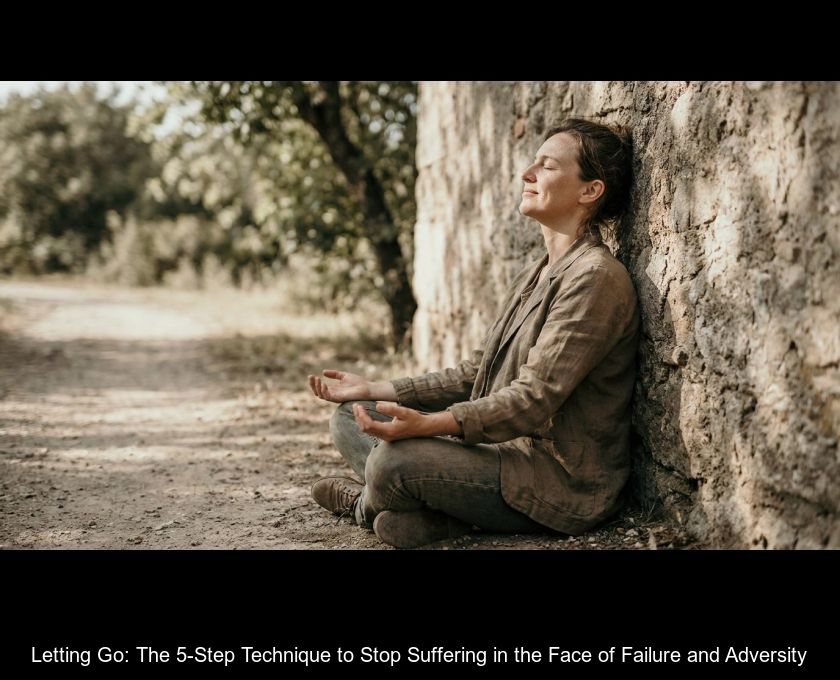
Letting Go: The 5-step Technique To Stop Suffering In The Face Of Failure And Adversity
Are you struggling with a problem without any results, and each failure leaves you feeling a bit more bitter? There is a concrete method, in several steps, to stop fighting against the wall and finally regain some lightness.
Letting go, an attitude more complex than it seems.
We often imagine letting go as a simple resignation, a bit soft around the edges: we give up, we rest, and voilà, peace returns on its own. In reality, it is much more demanding than that, and much more useful as well.
What we call letting go is actually a precise sequence of mental gestures, almost a multi-step method, that we can mobilize each time a failure makes us feel distress rising. There is nothing automatic or magical about it.
This involves deciding to stop forcing, accepting that the path is blocked, observing what stirs within us without repressing it, and then disengaging for a moment to breathe. Four distinct movements, which we will detail one by one, because skipping a step often means missing the entire exercise.
First step: decide to stop forcing.
Faced with a problem that resists, the first reflex is almost always the wrong one: to insist, push harder, do exactly the same thing hoping for a different result. Does that remind you of something?
The first gesture of letting go is precisely to stop this effort as we are conducting it. Not to abandon the goal, mind you, just to stop the way of approaching it, which clearly isn’t working.
It’s a conscious, almost voluntary decision: I choose not to persist in this way, here and now. A bit like when you let go of the steering wheel of a car stuck in mud instead of accelerating again and again in the muck.
Accept that the path is blocked, without judging oneself.
Once we stop forcing, the next step often comes, which is the most uncomfortable: acknowledging that it’s not working. And this should be done without self-flagellation.
Because there are generally three possible explanations, and none of them deserve us to label ourselves as incapable. Either it simply wasn’t the right path to achieve what we aimed for. Or it wasn’t the right time (the circumstances, the context, the other people involved weren’t ready). Or it wasn’t the right way to go about it, even if the goal remained valid.
This little sorting is valuable: it prevents turning a simple observation into a judgment about our own worth. We are not worthless because a door was closed; we just knocked on the wrong one, or too early, or too hard.
Observe without suppressing the rise of negative emotions.
After the realization comes inevitably a wave: disappointment, anger, dejection, sometimes even humiliation if the failure occurred in front of witnesses. There's nothing abnormal about that; quite the opposite.
The classic mistake is to want to chase these emotions away immediately, to act as if nothing happened. This never lasts very long; repressed emotion always comes back through the back door.
The right approach is to observe what rises within oneself, to name it internally ("Ah, I feel anger, disappointment") and to acknowledge that it's normal, even predictable, but not necessarily desirable in the long term. We watch the wave, we don't fight against it, and we also don't let ourselves be swept away by it.
Disengaging to give oneself a true breath of life.
Finally comes the moment to physically and mentally step out of the situation. To disengage from the task or problem, to leave the room both literally and figuratively, and to allow oneself a real breath.
To simply say: I will come back to this later, or maybe never, and that’s okay. This pause is not an escape; it’s a way to give air back to a mind that was going in circles.
For practice, nothing beats the little worries of everyday life: the key that can’t be found, the idea that doesn’t come for writing a somewhat delicate email, the interlocutor who clings to an unimportant detail. Letting go of these trivial matters for a few minutes, observing what it changes in the body and mind, is the best training before applying the same method to real failures.
Acceptance: saying yes to failure without submitting to it.
At the heart of this process lies a word that is often confused with resignation: acceptance. However, accepting has nothing to do with rejoicing in what hurts us.
Accepting is not saying "it's good," it's simply saying "it's there." An observation, almost neutral, immediately followed by a question directed towards the future: what can I do now?
In practice, it resembles saying yes, in your mind, to someone who disagrees with you. Not yes to their arguments, but yes to the existence of their disagreement, in order to continue listening to them before responding intelligently. Similarly, we say yes to failure, we acknowledge that it is there, without submitting to it or giving up on changing things afterward.
Why acceptance always precedes good action.
It is often thought that revolt, the great energetic "no," is better than the tranquility of acceptance. This is sometimes true, but not systematically.
The most effective sequence actually mixes the two: yes, it is this way, I see it, I accept it, but no, I am not going to let things continue in this direction. Acceptance does not come in place of action; it comes just before, like a buffer.
Without this pause, we only react impulsively, and impulsivity almost always brings us back to the same point of blockage. It is by taking the time to examine what is happening, to breathe, to understand and to feel, that we can finally choose the right action, one that is suited to the actual situation and not just to our momentary frustration.
How acceptance frees us from unnecessary struggles
The true benefit of acceptance is that it frees us from two types of exhausting battles. First, the struggles on the ground, those we fight against external obstacles when a simple letting go would do much better.
Then, and this may be the most insidious, the struggles that take place solely in our minds: all those rumblings of opposition to reality like "it's not possible," "it's not fair," "I'm dreaming." These phrases change nothing about the situation; they just exhaust us from within, silently, without us even realizing it.
To accept is to cut short these two fronts of battle simultaneously. We conserve our energy for what truly matters: to act, or to wait in peace for the moment to act.
Learning lessons from failure is as much an emotional task as it is an intellectual one.
There is a simple formula that summarizes the logical sequence of letting go: when we lose, we must not lose the lesson. Our successes reassure us, but it is our failures that truly make us more clear-sighted.
However, we must be willing to face them, to reflect on what they reveal, instead of endlessly chewing over the supposed injustice or bad luck. After the sting of defeat, it is about observing, then looking elsewhere: later ("if it happens again, what will I do differently?") and differently ("how can I reconsider all this with a more peaceful perspective?").
This work cannot remain purely intellectual. Understanding a lesson with your head is not enough; you also need to have received it on an emotional level, to have digested it in your body as much as in your ideas. It is a long, almost infinite process, but each small lesson learned makes us a little stronger in the face of the next storm.
When one fails to learn a lesson: accept that too.
It happens, and it's very common, to turn a failure over and over without gaining any wisdom from it. No clear lesson, no flash of insight, just a painful experience that remains painful.
Again, there's no need to feel guilty about it. There are failures from which we do not emerge richer, and that is precisely the message to receive: to accept that we cannot always transform pain into teaching.
This non-result is itself part of the learning of letting go. We accept the failure, we also accept not understanding why it happened or what it was supposed to teach us, and we move forward anyway.
Cultivating daily gratitude to anchor inner peace.
Once we have gone through failure, accepted it, and drawn what we could from it, there remains one last gesture to sustainably consolidate this regained peace: gratitude, practiced regularly and not just on special occasions.
It starts by simply feeling it throughout the day, for oneself. Then, from time to time, by expressing it concretely: writing a detailed letter to someone who has done us good, taking the time to specify why, what it brought us, and what it changed.
This small exercise forces us to slow down, to reflect, to fully feel the extent of what we owe to others, and it almost always ends up triggering a real encounter, a mutual recognition. A very concrete way to nurture, day after day, the inner peace we have just reconquered over failure and adversity.