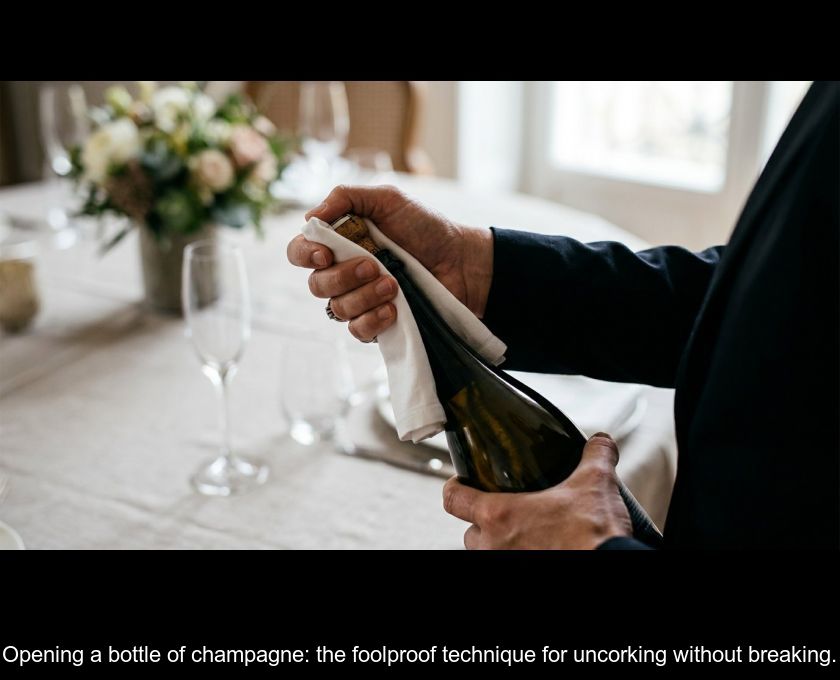
Opening A Bottle Of Champagne: The Foolproof Technique For Uncorking Without Breaking.
The cork that goes to the ceiling, the foam that floods the tablecloth, the grandma's vase that shakes... Here is, step by step, the method to open a bottle of champagne properly, safely, and with a nice discreet "Plop."
Why opening champagne is intimidating (and why it shouldn't be)
There are few table gestures as dreaded as this one. One imagines the cork flying towards a neighbor's eye, the grandmother's vase shattering, the foam splattering on the white tablecloth... As a result, we hand the bottle to the first guest who passes by, hoping they have more experience than we do.
This apprehension is quite understandable: a bottle of champagne contains pressurized gas, and a cork launched by that pressure is not an innocuous projectile. But rest assured, this creature can be tamed very easily.
It all comes down to five simple reflexes, which require neither strength, nor equipment, nor particular skill. Once understood, they become second nature, and you will come across as the most elegant person of the evening. Here is the procedure to follow, in order.
The golden rule: we spin the bottle, we never pull the cork.
Here is the number one mistake that everyone makes: grabbing the cork and pulling on it with all their might. It's exactly the opposite of what you should do.
The right method is to hold the cork steady with one hand and slowly twist the bottle around it with the other hand. It's the bottle that pivots, not the cork. The movement should be gradual, almost lazy.
The benefits are twofold. First, the rotation gradually loosens the grip of the cork against the glass, without any jerks. Second, and most importantly, you can feel the cork releasing millimeter by millimeter: you can therefore control your movement, slow down, hold back, and manage the pressure exerted by the gas instead of just enduring it.
The proper grip of the cap: palm and thumb to prevent it from flying away.
The hand holding the cork does not simply pinch it between two fingers. It covers it. Place the palm over it, like a lid, and squeeze firmly: if the pressure pushes suddenly, it is your hand that stops it, and the cork has nowhere to fly away.
As soon as the wire cage is removed, the thumb rests on the top of the cork and does not leave it. This constant contact makes all the difference between a controlled opening and a bottle that pops itself at the wrong moment.
An essential corollary: one never leaves an uncorked bottle of champagne unattended on a table corner. No time to fetch the flutes, no time to answer the phone. The cork stays under your hand, literally.
Never shake the bottle before opening.
A shaken bottle is a dangerous bottle. The gas in motion pushes violently against the cork, and the opening becomes unpredictable: foam erupts, the cork flies off like a bullet, champagne is lost for the most part.
However, one can shake a bottle without even realizing it. Did you carry it home from the store at the end of a bag, walking quickly, swinging your arm a bit? It has been well shaken.
In this case, the solution is simple: let it rest in a cool place for at least an hour and a half before opening it. This resting time, in the refrigerator or in a bucket, is enough to make it calm down again. It's the kind of detail that should be anticipated: buy the champagne a little earlier, rather than ten minutes before the aperitif.
The importance of temperature: champagne that is too warm is more dangerous.
Remember this rule, it is crucial: the warmer the bottle, the more likely the cork is to pop violently. Champagne left near a radiator or stored in the trunk of a car is not only less enjoyable, but also harder to control.
When it comes to tasting, sparkling wines and champagnes are served between 6 and 8 °C. Great champagnes, which are richer and more complex, benefit from being served slightly less cold, between 11 and 13 °C, to allow their aromas to express themselves. Beyond 20 °C, no wine, whatever it may be, is at its best.
And if you have to choose, it's better to be too cold than too warm: once served, a wine can gain four degrees in about fifteen minutes in the glass. Cold masks some aromas and accentuates acidity, while warmth makes the wine heavy, pasty, and almost cloying. It's best to start on the lower end.
Remove the wire cage safely, without ever letting go.
The muselet is that small twisted wire frame that covers the cork and prevents it from giving in to pressure. It is released by unscrewing the metal loop, and then it is removed.
From this moment on, the cork is only held by you. This is the most sensitive moment of the entire operation: the thumb immediately rests on the cork, the palm covers it, and the hand stays in place.
A good habit: point the bottle towards an empty space in the room, not towards your guests, nor towards the chandelier, nor towards the bookshelf. Even when held properly, a bottle is never completely predictable, and this precaution costs nothing.
Nota Bene: the word muselet simply comes from the idea of muzzling, restraining. It serves no purpose other than to contain the cork, and it has no utility once the bottle is opened.
The final gesture: accompany the cork until the
We're getting there: the cork is starting to loosen, you can feel it pushing against your palm. Above all, don't let go of anything. Hold the cork and the bottle until they are completely separated.
It's this final restraint that makes all the difference. By slowing down the exit, you avoid both a loud pop and overflowing foam. Continue to turn the bottle very slowly, guiding the cork rather than letting it slip away.
If the method has been followed from start to finish, you won't hear a bang but a discreet "Plop," a tiny sigh of gas. It's the sound of a successful opening, and incidentally, the most elegant of the evening. The cork stays in your hand, the tablecloth remains dry, and everyone is happy.
Keep a glass within reach to prevent foam overflow.
Sometimes we rush a bit, or the bottle has been shaken more than we thought. The foam then rises in the neck and threatens to overflow.
The solution is disarmingly simple: always keep a glass within reach of the neck before you start. If the foam rises, you don't have to run to the buffet; you pour immediately, and the champagne ends up in the glass rather than on the table.
In the same vein, prepare everything before opening: flutes out, lined up, a bottle coaster or a small plate ready to receive the bottle. Opening a bottle of champagne should be prepared like a small service, and those thirty seconds of organization save you from a lot of laundry.
The gesture of service: avoiding the famous drip.
The bottle is open; now it’s time to serve without letting that treacherous drop slide down the glass to inevitably land on the tablecloth. There are three solutions to choose from, depending on your equipment and patience.
The precautionary solution: place a coaster under the bottle on the table. There are very nice ones made of stainless steel or silver, but a simple coffee saucer works perfectly. The drops will flow onto it without damage, as long as you remember to always set the bottle back on it. Next is the instrumental solution: the half-steel, half-velvet ring that slips around the neck collects the liquid, and the drip stop, a small metallic sheet that you roll up and insert into the neck, cuts off the flow and prevents the drop from forming.
Finally, the manual solution, which requires a bit of skill and especially some practice: after pouring, make a slight wrist rotation while lifting the bottle. The drop then falls back into the neck. Two or three tries and the gesture becomes automatic.
As for the order of service, tradition dictates that women are served first, from oldest to youngest, followed by men in the same order. And don’t forget to never fill a glass beyond one-third: it’s not stinginess; it allows the wine to breathe and the aromas to develop.
In summary: five reflexes and it's won.
Let's recap, because everything can be summed up in a few words. Do not shake it; let it rest in a cool place for at least an hour and a half if the bottle has been jostled. Serve well chilled, between 6 and 8 °C for a classic champagne, 11 to 13 °C for a grand champagne, as a warm bottle is a more dangerous bottle.
Remove the wire cage, then immediately place your thumb on the cork and cover it with your palm. Never pull: slowly twist the bottle around the cork, feeling it loosen. Do not let go until it is completely separated, and keep a glass ready near the neck in case the foam rises.
The next time a bottle arrives on the table, do not pass it to your neighbor. Try the method: the discreet "Plop"; once you achieve it, you won't get tired of it.