
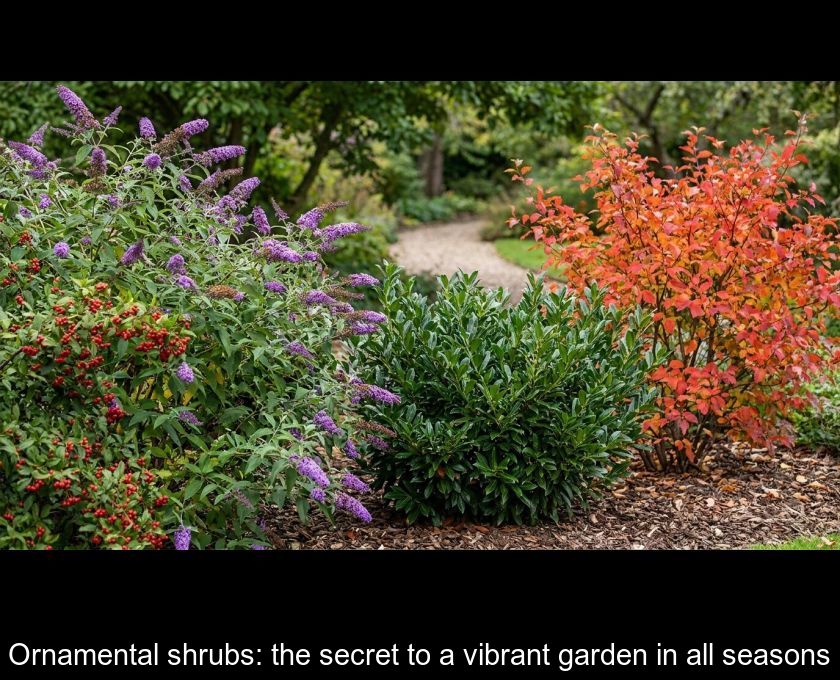
Ornamental Shrubs: The Secret To A Vibrant Garden In All Seasons
Foliage that changes color, flowers that take turns blooming, berries that delight the birds... when chosen wisely, shrubs transform an ordinary garden into a never-ending display. Here’s how to select and combine them intelligently.
Ornamental shrubs, structural pillars of the garden all year round.
A shrub is a woody plant that develops several main stems from the same base, with dimensions roughly between 30 cm and 4-5 m in height. This bushy aspect distinguishes it from a small tree, which only forms a single, relatively short trunk (lilac or magnolia are good examples).
What makes these plants so valuable is primarily their longevity. Once well-established and minimally cared for, most shrubs live for several decades, making them arguably the best value for money among all ornamental plants.
Another significant advantage is their minimal maintenance. The majority of species require only pruning every two to four years, and some can go without any pruning at all (aucuba, escallonia, laurel-tin). Therefore, without hesitation, this is the group of plants to prioritize when starting out in gardening.
Finally, shrubs structure the garden in every season, even in areas less suitable for other crops. They provide a constant plant presence where perennials and annuals come and go throughout the months.
An exceptional diversity to create your plant decor.
The choice available in this group is truly staggering: well-stocked nurseries commonly offer 3,000 different varieties, and even a good neighborhood garden center offers at least a thousand. It goes without saying that there is surely a shrub suitable for every corner of the garden, regardless of its exposure or soil type.
This diversity even allows for the imagination of a garden composed solely of shrubs, possibly combined with roses that botanically belong to the same larger group. Silhouettes, textures, dimensions, colors: everything varies from one species to another, allowing for extremely personal compositions.
Another significant advantage: many shrubs withstand air pollution very well, a criterion not to be overlooked in the city. Tough, glossy evergreen foliage (boxwood, holly, cherry laurel, spindle, ivy) tolerates particle deposits well, while deciduous ones also manage reasonably since they renew their foliage each year, limiting prolonged exposure to pollutants.
The right proportions: balancing evergreens and deciduous plants in the beds.
To ensure that a planting bed looks visually appealing all year round, there is a simple rule to remember: shrubs should occupy at least two-thirds of the total volume of your plantings. Within this volume, do not exceed 50% of evergreen species, except in urban areas where this proportion can rise to 75% to maximize greenery presence.
Deciduous plants indeed provide a dynamic changing aspect, often being more floriferous than their evergreen cousins, and they particularly brighten up the spring. Their weak point, the bare appearance in winter, is compensated by species with colorful bark such as the white dogwood (bright red), the bloodtwig dogwood (bright orange), or the contorted hazel with its golden catkins.
Conversely, evergreens ideally form the backdrop of the beds, providing a stable foundation for the decor and masking unsightly details (such as posts or electrical boxes). However, be cautious: an excessive proportion of evergreens, especially conifers, can harm neighboring deciduous plants, as their fallen leaves acidify the soil and the dense shade they cast hinders the growth of other species.
Create decrescendos of heights and associate perennials and annuals.
A successful planting scheme is never limited to shrubs planted in straight lines. The idea is to create a decrescendo of heights, with the most imposing subjects at the back or center and the shorter ones at the edges, so that each plant finds its place in the view without overshadowing another.
Slide perennials or seasonal plants between the shrubs: they fill in the gaps, especially when some deciduous plants are still young or not yet developed. Direct-seeded annuals (cosmos, gaura, Buenos Aires verbena) work particularly well in this slightly blurred and natural spirit, which also limits maintenance work, as spontaneous vegetation is less noticeable.
It is not only the height of a plant that matters when deciding its placement, but also the moment when its decorative interest peaks. Tulips that exceed 60 cm in April can very well be placed in front of 30 cm hellebores, since the latter have already bloomed in January-February and therefore do not obstruct the view.
Decorative foliage: shapes, textures, and colors throughout the seasons.
Too often, we only think of flowers when creating a flowerbed, forgetting that foliage remains present much longer, sometimes all year round in the case of evergreens. A good composition should allocate at least one third of the planted area to foliage that is truly decorative due to its shape, texture, or color.
In terms of shapes, there are two opposing options: finely cut foliage that creates a lace effect (Japanese maples, cutleaf sumac) or, on the contrary, large leaves with a bold design that bring an exotic touch (aucuba, David viburnum, Japanese aralia). The finest foliage benefits from being placed near a pathway, as it is best appreciated up close.
Regarding colors, dwarf conifers offer a beautiful palette: the bluish tones (from glaucous to steel blue in junipers) pair wonderfully with golden foliage, while the golden hues (bright yellow to bronze) blend better with purple or glaucous perennials. However, use these colors sparingly; a garden overloaded with bright shades can quickly appear cacophonous.
Don’t forget about autumn either: the cutleaf sumac, winged euonymus, oak-leaved hydrangea, or Japanese maple then ignite in reds, oranges, and purples, providing a true fireworks display at the end of the season, unmatched by what large trees can offer.
Remarkable blooms: the example of the butterfly tree
Each season has its own floral stars, and it's important to stagger them in the flowerbed to avoid decorative gaps. Curiously, summer is not the most generous season for flowering shrubs: the stars are mainly concentrated in spring and late summer, with a few notable exceptions.
The butterfly bush perfectly illustrates this type of summer shrub: this large deciduous plant often exceeds 4 meters and bears long, slightly curved clusters in July, which can be blue, white, or purple depending on the cultivars, and are highly fragrant and indeed nectar-rich. It is essential to choose sterile cultivars like Blue Chip or Purple Haze, as this plant has become invasive in certain regions, particularly in Île-de-France. There are also dwarf forms, perfect for pots on a balcony.
Since this summer flowering occurs on the stems of the year, a severe pruning at the end of the season is necessary: reduce all shoots to about 10 cm to encourage a complete renewal of the vegetation. Without this intervention, the shrub grows tall and becomes unsightly at the base, a common flaw in summer-flowering shrubs.
Decorative fruits, an asset to extend autumn interest.
Decorative fruit shrubs are often overlooked when making selections, deemed too ordinary in spring and summer. However, it is in autumn that they truly shine, while generously feeding the garden birds.
Several species deserve a prominent place. The cotoneaster is covered with shiny dark red round berries and grows well in all sunny soils, making it ideal for free hedges or borders. The berry-bearing St. John's wort produces yellow flowers followed by striking bright red berries, but it fears harsh winters. The buckthorn, more resilient, produces drupes that turn from red to black in October-November, making it a good plant to recommend to beginners despite its tendency to sucker. The opulent elderberry bears generous clusters appreciated by birds, while the snowberry adorns itself until December with small soft pink or white balls.
Once the berries have disappeared by late winter, proceed with rejuvenation pruning: reduce the branches by one third to half their length while respecting the natural silhouette, and remove the oldest branches at ground level each year. Above all, never apply insecticide treatments as soon as the fruits appear, so that birds can feed on them safely.
Train the shrubs with flexible branches to dress walls and fences.
Not all shrubs are meant to remain free in the middle of a flowerbed. Some, with sufficiently flexible branches, lend themselves very well to training against a wall or fence, which allows for space-saving while dressing up a somewhat dreary vertical surface.
The blue ceanothus is an excellent example: relatively frost-sensitive, it particularly enjoys being placed near a wall that shelters it from the cold, and its branches can be easily guided against a support. This technique is especially suitable for species that are somewhat sensitive to frost, as the wall provides them with valuable thermal protection in addition to support.
Training also helps to enhance shrubs that, if left free, would take on a silhouette that is too bulky for a small garden. It is a solution to consider systematically when ground space is limited, while fully enjoying the decorative potential of the plant.
Beware of invasive species in your flower beds.
Some shrubs, appealing on paper, turn out to be problematic once planted in the garden. A few species spread easily by wind or through birds and disrupt the natural environment: this is the case with the butterfly bush (excluding sterile cultivars), Japanese pittosporum, or tree ragwort.
Others do not pose an ecological risk but require regular monitoring because they produce abundant suckers that need to be cut frequently to avoid being overwhelmed: Japanese angelica tree, the turquoise tree, lilac, hazel, or Virginia sumac are among them.
Finally, some shrubs simply spread very quickly and take over space at the expense of their neighbors: Japanese cornel, white dogwood, red osier dogwood, and white snowberry deserve particular vigilance in small beds. Before planting any of these subjects, it is better to inquire about their long-term behavior rather than having to battle against them a few years later.
Renew the plantation by replacing aging subjects.
A mass of shrubs is never fixed forever. Over the years, many species age poorly: they become bare at the base and accumulate dead wood that detracts from the overall aesthetic. The mock orange is a typical example, hardly interesting after eight to ten years, as its fragrant flowers eventually only adorn the top of the shrub.
The solution is to systematically replace the unsightly subjects with younger plants, without waiting for the situation to become critical. This is also the perfect opportunity to test new species and evolve the garden's decor over time, rather than indefinitely repeating the same plantings.
To successfully establish new plants, work the soil deeply (ideally 50 x 50 cm to the same depth), mix an organic fertilizer with the original soil, and protect the young plant with good mulch during its first two winters. Always finish with a generous watering of at least 10 liters, then monitor the moisture for the next two months if the weather remains dry.
By wisely combining deciduous and evergreen plants, decorative foliage, staggered blooms, and autumn fruits, a well-thought-out shrub garden never looks dormant, even in the heart of winter. It just takes regular observation of the beds, timely pruning, and renewing tired subjects for the decor to continue surprising you, season after season.