
Convertible Sofa: The 5 Measures To Take Before Ordering
The convertible sofa carries a flattering reputation as the space-saving furniture. This is true... during the day. In the evening, once the bed is unfolded, the balance of power shifts and the living room suddenly shrinks. Many buyers discover this detail after delivery, when the coffee table no longer fits and the hallway door only opens halfway. However, everything is determined before placing the order, with a tape measure and a quarter of an hour at hand. Here are the 5 measurements to take to choose a sofa bed that will truly fit in your home, and not just in the catalog photo.
The convertible, the number one weapon in the hunt for square meters.
If this piece of furniture has become so popular, it's not by chance. French homes are no longer expanding; they tend to be getting smaller.
Apartments now account for 44% of primary residences, with an average area of 63 m². Nearly four out of ten apartments have only one or two rooms, and a quarter of them are less than 45 m². In new constructions, the trend is even clearer: the average size of homes under construction has dropped to 76 m² in 2025, compared to 83 m² in the previous decade.
Add to this the continuous increase in single-person households, which will represent the majority of new homes to accommodate by 2050, and you have an ideal setting for multifunctional furniture.
The convertible perfectly meets this need, as it frees up space during the day instead of permanently occupying sleeping space. However, be careful of the misunderstanding: it doesn't actually create more square meters; it borrows them at different times. That's why it needs to be measured twice, once closed and once open.
Click-clack, BZ or express opening: three mechanisms, three footprints.
Before even taking out the measuring tape, you need to know which system you are aiming for. It dictates everything else, as each mechanism unfolds neither in the same direction nor over the same distance.
In this area, the offerings have changed significantly. The ranges of design convertible sofas now feature mechanisms that are much more discreet than the sofas of the past, with real mattresses and lines that have nothing to envy from a fixed sofa. However, style does not change geometry.
Three main families dominate the market:
- The clic-clac: the backrest tilts backward and the mattress, in two parts, unfolds forward. Expect 85 to 95 cm in depth when closed, and about 190 cm when open. This is the simplest system, mainly reserved for occasional sleeping.
- The BZ: the sofa unfolds like an accordion, perpendicular to the wall, with a three-part mattress. When closed, it is often the narrowest of the bunch, around 80 cm. When open, it also extends up to 190 or 200 cm. A good option for a living room that is deeper than it is wide.
- The express opening convertible: the bed frame and mattress come out as a single unit from the front. It is deeper when closed (95 to 110 cm) and often requires more than 2 meters from the wall in bed position. In return, it is the only one that accommodates a mattress thickness of 14 to 18 cm, making it the only one truly designed for daily sleeping.
The rule can be summed up in one sentence: the more comfortable the sleeping arrangement, the more space the mechanism takes up on the floor. These values remain rough estimates; the technical sheet of the model provides the exact dimensions.
1- Measure the closed sofa: length, depth, and armrests.
This is the most obvious measurement, and it's also the one that is most often taken poorly.
Measure the available wall length by removing what won’t move: a thick baseboard, a radiator, the swing of a door. Then note the actual depth of the sofa, including armrests and legs. Product specifications sometimes mention seat depth, which is always shorter than the overall depth.
A common-sense tip to finish: leave 10 to 15 cm of margin on each side. A sofa wedged millimeter-perfect between two walls is a nightmare to install and impossible to clean behind.
2- The footprint of the bed once the sofa bed is unfolded.
Here is the measurement that almost no one takes, yet it is the one that causes real disappointments.
A standard double bed measures 140 x 190 cm, with some models going up to 160 x 200 cm. This length of 190 or 200 cm cannot be tucked away; it extends into your room from the wall.
So start from the wall where the sofa will be placed and mark the distance on the floor. What remains in front? If your living room is 3.20 m deep and the open bed takes up 2 m, you have 1.20 m left to move around, place a coffee table, and open a door. This is entirely feasible, but it needs to be decided beforehand, not afterward.
3- The swing: the necessary space to open the bed.
A convertible sofa doesn't unfold by magic. You need space to perform the action, and this space has a name among sellers: the clearance.
With a click-clack sofa, you should be able to stand in front of the furniture to tilt the backrest. With an express-opening model, you pull the mechanism towards you, so you step back during the operation. Allow for 60 to 80 cm of clearance in front of the sofa, even if the open bed ultimately takes up less space.
It's also the time to look at what's in front. A heavy coffee table, a thick rug, or an ottoman that needs to be moved every night quickly turns the bedtime ritual into a chore... and the bed ends up never opening.
4- The circulation space around the sleeping area
A folded bed is not an object placed in a corner. It is an obstacle that must be navigated at night without turning on the lights.
The usual guideline in interior design is to maintain a minimum of 60 cm of passage between two pieces of furniture, and preferably 70 to 80 cm for comfortable movement. Apply this to the open bed, not to the closed sofa.
Also check three points that are often overlooked:
- access to the room's door, which must remain passable at night,
- the swing of closet doors and windows, which should not hit the mattress,
- the passage to the bathroom, if the convertible sofa is used for daily sleeping.
In a studio, these constraints become the main focus. Other layout tips then combine very well with the choice of sofa, such as those gathered in our article on the 5 best tips for saving space at home.
5- Access template: doors, stairs, and elevator
The measurement that causes a delivery to fail is almost never that of the living room. It's that of the pathway.
A sofa delivered in one piece must pass through a building door, a staircase, sometimes an elevator, and then a hallway with a corner. However, a standard interior door often measures 73 or 83 cm wide, and the usable passage is even narrower by a few centimeters once the door is open.
So, before ordering, take note of:
- the width of the doors to be passed through, with the door open,
- the width of the staircase and the space available in the turns,
- the dimensions of the elevator cabin, including height,
- the ceiling height of the landings, which is often limited in older buildings.
If the pathway is too tight, there are two solutions. Some models are delivered in a kit or vacuum-compressed, which solves the issue. Others can be partially disassembled, such as legs, armrests, or backrest. Make sure to inquire before the purchase rather than on the day of delivery when the driver leaves with the sofa.
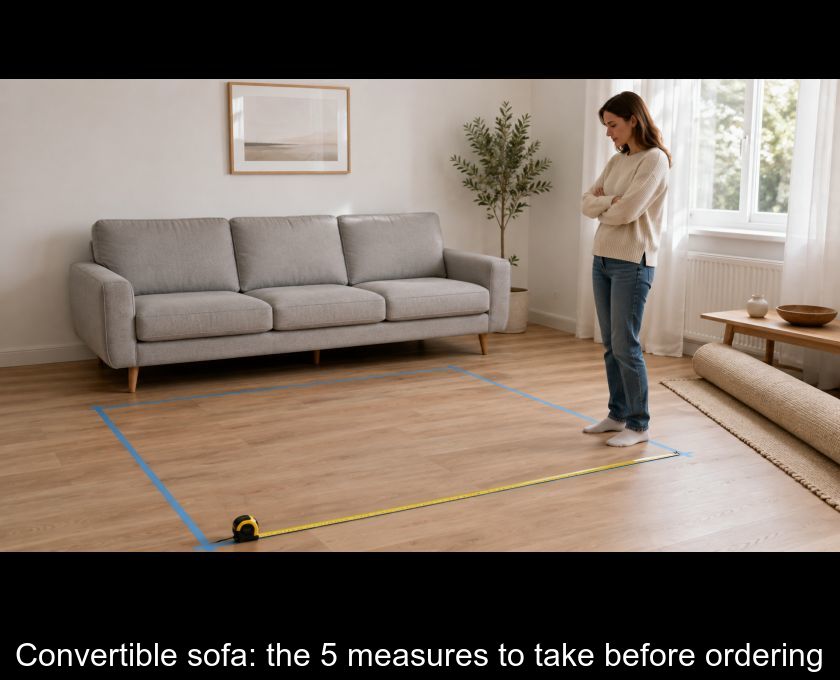
Mark the bed on the floor: the check that takes ten minutes.
Once the five measurements have been taken, there is one last step, and it is by far the most telling.
Get some masking tape, old newspapers, or just a piece of string, and outline on the floor the rectangle of the closed sofa, then that of the open bed. Live with it for an evening. Walk by, open the door, walk around the coffee table.
This simple method is worth more than a 3D plan. It will tell you in ten minutes what no product sheet can tell you, namely whether you will feel comfortable in this room once the furniture is installed. And if the verdict is negative, there will always be time to downsize or consider custom furniture, a topic explored in our article on small spaces and custom solutions.
Note: also remember to measure the height of the closed sofa. If placed under a window, a backrest that is too high will block the opening of the casement, and the tilt-and-turn window will be the first to suffer.
Note Well
- Footprint: actual surface occupied by the furniture, measured overall, including armrests and legs.
- Clearance: free space needed in front of the sofa to operate the mechanism, not to be confused with the space occupied by the bed once opened.
- Seat depth: distance between the front edge of the sofa and the backrest. It is always shorter than the total depth of the furniture.
- Mattress density: expressed in kg/m³, it indicates the firmness and durability of the foam over time. It is considered that a regular sleeping arrangement requires at least 30 to 35 kg/m³, more for daily use.