Weekend In Toulouse: What To See, What To Do, And How To Organize Your Stay In The Pink City.
If you're looking for a French destination that has everything to please for a weekend, Toulouse checks many boxes. A mild climate whose advantage is sometimes overlooked in France, a compact historic center (perfect for a short stay), generous cuisine, and a vibrant cultural life... The fourth largest city in France has even been named "best city to visit" by Lonely Planet, a recognition that has contributed to the influx of visitors in recent years. In 2024, the metropolis surpassed 5 million commercial overnight stays, and its cultural sites exceeded 3 million visitors in 2025. In other words, you won't be alone... but you'll have plenty to keep you busy. Here’s a guide to help you organize your weekend without missing anything.
1- How much time should be planned to visit the Pink City?
The question often arises. For a first visit, 48 hours offer the best balance between pace and enjoyment. 24 hours provide a good overview but will inevitably leave you with regrets, and 3 days are ideal if you want to include an excursion to the surrounding areas.
One of Toulouse's great advantages lies in its urban topography: the main monuments are located within a perimeter that can easily be explored on foot. The historic center, the Garonne River, and the lively neighborhoods are connected by brick alleys that invite leisurely strolls. There’s no need for transportation to go from one sight to another from morning until evening.
Note: prioritize accommodation in a central location, in the Capitole, Carmes, or Saint-Cyprien areas. The city is quite spread out, and radiating from a fixed point will save you valuable time.
2- Capitol Square and the must-see attractions of the historic center
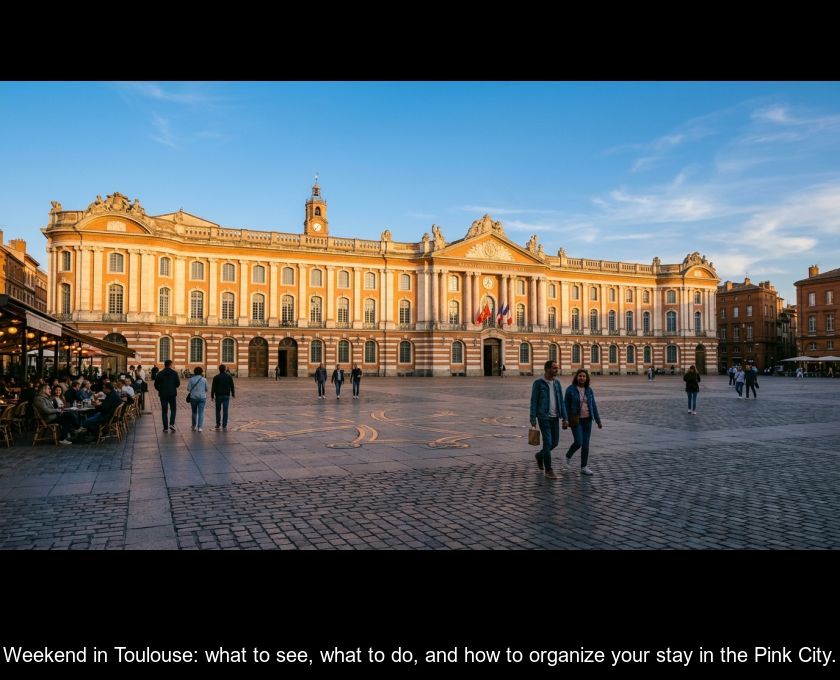
The first mandatory stop is the Place du Capitole. This vast 12,000 square meter pedestrian esplanade faces the majestic Capitole building, which has been the city hall since the 12th century. Take the time to admire the Occitan cross drawn by Raymond Moretti on the ground and the twenty-nine frescoes that adorn the arcade gallery.
Just a few minutes' walk away, the Basilica of Saint-Sernin remains the most visited site in the city, with nearly one million visitors in 2025. This largest Romanesque church in France, listed as a UNESCO World Heritage site, impresses with the intricacy of its sculpted capitals and the grandeur of its central nave.
Continue on to the Jacobins Convent, which saw a 15% increase in visitors that same year. Its Gothic nave conceals a true treasure: the famous "palm tree" with 22 ribs that seems to float above the choir. The adjoining cloister, calm and bathed in light, is one of the most beautiful places in the city to take a breather between visits.
Finally, don't miss the Hôtel d'Assézat, a masterpiece of the Renaissance that houses the Bemberg Foundation and its superb collection (Bonnard, Canaletto, Monet, Matisse, Picasso...).
3- Stroll along the Garonne and the Canal du Midi
The pink city is also experienced along the water. The quays of the Garonne, between the Pont-Neuf and the Daurade, offer a light at sunset that the people of Toulouse call "the pink hour" - this is where the brick facades take on their full intensity.
On the other bank, the Saint-Cyprien district deserves a real stroll, especially around the La Grave hospital and its recently reopened chapel. Also plan for a break on the banks of the Canal du Midi, a UNESCO-listed work that connects to the Mediterranean. Cruises lasting from two to six hours depart from the Saint-Sauveur port and allow you to discover its historic locks.
4- Good gourmet addresses and Victor-Hugo market
Talking about Toulouse without mentioning its gastronomy would be an affront. Head to the Victor-Hugo market, a true temple of Southwest products, where Toulouse sausage, black pork charcuterie from Bigorre, cassoulet, and sweet specialties like gascon pastis or fenetra coexist.
Note: The restaurants located on the first floor of the market are an institution for lunch. Expect to pay between 18 and 25 euros for a complete menu, with a guaranteed bistro atmosphere.
For a more upscale dining experience, "Ma Biche sur le Toit," the rooftop of Michel Sarran above the Galeries Lafayette, offers a 180° view of the city.
5- Treat yourself to an excursion in the surrounding area.
Here’s another advantage of Toulouse: the richness of its surroundings. If your weekend turns into a three-day stay, dedicate an entire day to one of the gems located less than two hours away.
Albi and its UNESCO-listed episcopal city are just a one-hour drive via the A68 (78 km), as well as by TER. Carcassonne and its medieval ramparts can be reached in 1 hour and 10 minutes via the A61 (about 95 km). For a more rustic day, Cordes-sur-Ciel, Saint-Antonin-Noble-Val, or the first foothills of the Pyrenees are within driving distance.
This is where the car really makes a difference. For these rural getaways where public transport quickly reaches its limits, booking a car rental in Toulouse from Blagnac Airport or Matabiau Station remains the most flexible solution. You leave when you want, stop in a village that catches your eye, and return at your own pace.
Note: To avoid the heat and crowds, leave early in the morning. The summer of 2025 was marked by several heatwave episodes that complicated some outdoor activities.
6- Half a day on the Airbus planet
It is impossible to mention Toulouse without talking about aerospace. The Cité de l'espace, located to the east of the city, offers an immersive journey around space exploration with a full-scale Ariane 5 rocket, a Soyuz capsule, and simulators. Plan for half a day to explore it without rushing.
Aviation enthusiasts can extend the experience with a visit to Aeroscopia in Blagnac, a museum that houses the Concorde and the Airbus A300B, or by taking the "Let's Visit Airbus" tour that goes right to the assembly lines (reservation required, ID needed).
Practical tips for preparing your weekend
- Ideal season: from May to early July, then from mid-September to October. The months of July and August are more touristy and subject to heat.
- Getting there: 4h20 by TGV from Paris, direct flights from most major European cities (Spain accounts for 40% of foreign visitors, the UK 10%).
- Accommodation: the average hotel occupancy rate is 65%, with an average price of around 88 euros per night. It is therefore wise to book 3 to 4 weeks in advance for spring and autumn weekends.
- Urban transport: the Tisséo network (metro, tram, bus) serves the entire metropolitan area. A day pass costs less than 7 euros and remains unbeatable for reaching the Cité de l'espace or Blagnac.
- Tourism Pass: offered by the tourist office, it provides access to over 50 partner sites at reduced or free rates for 3 days.
Note Bene: the ZFE and parking in the center
Toulouse implements a Low Emission Zone that gradually restricts the circulation of older vehicles in the city center. If you are arriving by car, check your Crit'Air sticker before departure. For parking, prefer the park-and-ride facilities located at the terminus of the metro lines (Basso-Cambo, Borderouge, Balma-Gramont): you can leave your car for the day for a few euros and access the center in 15 minutes.
Toulouse remains one of those French destinations where you arrive curious and leave enchanted. Between pink alleys, generous tables, and large open spaces just a stone's throw away, a simple weekend is enough to grasp its spirit. And often, it makes you want to return for a longer stay.