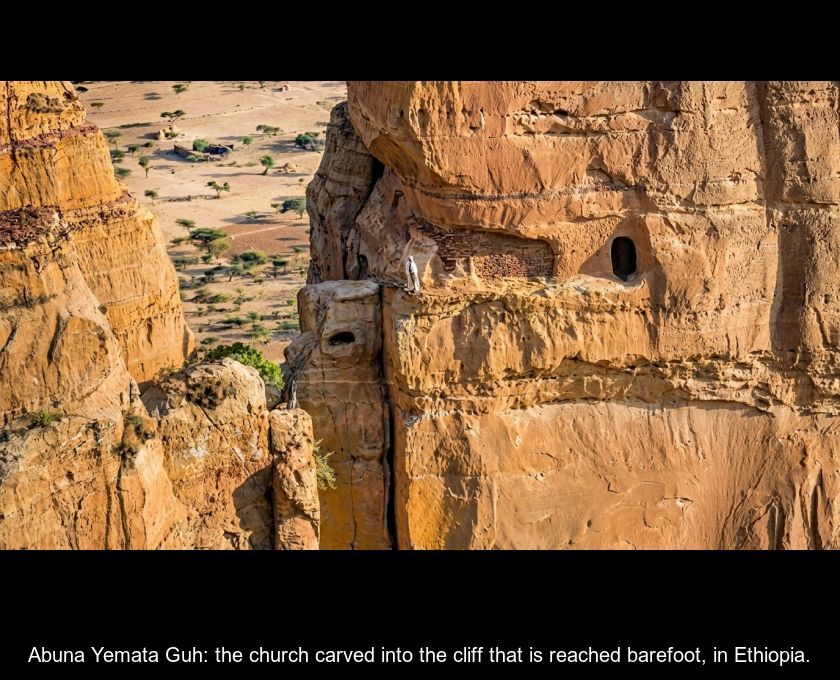
Abuna Yemata Guh: The Church Carved Into The Cliff That Is Reached Barefoot, In Ethiopia.
A church carved into the sandstone, at the top of a peak with 198 meters of void on all sides, a 45-minute climb, an ossuary of priests along the way, and a final wall to ascend barefoot: welcome to Abuna Yemata Guh, in eastern Tigray.
Abuna Yemata Guh, the church suspended in mid-air
Abuna Yemata Guh is a Christian church carved into the rock, at the top of a sandstone peak in eastern Tigray, Ethiopia. This monolithic sanctuary is surrounded by cliffs approximately 198 meters (650 feet) high on all sides, and it can only be reached after a 45-minute hike.
In other words, attending mass here involves climbing. One must navigate walls, makeshift bridges, and narrow ledges before arriving at a carved and painted cave, where a few devoted priests conduct the service as if nothing were unusual.
What strikes one, beyond the physical challenge, is the ordinariness of the act for them: this dizzying journey is part of their religious routine. For the visitor, it is the opposite, an experience that is both exhilarating and frankly terrifying.
A rock-hewn church nestled in the cliffs of Tigray.
The Abuna Yemata Guh church is located in the east of Tigray, northern Ethiopia, at the top of a sandstone outcrop overlooking a valley. Its coordinates are 13.915330° north latitude and 39.345254° east longitude, and the first major urban landmark to reach it is the city of Axum.
The terrain explains everything: the region is made up of towers and sandstone peaks, and it is directly into this material that the place of worship has been carved. It is said to be a peak that, according to the most generous measurements, reaches half a mile high, with the church perched at the very top like a nest.
Note Bene: a so-called rock-hewn church is not built with stacked stones; it is carved from the solid rock, from the outside in. It is also referred to as monolithic because it is a single block with the cliff that supports it.
The ascent: 45 minutes of dizzying climbing to the sanctuary.
To reach Abuna Yemata Guh, there is only one way: a 45-minute hike that combines approach walking and climbing. The route begins by crossing the valley located beneath the church, then tackles the sandstone pinnacle itself.
In detail, the ascent involves three types of difficulties: rocky walls to climb, rickety bridges to cross, and narrow ledges to navigate. On the rock, the challenge is to spot the few available footholds, as there are neither carved stairs nor handrails.
The final section is the most serious, a vertical wall that is climbed barefoot. A guide shows you where to place your feet, step by step, and the advice that always comes up is the same: whatever happens, do not look down.
The dangers of the route: cliffs, makeshift bridges, and narrow ledges.
The dangers of ascending to this rock-hewn church in Tigray are very real: cliffs to climb, makeshift bridges to cross, narrow ledges to navigate, and about 198 meters of void waiting for you in case of a misstep. The void is present on all sides of the outcrop, not just one.
The most challenging aspect remains the scarcity of footholds. On the sandstone, you literally have to search for where to place your foot, which turns even the slightest hesitation into a problem. The bridges that allow you to move from one ledge to another are rudimentary and unstable, and the ledges sometimes leave room for only one foot.
Hence the importance of a guide who knows the route by heart. This is not a comfort accompaniment; it is he who indicates the exact location of the supports on the final vertical section.
The tomb of the priests: an open-air ossuary along the way.
Yes, the path to Abuna Yemata Guh passes by an open grave filled with the skeletal remains of deceased priests. This open burial site is directly on the ascent route; it cannot be avoided or truly ignored.
The effect on morale is easy to imagine. You are already clinging to a sandstone wall, with nearly 200 meters of emptiness behind you, and there you encounter the bones of those who served this church before you. The feeling of apprehension rises a notch.
However, it must be seen as more than just a macabre setting: it is an ossuary, thus a place of memory for a religious community that is extremely attached to this sanctuary. The priests who ascend today pass by their predecessors at every service.
Why has no priest ever fallen off the cliff?
It is said about Abuna Yemata Guh that no priest resting in the ossuary has died from falling off the cliff. This is a claim rooted more in local tradition than in an official record, and it should be taken for what it is: a transmitted story, not a verifiable statistic.
That said, the practical explanation holds. The priests who serve the church make this journey regularly; they know the location of the few footholds, understand where the rickety bridge can support weight, and at what height the ledge narrows. Repetition creates a bodily memory that a one-time visitor obviously lacks.
Additionally, there is the technique of climbing barefoot on the final vertical wall, which puts the skin in direct contact with the sandstone. Nothing is infallible, but it is understandable why accidents concern occasional climbers more than regulars.
The sacred interior: frescoes and apostles painted on the rock
Inside this rock-hewn church in Ethiopia, the cave ceiling is adorned with two remarkable frescoes, featuring interwoven patterns and religious imagery. Notably, one can recognize the faces of nine of the twelve apostles of Christ, painted directly onto the carved rock.
The staging is striking: after the effort and fear, one emerges into a dark, cool space, entirely decorated above head height. Geometric patterns and figures unfold across the vault, compelling the visitor to look up, exactly the opposite of the instinct to ascend.
It is indeed these paintings that make Abuna Yemata Guh more than just a sporting achievement. The site is a painted cave, a decorated sanctuary, and it is this decoration that has justified so much effort to reach it over the centuries.
The Bible in goat skin: a unique liturgical treasure
Abuna Yemata Guh holds an Orthodox Bible with pages made from goat skin, featuring bright and vibrant colors. This book is located in the church itself, at the top of the outcrop, and is part of the liturgical treasure of the place.
The medium deserves a word of explanation. Before paper, sacred texts were copied onto prepared animal skins, and goat skin provides thick, flexible, and very durable pages, capable of lasting through the centuries much better than ordinary paper. The pigments applied to it also retain a surprising brilliance.
There is something dizzying about knowing that this work is preserved up there, behind a wall that must be climbed barefoot. Every liturgical object present in the church has been brought up by the strength of arms and legs.
Baptism at the summit: parents brave the void for their children.
Some Ethiopian parents climb Abuna Yemata Guh with their baby in their arms to have them baptized at the top of the cliff. They take this risk, with a 45-minute ascent and a final vertical wall, because the church is considered sacred enough to justify it.
Specifically, this means navigating narrow ledges and makeshift bridges with a newborn, over nearly 200 meters of empty space. It's hard to measure the mental burden of such a journey when carrying a child who cannot hold on.
This is probably the detail that best reflects the status of the place. Abuna Yemata Guh is not a curiosity for thrill-seekers; it is a living church where significant life events are celebrated, even if it means facing the cliff to do so.
Comparison: Abuna Yemata Guh versus Saint Simeon the Stylite in Syria
Abuna Yemata Guh in Ethiopia and the Church of Saint Simeon the Stylite in Syria share the same idea of seeking God in heights, but one is a sanctuary still frequented and the other a ruin. In Deir Semaan, on Mount Simeon, half an hour's drive from Aleppo, only a small part of the structure built in 491 AD remains.
The story of Simeon is worth the detour. This 5th-century ascetic, after about ten years in a monastery in Aleppo, declared that God wanted him to be immobile, climbed to the top of an abandoned pillar in the desert, and remained there for 37 years, eating barely anything and tying himself to a post to avoid sleeping lying down. He died on his column in 459 and inspired a wave of imitators.
Nota Bene: these imitators are called stylites, from the Greek stylos meaning pillar, as they spent their days praying and preaching at the top of a column. The original pillar of Simeon has been reduced to a stump of a few dozen centimeters by relic hunters, while at Abuna Yemata Guh, the rock still stands tall.
Getting there: practical tips from Axum
To get to Abuna Yemata Guh from Axum, expect about 3 hours and 30 minutes of driving, followed by a 45-minute hike to the church. The exact arrival point is located at coordinates 13.915330 north and 39.345254 east, in eastern Tigray.
The most important advice can be summed up in two words: take a guide. They will show you where to place your feet on the last vertical wall, where holds are scarce and improvisation has no place. Also, plan to climb light, as the final section is done barefoot.
Two things to keep in mind during the ascent: do not look down, and accept to move at the guide's pace rather than your own. The view of the valley will be waiting for you at the top, once both feet are on the platform.
Do you really have to climb barefoot before arriving?
Yes, the last part of the ascent to Abuna Yemata Guh, a vertical rock face, must be done barefoot. It's not an option for purists; it's the way to cross this passage, shoes removed before tackling the wall.
Two logics converge here. The first is purely physical: bare skin conforms to the sandstone and informs the climber about the quality of their foothold, which a rigid sole does not do, and this matters when foot holds are scarce. The second is the respect owed to the sanctuary; one does not arrive shod in a place of worship.
This remains the most exposed moment of the journey, and it is precisely here that the guide becomes indispensable, as they point out each foothold. Finally, remember the golden rule: keep your eyes on the rock in front of you, never on the void below.
In summary: a church, a pilgrimage, a physical commitment.
Abuna Yemata Guh encapsulates what rock-hewn churches and extreme pilgrimages in East Africa are all about: a sanctuary carved into sandstone, perched atop a pinnacle surrounded by approximately 198 meters of void, which can be reached after a 45-minute climb. Along the way, there are walls, rickety bridges, narrow ledges, and an open-air ossuary of priests.
At the top, the reward is twofold: the view of the valley, and especially a painted cave whose ceiling features two frescoes depicting the faces of nine of the twelve apostles, as well as an Orthodox Bible made from goat skin.
If the idea appeals to you, the plan is simple: a 3.5-hour drive from Axum, a guide hired on-site, shoes that must be removed before the final wall, and this advice repeated by everyone who has climbed before you: don’t look down. And if heights aren’t for you, know that the site can already be appreciated very well from the valley, observing this improbable pinnacle that houses a church at its summit.