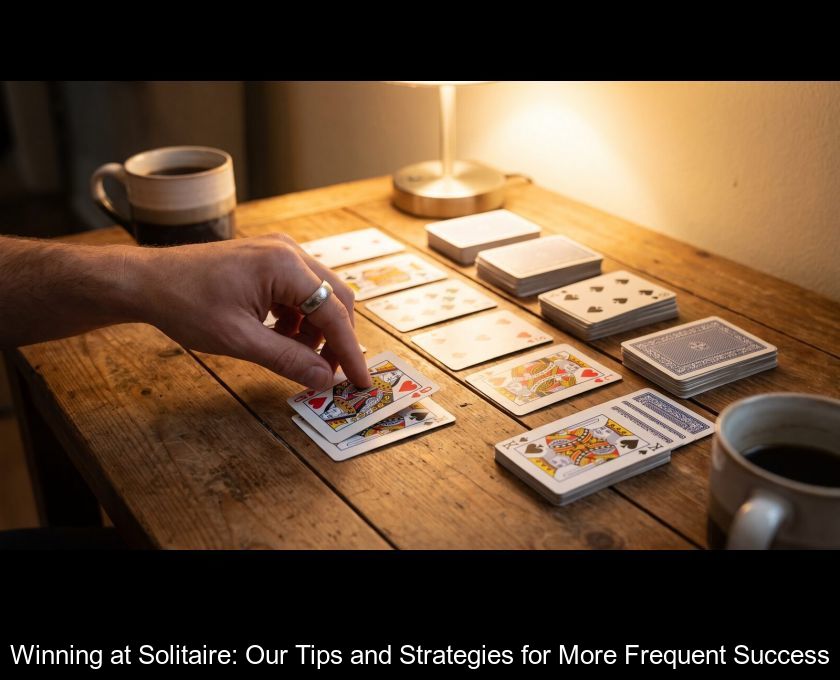
Winning At Solitaire: Our Tips And Strategies For More Frequent Success
Everyone has cursed at a success that refuses to happen. We keep drawing cards, turning them over one by one, and nothing works; the game closes like a trap. It's all the more frustrating when you feel like you've played well. The truth is that solitaire combines a bit of luck with a real element of strategy. You don't win every time, far from it, but you can significantly improve your chances with a few good reflexes. Here are our tips to turn your games into victories more often.
Can we really win at every game?
Let's admit it right away, no. Some hands are lost from the start, regardless of your talent. In Klondike played with a deck, the most common variant, it is estimated that about 79% of shuffles are theoretically winnable. The rest, a little over one hand in five, simply cannot be completed. That’s already something to reassure your self-esteem; when things go wrong, it’s not always your fault.
Except there’s a downside. While nearly eight out of ten hands are winnable on paper, the average player only wins about one in three. This gap between the possible and the actual is precisely the space of strategy. In other words, there is still plenty of room for improvement, and that’s excellent news.
Take the time to read the hand.
Before even moving your first card, take a few seconds to observe. This is a reflex that good players have ingrained in them and that beginners almost always overlook, too eager to dive into the action. A game of solitaire often unfolds right from the first moves, when options are still plentiful and a simple misstep can jeopardize everything going forward.
So, make it a habit to scan the entire tableau with your eyes. Where are the Aces and 2s, are they accessible or buried deep in a pile? Which columns are weighed down by hidden cards that need to be cleared as a priority? Do you already see possible sequences, a black Jack for a red Queen, a red 9 for a black 10? By taking this mental snapshot of the game, you give yourself a real head start.
This initial reading has another benefit; it prevents impulsive moves that you immediately regret after playing. In solitaire, as in other areas, it’s better to think a moment too long than to undo three moves later. Impatience is undoubtedly the primary cause of defeat, far ahead of the bad luck of the deal.
The very first instinct is to reveal the hidden cards.
At the start of a game of Klondike, a large portion of the cards are face down in the columns. As long as they remain hidden, they are of no use to you; worse, they deprive you of valuable information. Your number one priority is to turn these cards over as quickly as possible by playing the ones that cover them.
In the same spirit, don't hesitate to play your Aces and 2s as soon as they appear. These are the only cards that are almost always good to move up to the foundations right away. They have no place on the tableau and free up space. For the rest, think twice before moving anything up; we'll get to that.
Don't rush for the pickaxe.
This is the most common mistake among beginners. As soon as a move is missing, we instinctively draw a new card. Bad idea. Every time you draw, you consume a resource that may not come back at the right moment. Instead, get into the habit of exhausting all possibilities on the board before touching the draw pile.
Look at all your columns, look for moves that turn over a hidden card or free up a space. Drawing should only be a last resort, never a starting point. Rushed players lose a lot of games simply by emptying their draw pile too early.
Empty columns and Kings, handle them with care.
Completely emptying a column is a considerable asset, as the freed space can accommodate a King and restart an entire aspect of the game. But be careful, an empty space can only be filled with a King (or a sequence starting with a King). Don't waste it on the first King that comes along.
Ideally, choose a King that has useful cards trailing behind it, or that unlocks a color you need. A randomly placed King can, on the contrary, freeze the space for good. It's a real balancing act, and it's often what distinguishes a won game from a narrowly lost one.
Nota Bene: avoid moving your cards to the foundations too early. A card left on the tableau remains available to receive others, whereas once moved up, it rarely comes back down. For example, keep a red 6 in reserve as long as a black 5 may still need to land on it.
Draw one or three, choose your difficulty.
The draw mode changes everything, both the difficulty and the duration of a game. In single card draw, you see all the cards from the deck come out one by one, giving you maximum control. The success rate is around 33% for an average player, and a game lasts between three to eight minutes.
In three-card draw, the cards come out in batches of three, and only the top one is playable. As a result, the success rate drops to about 11%, and games often stretch between six to twelve minutes. If you're a beginner, stick to single card draw; you'll progress much faster and keep the enjoyment intact. Three-card draw can come later, on the day you seek a real challenge.
The bad habits that weigh down your games.
Beyond the techniques, some pitfalls keep recurring. Playing too quickly, without looking at the entire board, is one of them. Solitaire rewards anticipation, not haste. Take the time to scan all the columns before each move.
Another classic trap is stubbornly sticking to a clearly blocked hand. Knowing when to abandon an unwinnable game to start another is not a sign of weakness; it's actually a form of wisdom. And if your version allows it, don't hesitate to use the undo function to go back on a risky move; it's an excellent way to learn by testing different approaches.
Consistency, your best ally.
As with everything, practice makes the player. Through countless games, the eye gets accustomed, one quickly spots possible combinations, and good reflexes eventually become automatic. Some enthusiasts even reach great heights; it is said that a septuagenarian player managed to complete nearly 50,000 games of FreeCell, losing only about fifteen. That puts our modest defeats into perspective.
The simplest way to practice is to play solitaire online for free for a few minutes each day. You will find the draw by one or three, the undo function, and the ability to restart a deal infinitely. And if you need to review the basics before diving in, take a look at our reminder of the rules of solitaire. After that, all you have to do is play, again and again, to see your success rate climb on its own.