How Long Do Trees Live? The Incredible Longevity Of Beech And Oak Trees.
400 years, 500 years, sometimes more... Behind these impressive numbers lie unsuspected survival mechanisms. Here’s what really determines the lifespan of a tree, and how to read its age with the naked eye.
400 to 500 years: the theoretical range
When asked how long a tree lives, the most honest answer is a range: for a beech or an oak, current knowledge places the lifespan around 400 to 500 years. That's already staggering, considering that a 120-year-old tree is, on a human scale, a young one that has just finished its schooling.
In theory, most tree species can reach a very old age. Some records are truly exceptional: there is a Norway spruce in Dalarna credited with over 9,000 years, and a clonal colony of quaking aspens in the United States that consists of more than 40,000 trunks over about 40 hectares, estimated to be several thousand years old.
But beware: these figures describe a potential, not a guarantee. A beech tree taken out of the forest and planted alone in the countryside barely reaches 200 years. The same oak, situated near an old farm or in a meadow, easily exceeds 500 years. Context matters as much as the species.
Why statistics say nothing about your tree
For a given individual, whether tree or man, statistics often hold little value. A thousand things can alter the fate of a tree along the way: the fall of a neighbor that tears off its bark, a deer that gnaws at its trunk, lightning, an invasion of insects at the wrong time.
A striking example: the oaks that grow on a south-facing slope, their roots clinging to the exposed rock. In summer, the sun heats the stones to white and the slightest moisture evaporates; in winter, the frost penetrates deeply due to the lack of soil layer. No humus forms, and the wind sweeps the leaves down the slope. The result: after a century, these trees are as thick as an arm and barely reach five meters.
Their counterparts situated in the comfortable forest microclimate exceed 30 meters at the same age. But the ascetics of the slope survive, and sustainably, because scarcity has driven away all competition. Two radically different destinies for the same species, over just a few hundred meters.
The health of a tree is primarily the health of the forest.
The health of a tree depends on the stability of the ecosystem surrounding it. Temperature, humidity, and light should never experience sudden fluctuations, as trees have a very slow reaction capacity: they do not absorb shocks; they endure them.
Under normal circumstances, a tree allocates its resources with clockwork precision. A portion for daily needs (breathing, digesting food, supplying sugars to the fungi associated with its roots, growing a little), a portion for growth, a portion set aside for reproduction, and a latent reserve intended for fighting off pests. This reserve contains repellent substances specific to each species, phytoncides, which have a real antibiotic effect: a pinch of crushed spruce or pine needles kills protozoa in a drop of water in less than a second, and the air of a young pine forest is rendered almost sterile by these molecules. The walnut tree, for instance, fights against insects thanks to the components of its leaves, so effectively that placing a deck chair underneath significantly reduces the risk of mosquito bites.
If this balance is disrupted, everything goes awry. Take the death of a neighboring tree: light suddenly floods the canopy, the tree abandons everything and dedicates itself to the growth of its branches, which can grow from a few millimeters to 50 centimeters per year. This energy is no longer available for defense. A fungus infiltrates the dead wood of a branch stub, a bark beetle pierces without encountering any reaction, and the once-healthy trunk becomes infested.
Nota Bene: insects, fungi, bacteria, and viruses are constantly on the lookout. They do not enter because they are strong, but because the tree is momentarily out of balance.
The oak: a colossus that doesn't measure up... except when alone.
In temperate forests, the oak suffers. The unmistakable sign is the water sprouts: those small shoots that emerge low on the trunk, often drying out and falling off. A healthy tree never expends energy on these; it grows upward. The water sprouts are proof that the tree has been struggling for a long time.
The story often begins with a jay burying an acorn at the foot of a sturdy oak. The following spring, it germinates, and for decades, the young beech grows quietly in the protective shade of the old oak. Underground, it’s already a fight to the death: the beech's roots infiltrate every available space, extending beneath the old trunk and stealing water and nutrients. After 150 years, the beech invades the oak's canopy, and a few decades later, it surpasses it.
The beech then develops a magnificent crown that captures 97% of the light. The oak, a heliophilic species that requires a lot of light for photosynthesis, finds itself on the second tier with only 3% of the sunlight. Sugar production drops, and reserves dwindle. It attempts to grow water sprouts, whose particularly large and tender leaves can manage with less light, but 3% is not enough: they die of starvation, and the energy invested is lost. The tree can survive for a few decades in this chronic undernourishment, then gives up, sometimes finished off by the larvae of a buprestid beetle that devour its bark.
Should we conclude that the oak is weak? Not at all. Without competition, it is a rock. The whole question is where it grows.
Fungicides and tannins: oak wood absorbs the wounds.
A nasty wound, a trunk scarred by lightning? The oak barely flinches. Its wood is impregnated with fungicidal substances that significantly slow down the rotting process, and it also produces tannins that repel insects (incidentally, these are what give a particular flavor to wine aged in oak barrels).
Better yet: even severely damaged individuals, with broken branches, have the ability to develop a replacement crown and live for several more centuries. Its rough and thick bark is also much more resistant than the smooth and thin bark of beech, providing much better protection from the outside.
To understand the stakes, one must know how a tree closes a wound. Exposed wood is an ideal substrate for fungal spores, which arrive within minutes. Their progression is initially slowed by the sapwood, the layer of soft, water-saturated wood: fungi thrive in moisture but die in waterlogged environments. A slow race begins: the fungus advances as the sapwood dries, while the tissues around the wound cover up to one centimeter of exposed wood per year.
In five years, everything must be sealed: new bark covers the wound, the tree re-irrigates the wood, and kills the fungus. Provided it hasn't reached the heartwood, the "perfect wood" at the core, which is drier and devoid of living cells, where the tree can no longer intervene. Hence this rule of thumb: beyond three centimeters in width, a wound becomes concerning. And even when the fungus wins, it takes up to 100 years to consume everything, without affecting the stability of the tree: it can end up hollow like a stovepipe and remain as upright as a stovepipe.
Beech in the forest, isolated oak: two reversed longevities.
It is one of the most striking paradoxes of the forest. The beech is unbeatable among its own kind, and fragile as soon as it leaves. The oak, on the other hand, is overshadowed by the beech in the forest but becomes a patriarch in open spaces.
The reason? Beeches practice true mutual aid. In natural beech forests, the trees synchronize so that all provide the same performance, even though soil quality can vary dramatically within just a few meters. The rebalancing occurs underground, through the roots and the vast network of fungi that acts as a redistribution machine: those who are well-off give, while those who struggle receive. Trees spaced less than a meter apart thrive very well, and dense stands produce more biomass.
Remove this safety net, and everything changes. A solitary beech whose beautiful crown is damaged by a gust has little more than a few decades to live. The condition of a tree can never be better than that of the surrounding forest: even robust individuals fall ill several times in their lives and then depend on the help of weaker neighbors.
An almost unsettling example: young beeches from which a wide strip of bark had been removed at a height of one meter— a practice that should kill them, since without continuous bark, the leaves can no longer send sugars to the roots—have survived, sometimes for years. Their intact neighbors had nourished their roots through underground connections, and some even managed to regenerate bark over the wound.
Slowness, the secret to a long life.
Here is the most counterintuitive point: growing slowly in early life conditions the possibility of reaching a great age. A young beech tree measuring one to two meters, which one might think is ten years old, can actually be 80 or more. This can be verified by counting the small wrinkled knots that form each year beneath the buds on the branches: a twig of 20 centimeters can bear 25. Beyond three millimeters in diameter, the knots disappear into the bark.
This slowness is not endured; it is imposed. Mother trees cover their offspring with their immense canopies and allow only 3% of light to filter down to the ground. This is just enough to stay alive, not enough to grow. But the consequence is decisive: the wood cells remain very small and contain little air. The tree gains flexibility that allows it to withstand strong winds without breaking, and a tissue hardness that significantly limits the spread of fungi.
In the meantime, the young tree optimizes: its lateral branches become significantly longer than its vertical stem, it spreads its foliage horizontally, and produces thin and very sensitive leaves. Some take on the appearance of umbrella-like bonsais. If you see this in the forest, you are looking at a tree in waiting mode. The mothers soften the patience by nourishing them with sugars and nutrients through the roots.
In contrast, trees that grow quickly pay a heavy price. Pioneer species like birch or aspen can extend their terminal growth by more than a meter per year, but after the first three decades, exhaustion sets in: their wood, made of large air-filled cells, allows fungi to infiltrate, and a large broken branch is enough to open the door to rot. The same logic applies to trees boosted by rapid growth: wide rings, airy, moist wood... ideal for a fungus.
One centimeter per second: the hidden speed of sap
We believe trees are motionless, as unanimated as stones. This is an optical illusion: their voluntary movements, like the unfolding of leaves or the growth of branches, take place over weeks or months. The whisper of the wind in the treetops and the cracking of trunks are merely involuntary movements.
But beneath the bark, things are moving. Water and nutrients, this "blood of the tree," can travel from the roots to the leaves at a speed of one centimeter per second. In relation to the height of a large beech, this gives an idea of the constant traffic flowing through an apparently dormant trunk.
This liquid is not spectacular; it resembles water, but its loss is as detrimental to the tree as a hemorrhage is to us. Woodpeckers know this: in spring, they drill small dotted holes in the trunks of small-diameter trees and lick what oozes out. Over the years, these alignments evolve into stripes or rings that wrap around the trunk like necklaces.
Aphids, lazier, plunge their proboscis into the vessels of the leaves and pump. They filter the liquid to extract the proteins they lack and excrete the intact sugars: hence the sticky rain under infested trees, which makes a windshield wiper ineffective under a plane tree. On the scale of a forest, these little creatures can remove several hundred tons of pure sugar per square kilometer.
1.8 million beech nuts for a single tree
A beech tree produces at least 30,000 beechnuts with each fruiting, and it only flowers every three to five years. Depending on the light it receives, it reaches sexual maturity between 80 and 150 years. Considering a lifespan of 400 years, it will fruit at least 60 times and produce a total of about 1.8 million beechnuts.
Out of this 1.8 million, only one will become a tree. Statistically, a tree begets a single successor that will take its place when the time comes. Everything else is eaten by animals or transformed into humus by fungi and bacteria. Dozens of generations grow at the foot of the mother tree and then disappear one after another. In the case of the poplar, it’s even harsher: up to 26 million seeds per year, over a billion in a lifetime, for just one winner.
This flowering is very costly. There is no designated space for flowers on the branches; the leaves must give up their spots: during fruiting years, the crowns appear defoliated, and the forest seems sick. The reduced foliage produces less sugar, and most of this sugar is converted into lipids in the seeds. Almost nothing remains for the construction of the tree, winter reserves, and disease defenses.
Insects take advantage of this. The beech weevil, barely two millimeters long, lays millions of eggs on the defenseless foliage: the larvae burrow galleries between the two membranes of the leaves, leaving rusty spots, and then the adult bores holes like shotgun pellets. Some years, the foliage of beech trees appears rusty from a distance. Healthy individuals can withstand it, but a weakened one may lose its life.
Nota Bene: an abundance of acorns and beechnuts does not indicate a harsh winter. Flowering prepares during the previous summer, so a profusion of fruits best reflects what happened a few months earlier—often a drought or intense heat that pushed the tree to flower massively.
Reading the age on the bark: instructions for use
The bark is to the tree what skin is to us: a barrier against aggression, against drying out, against fungi and insects that would be powerless against healthy, properly hydrated wood. And like the skin, it renews itself by shedding. A growing tree thickens by 1.5 to 3 centimeters per year: without exfoliation, its bark would crack everywhere. Observe the ground during windy and rainy weather; it is strewn with flakes that can reach 20 centimeters, with those from pines being thick and reddish, easily recognizable.
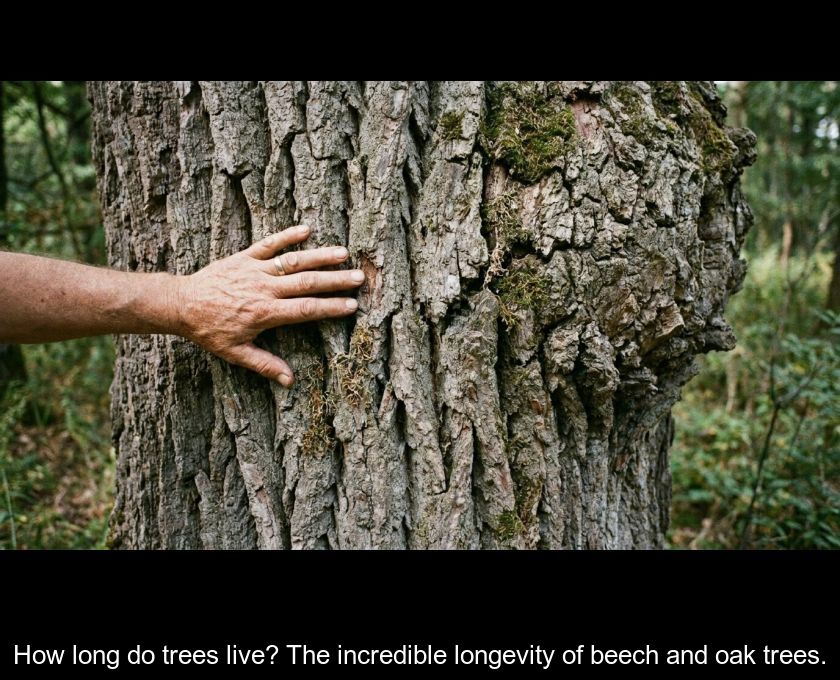
It is the speed of this renewal that reveals the species and age. In beech trees, the renewal rate is high: their silvery-gray bark remains thin, adapts to the circumference, and stays smooth until about 200 years old. The white fir behaves similarly. Pines, oaks, birches, or Douglas firs, on the other hand, take their time: a much thicker cork forms, with the upper layers dating back to when the tree was young and frail. As the circumference increases, these layers crack until reaching the most recent one. Remember the rule: the deeper the cracks, the slower the species is to exfoliate.
After reaching 200 years, the base of beech trees also begins to crack, and mosses colonize the crevices where rain moisture lingers longer. This is an excellent terrain marker: the higher the vegetation grows on the trunk, the older the tree is. Be careful, the formation of cracks is also a matter of temperament, and an excess of light accelerates the process—ultraviolet radiation ages the skin of trees just like ours, and cork exposed to the sun becomes harder, thus less flexible and more prone to cracking.
Other signs confirm great age. Between 100 and 300 years depending on the species, the annual shoots at the top shorten: in broadleaf trees, this results in crooked branches resembling fingers deformed by rheumatism. Then the tree stops growing in height (pushing water ever higher exceeds the capabilities of its vascular system) and expands. Finally, the upper branches die, storms sweep them away, the silhouette shrinks, and fungi signal their advance with half-dish fruiting bodies that grow larger year by year. The tree still defends itself for decades by forming thick calluses of wood on either side of the wound before the trunk breaks.
And very old trees are not dead weight; on the contrary: the mosses settled in their forks house cyanobacteria capable of fixing nitrogen from the air and transforming it into fertilizer that rain brings to the roots. The elders nourish the soil and help their offspring get started. One more reason for anyone who owns an old tree to let it age in peace.