
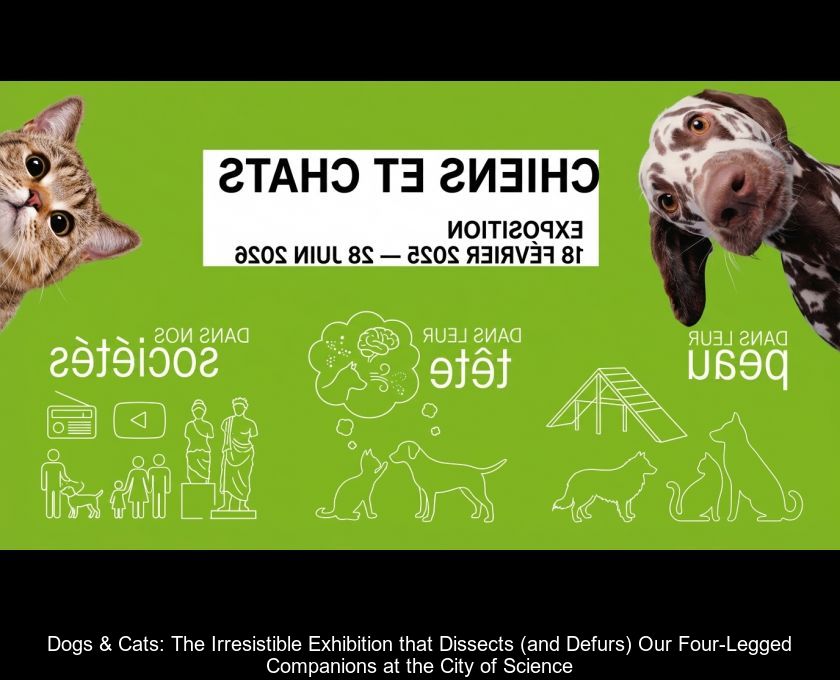
Dogs & Cats: The Irresistible Exhibition That Dissects (and Defurs) Our Four-legged Companions At The City Of Science
Purr Therapy or Leash Walking? Whether you're more of a kibble team or a fan of tuna cans, it's impossible to resist the new exhibition "Dogs & Cats" arriving at the City of Sciences from February 18, 2025, to August 30, 2026. A sensory, scientific, and delightfully playful dive into the world of our favorite furballs.
A quintessentially French passion... and numbers that meow (or bark)
Did you know that France now has nearly 15 million cats and just over 7.5 million dogs? In other words, there are statistically more whiskers than children in French households! Each year, we spend about 5 billion euros on food, toys, and veterinary care, a market that is anything but trivial. It's no wonder, then, that the City of Sciences is finally dedicating a major exhibition to those who occupy our sofas, Instagram stories, and sometimes even our marital beds.
An interactive journey designed for the whole pack.
Here, no dusty displays: we scratch, sniff, and play. The journey is divided into three zones (the teams at the Cité are fond of trilogies):
- "In Their Skin" to understand physiology: how does a cat see in the dark? How far can a dog perceive ultrasonics?
- "In Their Minds," a guaranteed favorite, with ethology quizzes and 3D simulations that challenge our often... anthropomorphic intuitions.
- "In Our Society," where we dissect the place (sometimes very Instagrammable) of pets, from the Middle Ages to specialized TikTok accounts in #PetTok.
Science + Sociology + Humor = The Universcience Cocktail
Beneath its relaxed facade, the exhibition is based on a solid scientific foundation. It covers the genetics of domestication, neuroscience (yes, cats do dream!), as well as AFNOR standards and European legislation on animal welfare. All of this is sprinkled with irresistible humor, nodding to life-sized feline memes projected on an LED wall. Visitors leave having learned something without even realizing it, which is exactly the hallmark of the Cité.
Workshops that wag the tail
Because an animal exhibition would be nothing without a bit of movement, the program is enhanced with olfactory workshops (challenge: recognize five canine scents), a feline climbing wall to test your agility against the grace of a Siamese, and even a "sociability match" area where dog-child interactions can be observed safely.
On weekends, canine educators will come to decipher calming signals, giving you the chance to understand, at last, that Fido isn't "holding a grudge," he's communicating.
A bustling satellite programming
Roundtable on responsible adoption, documentary film screenings (turn off Netflix, come watch "The Cat from the Cold" on the big screen), book signing sessions with star YouTube veterinarians... the City has thought big. Special mention to the public lectures on zoonoses, a serious topic in the post-Covid era, but addressed without gloom.
Practical information: prepare your kibble, uh... your tickets!
Dates: from February 18, 2025 to August 30, 2026.
Hours: Tuesday-Saturday 10am-6pm, Sunday 10am-7pm (closed on Monday).
Prices: 13 euros full price, 10 euros reduced price, free for under 6 years old (reservation recommended during school holidays).
Address: 30 avenue Corentin-Cariou, Paris 19th district, metro Porte de la Villette.
Tip: consider the Pass Universcience if you plan to also explore the Geode or the Sparks of the Palais de la découverte.
Why we come out conquered (and a little more responsible)
Beyond games and "wows" at the sight of a Chartreux's night vision, "Dogs & Cats" subtly reminds us that an animal is neither a plush toy nor a gadget. The exhibition slips in messages here and there about summer abandonment, the importance of spaying and neutering, and the consequences of impulsive adoption. You leave with a smile on your face, but also with a head full of ideas to improve the daily lives of our furry roommates.
Nota Bene: Ethology, what is it?
Ethology is the science that studies the behavior of animal species (including humans) in their natural environment or in controlled situations. It should not be confused with ethnology, which focuses on human cultures. At the City, these two disciplines come together to better decipher the fabulous, and often misunderstood, relationship between humans and animals.